Building trust through community presence and open communication is easy to say and very hard to do – but it’s worth the effort
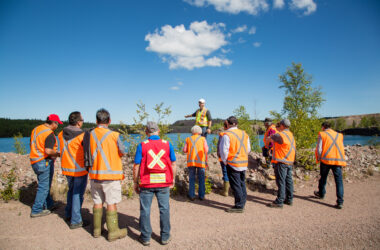
The former Gunnar Mine is located on the north shore of Lake Athabasca, approximately 25 kilometres southwest of Uranium City. The Saskatchewan Research Council is managing Project CLEANS to assess and reclaim the site. Here, a group tours the property. Photo courtesy of SRC
For companies operating in the mining and energy sectors, community engagement is an important component of many projects and sites – from exploration through operation to remediation. A key to success is the integration of local knowledge into operational and closure plans. However, before this knowledge can be integrated, local trust and project understanding must be established. This can only be developed through a principle-centred approach to a shared project vision, two-way communication of knowledge, alignment of project goals and understanding the local needs early in the project. Once community confidence is obtained, this local trust and project understanding must be maintained throughout the entirety of the project. An important principle of this approach is to co-generate plans and activities with communities and not just develop them on the communities’ behalf.
During exploration and environmental assessment phases, integration of local knowledge can include the development and implementation of land use surveys to determine realistic travel and occupancy needs, specific traditional knowledge and land use studies to develop a detailed working knowledge of local land use, resource utilization, country food intake and human history of the site(s). The local knowledge gained during the assessment process is invaluable as it provides the information required to support project planning, such as valued ecosystem components, human trophic utilization, length of site occupancy, cultural value assessment and future land use considerations.
This approach involves an open planning method that requires the proponent to not only communicate with local communities, but also to be open and prepared to adjust project planning to accommodate the direction provided through these processes. For meaningful dialogue to take place, a relationship of trust and joint understanding must be built. Building trust through community presence and open communication is very easy to say, but very hard to do, and it takes a lot of time and effort. Gaining trust means you have the social licence needed to work in the region. Not only is it important to gain trust, but it also takes work to maintain it.
Community leaders tour the modern-day Gunnar Mine site. The facility operated from 1955 to 1963 and officially closed in 1964 with little to no decommissioning.
The role SRC is playing
The Saskatchewan Research Council (SRC) is managing Project CLEANS (Cleanup of Abandoned Northern Sites) – a multi-year, multimillion-dollar project aimed at assessing and reclaiming Gunnar Mine and Mill site, Lorado Mill and 35 satellite mine sites in northern Saskatchewan, near Lake Athabasca. The project is funded by the Governments of Saskatchewan and Canada.
Uranium from these sites was mined by private companies from the early 1950s to the mid-1960s. When the mines and mills were abandoned, there was very little decommissioning completed. Because of this, the sites pose potential risks to the surrounding communities and the environment. SRC has been working since 2006 to safely reduce these risks through extensive decommissioning, remediation and monitoring work.
Engagement of local communities has been key as SRC’s Project CLEANS team maintains working relationships with local residents and their leadership within the communities. SRC holds regular community meetings to provide updates and receive feedback from northern residents. Key concerns addressed through this engagement process include human and environmental health, employment and business opportunities, remediation options and potential site end-uses.
The way forward
SRC developed an adaptive and open process to engage local communities that continues to evolve as community leadership changes, local expectations increase with project success, and the project parameters progress and change.
Although SRC’s approach to the development of communications, trust and traditional knowledge integration has been specifically applied to Project CLEANS, the approach and concept is applicable through the entirety of the mining cycle (exploration, assessment, construction, operations, remediation and divestment), in any geographic region.
Who is responsible for delays in multi-party projects? What happens when there are multiple independent causes of delay in the same time period? How do courts determine if a delay impacts the critical path of the project schedule?
The Ontario Superior Court of Justice was faced with these issues in the recent case Schindler Elevator Corporation v Walsh Construction Company of Canada,1 where several subcontractors, including Schindler Elevator Corporation (“Schindler”), had delayed the performance of their respective contracts. These delays allegedly impacted the critical path of the Women’s College Hospital Capital Redevelopment Project (the “WCH Project”) led by Walsh Construction/Bondfield Partnership (Walsh Construction Company of Canada and Bondfield Constructed Company Limited, collectively “WBP”).
This case provided a thorough analysis on apportioning liability to one of multiple parties in a complex commercial construction project and a lengthy review of documented evidence and expert testimony on calculated impacts. The case also defined the meaning of “concurrent delays” to be used in future construction disputes to ensure a fair and just assessment of responsibility for delays.
Background
In 2010, Women’s College Partnership (“ProjectCo”) entered into a construction contract with WBP for the design, construction and maintenance of a new 624,000-square-foot hospital replacing the old Women’s College Hospital in downtown Toronto for a price of $272 million.2 The contract followed the same deadlines of ProjectCo’s project agreement with Women’s College Hospital (“WCH”), which was to contractually achieve interim completion by April 29, 2013, and achieve substantial completion by Sept. 9, 2015.3
WBP subcontracted Schindler to fabricate, deliver and install all 10 elevators for the new hospital facilities at an agreed base subcontract price of $2.1 million.4 It also engaged a substantial number of other subcontractors for the project, including trades for curtain wall and glazing work, mechanical and electrical work, supply and installation of precast panels, painting services and various interior civil works.5
The critical path delay
Before Schindler commenced work and throughout the installation, there were a number of project delays occurring around the same time.6 Upon Schindler’s delay in its own work, WBP had issued numerous written notices of default and withheld all further payments.7 The court found that there were some events that were out of Schindler’s control and extended the time accordingly.8 However, Schindler was ultimately found to be liable for breach of its subcontract due to the delayed completion of the elevator work.9
Schindler registered a claim for lien for almost $1 million in unpaid services and materials.10 WBP counterclaimed for $2.2 million in damages and contractual penalties for Schindler’s delayed performance.11 However, in order to determine liability for overall project losses, it was necessary to find that Schindler caused critical path delay to the WCH Project. The “critical path” was defined as “the longest chain of logically connected activities in a project schedule that, if delayed, will delay the end date of a project”.12
WBP had the evidentiary onus of proving a causal connection between each of Schindler’s delays and WBP’s delay and impact losses, on a balance of probabilities, in order to indemnify WBP’s costs for mitigation and delay penalties.13
Defining concurrent delay
WBP acknowledged that other subcontractors also contributed to the project delay through the same period.14 In describing the concept of simultaneity of delays from two or more sources in large-scale construction projects, the court turned to Glenn Grenier’s article: “Evaluating Concurrent Delay: Unscrambling the Egg”.15 Grenier illustrated that evaluating a concurrent delay is a “much more involved and speculative process compared to an isolated or singular cause of delay” and the parties and the court must break down the overall project delay into its component parts to apportion the time, responsibility and costs.16
The court rejected Schindler’s expert testimony that concurrent delay meant there were two co-critical, co-controlling activities that had the same timing and duration.17 Instead, it relied on the observation that delays starting and ending at the same time were rarely the reality and concurrent delays were more commonly experienced as overlapping events.18 At least in more complex cases of concurrency, a more flexible definition would avoid one party being held solely responsible for a project delay and would more likely lead to a fair and just result where it is supported that multiple parties delayed the project.19
The court ultimately found that there was no clear evidence that Schindler materially contributed to the overall critical path delay. While there was a delayed turnover of the freight elevators which directly impacted the immediate subsequent activity, the manner in which the subsequent activity caused delay to the overall project was not shown.20 Therefore, the court concluded that Schindler did not cause or materially contribute to the failure to achieve the interim completion deadline.21
However, in light of the extent of Schindler’s performance delay, the court concluded it would be inequitable to absolve Schindler entirely of causally connected losses and damages.22 The court reviewed each of Schindler’s disputed activities which allegedly caused the delay and assessed the evidence for each claim. The finding was that Schindler owed a total of $51,653.79 to WBP for its delay and the court dismissed WBP’s remaining claims for damages.23 The net result was WBP owing a sum of $650,786.20 for unpaid amounts to Schindler.
Key takeaways
Following the Schindler decision, future dispute resolutions for delays in large, multi-party projects may see a flexible approach in defining concurrent delays to fairly distribute the responsibility of events where responsibility is due. Determining causation of the critical path delay will require clear evidence of the subcontractor’s specific performance delay and how it materially contributed to the overall project delay.
It is important to maintain a distinction between liability for breach of a subcontract and liability for overall project delay and associated losses. To claim unpaid amounts in the subcontract, Schindler had the evidentiary onus of proving any delays, impacts and its right to an extension of time in accordance with the subcontract. To counterclaim losses for the overall project delay, WBP had the evidentiary onus of proving a material causal connection between Schindler’s delays and the critical path delay. Thus, a breach of a subcontract does not necessarily mean liability for overall project delay losses.
Accordingly, unanticipated delays should not hinder compliance with the contractual terms which govern project delays. In Schindler, the court made evident that both WBP and Schindler were sophisticated parties who agreed to detailed terms dealing with payment, delay, notice of default and default remedies.24 Significant weight was given to the contractual interpretation of the subcontract which governed the time period and remedies used in the court’s analysis.
The decision in Schindler underlines the need for assertions of overall project delay to be supported by evidence that connects the contractor’s delays or defaults with the project’s critical path. Claims of overall project delay, in the absence of such evidence, are unlikely to succeed.
Finally, co-operation, collegiality and organization were recognized as key throughout the course of the lengthy and complex trial. The professionalism and the preparation of all the parties involved were “a model example” of how to present these cases to the court.25 It is good practice to keep records of all work done for projects, including items such as work tickets, emails, incidents, shop drawings, shutdowns due to safety concerns, monthly reports and schedules, game plans, letters, invoices, cheques and timesheets that clearly support their relation to the operation, the dates the work was performed, and when the work was undertaken. Detailed and diligent documentation by the parties involved will be important to support any future claims when projects get delayed.
Khurrum Awan is a partner in the Saskatoon office of Miller Thomson LLP. For inquires contact him at kawan@millerthomson.com.Disclaimer: This publication is provided as an information service and may include items reported from other sources. We do not warrant its accuracy. This information is not meant as legal opinion or advice.
2021 ONSC 283 [Schindler].
Ibid at para 11.
Ibid at para 10.
Ibid at para 21.
Ibid at para 24.
Ibid at para 26.
Ibid at para 35.
Ibid at para 27.
Ibid at para 266.
Ibid at para 5.
Ibid at para 268.
Ibid at para 296.
Ibid at para 292.
Ibid at para 37.
(2006), 53 CLR (3d) 46. This paper was presented by Grenier at the Ontario Bar Association Conference for the Construction Law Section in Toronto in 2006. Grenier was a Partner and Head of the Construction Law Practice Group at Lang Michener LLP in Toronto.
Taking advantage of risk management will allow heavy construction operators to take advantage of opportunities
Much has changed in the heavy construction industry in the last few decades, including new technology, improved work practices and the advent of social media. Although these changes are readily acknowledged, there is less focus on another changing aspect of the industry – the need for new risk management strategies.
“The opportunities and the risks have changed over time,” said Greg van Ginkel, a managing partner and the construction leader at EQUA Specialty Risk Partners Corporation (EQUA). “There has to be an assessment of those opportunities in order to mitigate risk. Taking advantage of risk management will allow heavy construction operators to take advantage of opportunities.”
Risk management is important for clients, insurance companies and employees. Clients want to know their contractor is aware of all the safety and risk management factors. Insurance companies want to know that operators have utilized risk management strategies, which in turn, will enable the companies to take advantage of new business opportunities and remain competitive. Employees overall want their companies to properly manage risk because it impacts their safety and the viability of the business.
“It’s really a question of surviving as a business or not – you have to be agile, thoughtful and consistent with your use of risk management tools and standards to stay afloat, let alone compete,” said van Ginkel.
Nearly every industry has been impacted by environmental and social developments and the heavy construction industry is no exception. The introduction of new technologies has enabled companies to become more efficient, safer and more transparent with stakeholders.
For example, GPS tracking and cameras are now available that assist companies in reducing equipment theft. If equipment gets stolen, the GPS unit will locate it. Underground construction once represented a significant risk to the industry, but new scanning tools which help identify geological structures have helped mitigate that risk.
Contracts have also evolved over time, allowing businesses and project owners to avoid assuming risk that is not appropriate for them. If a company is conducting testing and assessment work for a specific project, the associated risk should be passed on to them. In other words, if a government department or engineering firm is doing the testing, then the contract should stipulate that they are responsible for the associated risk and the efficacy of the results they produce, not the business or project owner.
“Owners must be aware of what’s in these contracts,” said van Ginkel. “They have to consider how a court will assess the contract wording.”
If an owner contracts a design firm and that firm provides an industry-standard contract, the owner may not be aware that the contract may exclude any risk for the design firm. The owner may then pass that risk onto the contractor.
“It’s a matter of being aware of where liability gets allocated and to which parties as part of the project process. This is best discussed at the beginning of a project between a contractor and the ultimate owner,” advises van Ginkel.
“It’s a matter of being aware of where liability gets allocated and to which parties as part of the project process.”
– Greg van Ginkel, EQUA Specialty Risk Partners Corporation
Changing landscape
These issues are all part of the changing landscape within the industry. All stakeholders are now assessing who is going to accept the risk on construction projects. Decisions must be made about whether the risk should be allocated back to the party that is most capable of accepting that risk, or if it should be passed to individual contractors, some of whom may not have the financial capacity to accept the risk.
Van Ginkel recommends that before embarking on a project, you review your vendors and partners to ensure they’re capable of assessing risk and understanding what risk should be passed along to insurance and what aspects cannot be. Some partners may have different contracts within their own organizations, which can also lead to uncertainty.
“It can be helpful to have a risk expert, someone who understands risk and insurance, to join these discussions, to explain where risk lies, what needs to be assumed, and what can be passed onto insurance companies. It may also be useful to consolidate your contract structures.”
A risk expert would complement an existing team of lawyers and tax experts when reviewing contracts. Organizations shouldn’t assume that lawyers, who often draft and review contracts, have the proper depth of industry-specific knowledge for understanding risk management. Lawyers may use standard contracts without considering how the language may be applied in context due to the constantly changing landscape of insurance and risk management.
“You need to bring the expertise together so your legal counsel can get the opinions of everyone and craft the contract language according to the intent of the risk mitigation within your specific industry.”
Van Ginkel said there are strategies that you can employ to mitigate your risk. One of the main tools is education and the proper employee training programs can have a significant positive impact. With online reviews and social media, it is becoming increasingly important to ensure workplaces have zero tolerance for abuse and discrimination and that this standard is incorporated into employee education and training. Failure to do so could lead to some unflattering comments on the internet that create red flags around your organization.
Insurance is directly tied to modern risk management processes and that’s why items such as abuse coverage must be purchased separately – it is no longer part of a general insurance policy. If you can’t show an insurance company how you are mitigating the potential for abuse, insurance companies may not provide that coverage.
“Your insurance broker and risk management team are incredibly important in this process – you need to work with individuals who understand this landscape and who are dedicated to remaining apprised of developments,” concluded van Ginkel. “It’s not static. Risk management is dynamic and constantly evolving. Your team of advisers is key to ensuring your business will succeed.”
“It’s not static. Risk management is dynamic and constantly evolving.”
Free online training course aims to reduce underground utility strikes and dangers due to soil collapse
From left to right: Erin Rodger, SCGA Public Awareness and Education Committee chair; Natalya Uchacz, chief operations officer, Heavy Construction Safety Association of Saskatchewan; Eli Sorenson, youth ambassador; Bret Dielschnieder, safety advisor, Wappel Construction; Derrick Mann, SCGA president; Ryan Jacobson, CEO, Saskatchewan Safety Council.
“Youth is our future.” Is this just another tired cliché? Or is it something that many people take to heart?
For the Saskatchewan Safety Council (SSC), the Saskatchewan Common Ground Alliance (SCGA) and the Heavy Construction Safety Association of Saskatchewan (HCSAS), that phrase isn’t just empty words. It is a call to action that merited a united response during a special media event on July 15.
On that day at a Wappel Construction site in Regina, the three partners launched what is believed to be a North American first: a free online construction safety program aimed at youth aged 14 to 21.
The “Ground Disturbance for Saskatchewan Workers” training initiative, available on the SSC website, will promote safe working practices to future young employees.
For SSC President Ryan Jacobson, the initiative is a game changer, especially in a larger and more sparsely populated province like Saskatchewan.
“Everyone that works in a ground disturbance industry, whether it be agriculture, landscaping, construction or road building, needs access to basic best practices to work safely,” said Jacobson. Citing the unique industry-created online course, he added that it provides a way “to get all those trained in rural Saskatchewan that may not have training agencies close at hand.”
If the participant passes the two-hour online course they will receive a recognized safety construction certificate, immediately downloadable upon completion. The program is a key component in the SSC’s Career Safety Education Program, which has been designed by industry experts to address the most common injuries to new workers in their respective fields.
SCGA President Derrick Mann said evidence shows injuries happen during complex construction work but also during more routine situations.
Canada incurs $1 billion in underground facility damage annually. But Mann said the biggest issue remains eliminating the risk of personal injury and even death. These incidents are preventable with the right safety mindset.
“Developing safety habits when one is young produces a lifetime of benefits,” he added.
Youth ambassador Eli Sorenson sees the new program as evidence of industry’s commitment to worker health and safety.
Construction activity in Saskatchewan has remained at historically high levels, even during the COVID-19 pandemic. There were 151,282 requests for line locates in 2020, a close to seven per cent increase from the previous year, and about 700 contacts with underground facilities in 2019.
The new online ground disturbance course puts the industry “one step closer to being able to create that safety culture, that safety behaviour, right on site,” said Natalya Uchacz, chief operations officer at the HCSAS. “When we are able to start right at the beginning with our youth and help them become informed before they actually go into a construction site . . . then overall we will have a safer industry.”
The three partners are confident this training can reduce the incidence of underground utility infrastructure strikes or soil collapse. The course includes content such as ground disturbance and hazards assessment, reporting damage and line locating, daylighting, control zones, colour codes, soil conditions and emergency assessment, among other things.
“Developing safety habits when one is young produces a lifetime of benefits.”
– Derrick Mann, SCGA president
Young workers and those new to jobs that work in soil, who are pursuing careers in agriculture, heavy construction, residential construction, landscaping or with companies that provide services to utility companies are encouraged to complete this free training course.
For Eli Sorenson, a young field worker, the course is the kind of encouraging development that shows the industry is committed to the health and well-being of its workers, in addition to providing competitive pay and a good working environment.
“As a person with my whole life and career in front of me, I want to work in a place where they take safety seriously,” Sorenson said at the media event in July.
That’s exactly the type of environment these three partners want to create in every construction workplace. They want to prove that working safely, much like investing in our youth, is definitely more than a cliché.
Shannon Doka is the executive director of the Saskatchewan Common Ground Alliance (SCGA).
For many of us, summer brings back fond memories of camp. Learning to paddle a canoe, roasting marshmallows over a campfire, slapping mosquitoes on endless walks through the woods, and for some… learning to use power tools.
Of course, camp these days can mean many things, with options ranging from traditional nature camps to urban sports-themed or creative arts options. But power tools? Saskatchewan Polytechnic’s Brittany Grimsdale says, “Absolutely!”
Grimsdale heads up Women in Trades and Technology (WITT), which offers a variety of trade and technology-themed summer programs for youth. With nearly 30 summer camp seasons under its belt, it seems WITT must be on to something. WITT offers two Girls Exploring Trades and Technology (GETT) camps—one in Regina and one in Saskatoon—and has offered other camp options in previous years, including a welding camp called Mind Over Metal. WITT also supports a camp called Plan, Program, Play, put on by Sask Polytech’s Business Information Systems program, where youth spend three days exploring game development. “Camp can be fun, a great learning experience and career exploration all at the same time,” said Grimsdale.
A plumber by trade, the WITT program head shares her skills with girls ranging from 12 to 15 years old at the Saskatoon GETT camp. There, she says, opening minds to opportunities is the focus. “Studies show that before girls hit high school is really the time to share the opportunities available in terms of careers. Maybe they’ve never thought of a trade before. Trades are not often thought of as a first-choice career for girls. Whether or not they go into trades later in life, it’s a chance for them to gain some skills and gain confidence.”
That’s exactly how Saskatoon camper Nevaeh Moore experienced GETT. At 13, she was this year’s youngest girl in the week-long camp, and she came away with some new skills and the handiwork to show for it. “We got to come up with our own design for a table and build it,” explained Moore. “Mine is rounded on the edge on one side and stained with dark stain. It’s in my bedroom now for makeup and hairbrushes.”
The Grade 8 student had some experience with tools, having helped her mom in the past, but at GETT she got to try new things and improve on what she already knew. “Now I know how to design a table that stands up and works,” she said. “The table legs were a challenge. I had to take my table apart and put it back together three times! I learned how to use a level, right angle and a measuring tape.”
Moore’s mom, Amy, saw a change in her daughter’s confidence by the end of the week. “It was a cool opportunity for Nevaeh to tinker with some tools and make a useful object. The empowerment of being able to create something independently was great to see.” GETT’s girls-only focus is part of what contributes to that confidence building, says instructor Robin Reynolds, who teaches the carpentry portion of the Saskatoon camp.
“All our instructors are women, that makes a difference,” she explained. Reynolds describes the camps as a safe place for teen girls to try something new. “It’s a really supportive environment. They’re among peers that are at the same skill level, so it’s less intimidating.”
“Trades are not often thought of as a first-choice career for girls. Whether or not they go into trades later in life, it’s a chance for them to gain some skills and gain confidence.”
– Brittany Grimsdale, Women in Trades and Technology (WITT)
The journeyperson carpenter has been an instructor at camp for six seasons, and it’s clear she also gets something from the experience. “It’s been a blessing to be part of it,” said Reynolds. “I love seeing how proud the girls are of themselves. It’s a nice atmosphere. It has also become a community at the instructor level, and I really value that.”
The Regina and Saskatoon camps vary slightly in activities, but both offer a hands-on experience and exposure to career choices not traditionally thought of as options for women. Both camps have a strong carpentry focus—an area most campers really enjoy because they can build something to take home. This year, Saskatoon campers had some plumbing instruction, a visit from a firefighter and spent a morning learning about robotics. In Regina, campers learned some computer coding and built robots, and had a visit from Rose Santos, an electrical engineer from the camp’s title sponsor, SaskPower.
SaskPower has been the GETT camps’ title sponsor for several years, providing funding and guest speakers. In addition, the Crown corporation sponsors four seats (two in each city) that WITT filled through the Big Brothers/Big Sisters organization. “SaskPower has been great to work with. We use pallets for lumber, and this year when they were hard to come by, SaskPower sent us a whole crate from their shipping department,” said Grimsdale.
“It was incredible to see SaskPower involved in this program, and to help Saskatchewan girls explore career possibilities in Trades and Technology,” said Rose Santos, project portfolio manager, Distribution Construction at SaskPower. “In the early 1900s, Saskatchewan women couldn’t vote, so we’ve come a long way. It’s exciting to be a part of the evolution of this journey!”
Reflecting back on this summer’s camps, Grimsdale talks about the range of girls the camps appeal to. Some are there to learn skills for a hobby. Others are more serious and quite focused. Grimsdale describes a camper who brought a pen and paper and furiously scribbled notes about everything she could glean from her instructors.
“She wants to learn how to renovate and flip houses and is actively seeking skills that will help her prepare for that.”
Others, like Moore, who hopes to become an orthopedic surgeon, want to try new things and have fun. Most teens fall somewhere in the middle, and don’t yet know what life has in store for them. Regina camper Rycelle Amurao perhaps summed it up best: “I had a really great time at the camp. Even though I might not take a job in any of these subjects, I don’t feel like I wasted any time. I had fun learning about the different types of trades. I feel like it helped me learn new things and gave me new job opportunities to consider.”
GETT campers vary in age and focus, but they often end up being a tight-knit group by the end of the week. Moore went to the camp by herself but came away with a few friends with whom she’s keeping in touch. “Two girls had done the camp before, so they got to do some more advanced stuff,” she said. “I might do it again.”
“We do see repeat campers,” said Grimsdale. “Even more amazing is that mothers who took the camp years ago are now sending their daughters. GETT is now old enough we have alumni parents!”
Regina Blue Seal carpenter Patricia Fayant, who has been instructing WITT camps since the 1990s, was one of three instructors this year with a special connection to a camp participant. “My granddaughter attended, and two other instructors had a daughter and niece join.”
Fayant, who is Métis, enjoys instructing the camp and being a face for Indigenous women in trades so much that she plans her contract work around it. “It’s a really positive experience and one of my favourite weeks of summer.”
For more information about Women in Trades and Technology, including summer camp programming, visit our WITT Program and Event page.
In 2022, clients will be able to access apprenticeship services any time, anywhere
goodluz/123rf
The Saskatchewan Apprenticeship and Trade Certification Commission (SATCC) is excited to announce that in 2022 it will launch MyATC – a new online self-service system that will provide faster and more efficient service for apprentices, tradespeople and employers across the province.
“MyATC will completely transform the way we do business,” SATCC CEO Jeff Ritter said. “We have never had a client-facing system before and now our clients will have the ability to self-serve, allowing them to access apprenticeship services when it’s convenient for them.”
Apprentices and employers have been asking for the ability to self-serve through the SATCC’s biennial client satisfaction surveys, and now the SATCC is close to making that request a reality.
MyATC will replace paper-based methods of delivering apprenticeship services and will streamline SATCC’s processes. Clients will be able to register apprenticeship contracts, pay fees and tuition for technical training, update personal or business information, and submit trade time hours online.
“The fact that our clients will be entering their own data means our staff will be freed up to do the sort of work that creates real value for clients,” Ritter said.
Users can log in to MyATC anytime, anywhere – improving access to information and providing efficiencies for apprentices, tradespeople and employers alike.
Q: When will MyATC go live?
A: The tentative launch period is early 2022. We don’t have an exact launch date yet.
Q: Does MyATC work on mobile devices?
A: Yes, you can use MyATC on a mobile device; however, it is optimized for a desktop experience.
Q: Will clients require training?
A: MyATC is like other online applications you may have used in the past, such as online banking or booking a hotel reservation, and is designed to be user-friendly. There will be help articles built into the system to help clients navigate the process.
Q: What if someone needs help? Can they talk to an actual person?
A: Yes, SATCC staff will always be able to help you. SATCC is proud of the top-quality service it delivers to clients. MyATC will provide clients with service wherever and whenever they want. In addition to communicating by email or through MyATC, clients have several options:
Visit the comprehensive knowledge centre within the system that walks you through the process step-by-step;
Visit any SATCC office and speak to a staff member in person; or
Call SATCC’s offices directly, just as you have always done, to speak to a staff member.
For employers, field consultants will still be making worksite visits and will be able to answer your questions in person or walk you through how to use MyATC.
Q: Do clients have to use this system?
A: The expectation will be for clients to use the system. The system offers many benefits, including access to information when it’s convenient for clients; however, SATCC staff will always be willing to walk you through the process over the phone or in person at one of our offices. Field services staff will still be making visits to employers and will be able to provide support or answer questions about MyATC if needed.
Exceptions will be made for clients who don’t have internet access. SATCC staff will still be able to enter information into the system on behalf of clients if there is a significant obstacle preventing them from using the system.
Q: Where can we get more information on MyATC?
A: As the project progresses, the SATCC will share more information on its website, through industry publications and its own client newsletter. Prior to the actual launch of MyATC, employers, apprentices and tradespeople will receive information in the mail providing them with details about the system and how to log in.
In the meantime, if you have questions, please contact project director Curtis Leung at (306) 531-4903 or curtis.leung@gov.sk.ca.
Representing 20,000-plus member firms, the Canadian Construction Association (CCA) is proud of its mission to inspire a progressive, innovative and sustainable construction industry. The key to our success is you, our members – and the trust you place in CCA as your partner, adviser and champion. CCA has taken a strong and proactive leadership position throughout the COVID-19 pandemic, relentlessly pursuing programs, policies, resources and tools to help the industry meet and excel at any challenge.
Your trusted partner
A central focus of CCA’s advocacy is the need for a 25-year infrastructure planning and investment strategy. The federal government’s proposed National Infrastructure Assessment initiative, “Building the Canada We Want in 2050,” is an encouraging step in this regard, with the potential of providing significant economic, social and environmental benefits for all Canadians.
CCA led a broad consultation process to ensure our submission reflected the national interests of our membership. Recommendations focused on accelerating the flow of much needed infrastructure investment to communities and a national vision for the future guided by evidence-based and independent expert advice. A stable, long-term infrastructure pipeline will create a profitable, sustainable and resilient industry powered by a diverse, skilled future workforce.
The recommendations, endorsed by our 63 local construction association partners, can be reviewed in more detail in CCA’s response to the National Infrastructure Assessment. The points raised in the report also provided the basis for CCA’s advocacy efforts during the federal election campaign.
A stable, long-term infrastructure pipeline will create a profitable, sustainable and resilient industry powered by a diverse, skilled future workforce.
Take action today! Economic revival is a top priority for all Canadians. Almost two-thirds of Canada’s GDP comes from trade – a number that is above the global average and twice the same figure for the U.S. Canada’s trade corridor will play a big role in its economic future. CCA recognizes this potential and is currently supporting efforts to grow the flow of domestic and international trade. We have worked to persuade governments to put an end to interprovincial barriers and are currently supporting efforts to improve investment in the Western Canada trade corridor. This included a recent roundtable discussion, in partnership with Export Development Canada and the Western Canada Roadbuilders and Heavy Construction Association, with business leaders from across Canada affirming their support. The economy needs reliable infrastructure to connect supply chains and efficiently move goods and services across borders.
Your trusted champion
CCA’s voice, amplified by our network of 63 partner associations across Canada, secured big wins for the industry in 2021.
Since the onset of the pandemic in March 2020, CCA campaigned the federal government for the creation of an Emergency COVID-19 Cost Reimbursement Program. Thanks to your letters and joint engagement on the file, our continued discussions with Public Services and Procurement Canada (PSPC) led to recognition of the unforeseen and extraordinary costs contractors have had to shoulder on federal projects due to COVID-19, while continuing to provide the essential services that Canadians rely on every day. To date, this amounts to over $50 million returned to the pockets of contractors!
We were also pleased that the federal budget included the extension of the Canada Emergency Wage Subsidy, Canada Emergency Rent Subsidy and Canada Emergency Business Account until Sept. 25, 2021. CCA has advocated for these business support programs since the beginning of the pandemic.
Our focus on government relations and advocacy keeps us in constant communication with key leaders and representatives from various departments and agencies, including Infrastructure Canada, Finance, PSPC, Defence Construction Canada, and Employment and Social Development Canada.
Another win was to delay the unilateral roll-out of changes to the federal security screening process; changes that would have made it increasingly difficult for smaller contractors to participate on government projects, reducing fair competition in procurement.
CCA continues to champion growing workforce capacity through its “Talent Fits Here” campaign, designed to shift perceptions and encourage more Canadians to consider a career in construction. Both the industry and the government share a desire to have a more inclusive and diverse construction industry building for the future, today. We are currently working to obtain funding from ESDC on an expanded variation of the campaign targeting Indigenous groups across Canada.
CCA launched several services to help our members accelerate the adoption of innovation in the industry.
Your trusted adviser
Advancing the innovation agenda has been a focus area for CCA for several years now, the importance of which was further highlighted by the pandemic. Companies that had re-created themselves for a digital world were in a much better position to weather the storm of change brought on by COVID-19.
CCA launched several services to help our members accelerate the adoption of innovation in the industry. With our partners at KPMG in Canada, CCA offered a digital maturity assessment tool to assist Canadian construction companies to measure their digital readiness, which culminated in a report designed to help them make informed strategic and operating decisions. We also delivered a series of webinars, “The Power of Innovation” with BDO Canada and the “R&D Showcase” with Cognit.ca, to bring more attention to industry advances.
CCA published the first edition of its Insight report: Innovation and R&D in constructionin July. The report serves as a quick reference guide to important innovations in construction and why they matter to your business.
CCA developed a companion piece to its research paper on the benefits of investing in sustainable and resilient infrastructure to help members better equip themselves to manage environmental impacts and be part of the climate change solution. The 13-page document, Strength, resilience, sustainability: A guide to implementing climate resilience in construction risk management, serves as a best practices guide for project owners, designers and contractors in developing their understanding of climate risks and incorporating that information in the way projects are conceived, proposed, designed and built.
CCA continues to strengthen its member services and advance best practices through its Gold Seal program, Canadian Design-Build Institute (CDBI), Lean Construction Institute of Canada (LCIC) and Canadian Construction Documents Committee (CCDC). Virtual training sessions were delivered by CDBI and LCIC this summer and CCDC continues to inform and educate members on its two new documents, CCDC 2 “Stipulated Price Contract” and Master Specification for Division 01 “General Requirements.” A series of CCDC document webinars will launch in October to address your frequently asked questions and solidify your confidence while using CCDC documents. Starting your Gold Seal certification has also never been easier, thanks to a streamlined enrollment framework and new competency and credit self-assessment tools.
Stay in touch!
Canada will be counting on the construction industry to build back better. You can count on CCA to be your voice with the federal government, to provide helpful tools and to share best practices across the country. We are working passionately on your behalf and will continue to put Canada’s heavy civil, institutional, commercial and industrial construction industry first in everything that we do.
Stay in the loop by subscribing to CCA’s newsletter at bit.ly/ccasubscribe, by following @ConstructionCAN on Twitter, or by looking up Canadian Construction Association on LinkedIn.
Please email me at mvanburen@cca-acc.com if you have any feedback or comments on how CCA can serve you better.
Mary Van Buren is president of the Canadian Construction Association (CCA).
Regina-based NIS Contractors has a reputation for excellence when it comes to the installation and repair of residential sewer and water lines.
Photos courtesy of NIS Contractors
Jason Bast, general manager, NIS Contractors Ltd.
NIS Contractors Ltd. has been in the business of connecting Saskatchewan communities to vital services since 1975.
The Regina-based company specializes in water and sewer infrastructure installation and repair, both locally and across the province. According to general manager Jason Bast, NIS operated under the name Northern Industrial Structures prior to 1975, when municipal infrastructure and water treatment plants represented the majority of its work. Since then, however, the company has become known for its expertise in installing water and sewer lines in new residential and commercial areas.
“We are known among developers in Regina for our subdivision work,” said Bast, who has been with the company for five years.
In fact, NIS has installed about 70 per cent of all underground water and sewer lines used in Regina subdivisions over the last 35 years. The company is experienced in working with large diameter piping, water supply and trunk mains, and large diameter sewer force mains.
“One of our other specialty services is watermain hot tapping—we can tie into an existing water line without taking it out of service,” said Bast. “This is done with a tapping valve installed on the watermain. Then, we cut into the watermain with a tapping machine by inserting it through the valve, make the cut into the watermain, retract the machine and hook onto the new pipe. That allows us to get the work done without shutting off the water to the whole area.”
Bast said the Regina housing market is starting to pick up after being quiet for the past couple of years, likely due to the Covid-19 pandemic. He’s optimistic about future opportunities for NIS. “I’m thinking it will definitely grow,” he said. “We’re seeing a lot of infrastructure investment now from the provincial government. They’ve done a lot for new capital projects in our province.”
Bustling communities mean lots of work for NIS, which employs 40 people in total, including field and office staff. Recently, the company completed watermain replacement projects in Moose Jaw and Melville. Although future expansion depends largely on the market, Bast said NIS will remain focused on residential work, infrastructure replacement and working with general contractors, municipalities and governments.
Since it was incorporated in the mid-1970s, NIS has been an employee-owned operation, where staff can buy into the business after a period of time. Today, about 18 employees own shares of the company.
Bast believes NIS joined the Saskatchewan Heavy Construction Association (SHCA) some time in the 1980s and he values the opportunity to be part of the provincial contracting sector. “We all face similar problems and being part of the community is a great way to give back and get those addressed,” he said. “It’s been an excellent way to get involved.”
He believes in the power of that community so much that he accepted a director’s position on the SHCA board in early 2020. “I enjoy attending association events, getting daily communications and advocating for our members,” he concluded. “The SHCA is always out there talking to contractors and different levels of government.” Although there is no shortage of issues to address, he’s confident in both the future of the association and that of NIS itself.
Nation-building projects that elevate Canada’s trade competitiveness are foundational to economic recovery and sustainable future growth
Canadians have been asked what we want for the future of our country and to decide who should lead efforts towards fulfilling that interest.
This decision comes at a time when each of us is considering how we fared living through an unsettling pandemic that saw social inequalities and environmental concerns brought to the forefront of the national conversation.
What has been built – and still needs to be built – to make Canada an even better place to live, work and play post-pandemic is an important element of that conversation. A key to reviving and strengthening Canada’s economy at this point in history is strategic infrastructure investment with a focus on that which supports trade, given Canada’s dependence on exporting.
That is the position being taken by the Western Canada Roadbuilders & Heavy Construction Association (WCR&HCA), based on research by the Canada West Foundation (CWF). It delivers recommendations on how strategic investment in trade infrastructure that is based on solid data, private sector input and established criteria can help Canada maintain its trade competitiveness in the global marketplace as it pursues post-pandemic economic recovery.
“Infrastructure, in particular nation-building projects that elevate Canada’s trade competitiveness, is foundational to economic recovery and sustainable future growth,” the WCR&HCA said in a submission it made to the federal government in June.
Almost 65 per cent of Canada’s GDP is derived from trade, the WCR&HCA points out. Trade supports around two million of the more than 19 million jobs Canada generated at the end of 2019, according to Statistics Canada data.
“Repeat economic analyses have verified that strategic, trade-enabling infrastructure investment holds amongst the highest returns to GDP, through immediate, first-year and long-term ROI,” it goes on to say in that submission.
Assessing Canada’s infrastructure for the first time
That WCR&HCA submission was one of more than 300 made to the federal government prior to the federal election being called in August. These submissions on infrastructure and its funding were part of a first-of-its-kind initiative launched by then-Minister of Infrastructure and Communities, Catherine McKenna.
That initiative was labelled the National Infrastructure Assessment. A wide variety of organizations from across Canada participated – electrical utilities, parks organizations, municipalities, climate and green energy groups, technology companies, manufacturers, and more – as it invited views on more than roads, railways and ports.
“In the 21st century, the concept of ‘nation-building infrastructure’ is taking on new meaning,” said McKenna, who mentions high-speed broadband and digital infrastructure, as well as clean energy and water, public transit, cycling paths and electric vehicles, plus affordable housing, childcare, and community, cultural and recreation centres, in her call for submissions.
Infrastructure supporting trade benefits social and environmental initiatives
Trade infrastructure has an important role to play in supporting the overall infrastructure needs of the country. Both the WCR&HCA and the CWF encourage a long-term view of planning and investment in trade infrastructure to support social and environmental efforts.
“There is the infrastructure we want as a nation, the infrastructure we need as a nation and the infrastructure that generates the immediate ongoing revenue to help pay for it all,” the CWF submission reads.
“Getting the National Infrastructure Assessment right requires first getting the trade infrastructure component – that is, the infrastructure that helps pay for the rest – right.”
Added WCR&HCA President Chris Lorenc: “We need strong quality-of-life programs, and we need to ‘green’ our economy, but those goals can only be reached through ensuring our economy spins off the revenues to support them.”
The WCR&HCA encourages the federal government to conduct a comprehensive survey of the condition of the national, provincial and municipal infrastructure that is strategic to national interests. It further recommends estimating the level of investment required to bring that infrastructure up to good condition and for building new infrastructure necessary to support economic growth. Surveying the public and private sectors’ regional, provincial and municipal infrastructure priorities for those that are of national significance is also important, as is setting out the steps necessary to move to a sustainable, long-term funding strategy to meet those needs.
When the National Infrastructure Assessment was launched in March, McKenna explained why 2021 was an appropriate time to initiate an assessment such as this. In the engagement paper calling for submission, McKenna acknowledged the history of building in Canada to develop the nation while also pointing out Canada is now in a different place than it was when her government released its first budget in 2016.
“It is clear that COVID-19 has exacerbated existing social and economic inequities, disproportionately impacting women, Black and other racialized communities, Indigenous Peoples, and people with disabilities,” said McKenna in her foreword in “Building the Canada We Want in 2050: Engagement Paper on the National Infrastructure Assessment.”
“That is why when we build back better, it is even more important to address these inequities by investing in key areas, including childcare, affordable housing, public transit and high-speed broadband.
“Further, Canada is in a competitive global race at a time of a rapidly changing climate, digital transformation, changing demographics, and shifting geopolitics,” McKenna goes on to state.
“Countries with next-generation infrastructure will be outsized winners at this critical movement of transformative change.”
“The old thinking to build more rails to get more hopper cars to ports is not the reality of modern trade infrastructure.”
– Carlo Dade, Director of The Trade and Investment Centre, Canada West Foundation
Learning from other nations
Countries such as Australia, the U.K. and China have a strong lead on Canada in terms of strategic, evidence-based, long-term infrastructure investment.
Carlo Dade, the director of the Trade and Investment Centre at CWF, sees this first-of-its-kind effort at a federal level as a long overdue, but welcome, development.
Dade has been advocating for Canada to adopt best practices developed by other countries years ago in order to protect Canada’s global reputation as an exporter. He says Canada can learn from its competitors as well as its customers.
He points to Infrastructure Australia, that country’s independent infrastructure adviser established in 2008. It is governed by legislation that defines its role and responsibilities in guiding nationally significant investment and reform.
“What we see in our competitors, like Australia, are these permanent public-private structures that can take a long-term view that doesn’t lose knowledge, that can follow issues over decades, which matches the timelines for identifying, designing, building and operating these assets,” said Dade.
Then, there are Canada’s export customers. While the U.S. is Canada’s primary trade partner, Western Canada relies heavily on exporting to Asian markets. Economic superpowers, such as China, have a governing structure that differs from Canada and that won’t approve of episodic funding of infrastructure.
“We have a set of economic actors that can take long-term views who are our major customers and competitors,” said Dade.
“We’ve got to be thinking about realigning our economic governance structures with those of our largest customers, who are growing.”
If Canada does not move to long-term infrastructure investment planning, Dade says these customers could continue to lose confidence in Canada’s ability to deliver as an exporter.
Looking decades ahead when planning investment
A long-term view requires a different perspective on picking projects to receive funding – one that extends beyond the election cycle. The return on investing in a major road will not be realized by the time an election rolls around, making it a challenge to get politicians to recognize the importance of long-term funding.
“You have a political cycle and an election cycle that is diametrically opposed and actually harmful to long-term funding models,” said Dade.
The CWF points to the timelines of the United Kingdom’s National Infrastructure Commission, an arm’s length organization like Infrastructure Australia. It uses a 30-year planning horizon and then, every five years, formally updates its national infrastructure plan.
“Best practice qualifies prospective projects on the basis of evidence-based proposals, qualifying them against criteria of national significance and demonstrating lasting value over the long-term,” the CWF submission reads.
Dade recommends Canada develop “criteria of national significance” to determine which projects should receive funding.
“It protects us from the political nature of any government,” said Dade. “That is a discipline on the political spending of any money.”
While it can reduce perceptions that some regions are being supported for political benefit, it also helps ensure a modern and comprehensive take on thinking about what types of infrastructure will generate a return on investment.
“The old thinking to build more rails to get more hopper cars to ports is not the reality of modern trade infrastructure,” said Dade.
“You are talking the movement of goods, yes, but you are also talking about the movement of people and money and ideas and services. All of these are components of the modern economy and all need attention.”
Investing in “shovel-worthy” projects
Criteria of national significance and evidence to support that a project meets the criteria would result in different asset types in different sectors of the economy getting attention. That would help determine what projects will generate returns and have benefits for other sectors. This would move funding towards “shovel-worthy” projects as opposed to the “shovel-ready” projects governments have been funding.
“Time and time again, you hear governments say we’re going to fund shovel-ready projects,” said Dade. “Shovel-ready does not mean it makes sense. It does not mean it’s going to generate returns. It does not mean it’s a good use of money. It only means it’s politically expedient.”
Collecting data that can be used to demonstrate the economic benefit of infrastructure projects and their funding has been an issue for Canada as well. Most G20 countries (excluding Canada and the U.S.) and a number of developing nations as well as Inter-American Development Bank and World Bank have tools to collect data and perform infrastructure modelling. This allows them to take longer-term views of issues and determine how their efforts link with neighbouring economies. He also points to the need for the private sector’s input to be appropriately and effectively collected and used to support decision-making.
“We need better information. We are still not collecting basic data,” said Dade, who explained that academics at universities are doing some of that work. But he sees a better scenario in having that data collection and modelling done by an independent body similar to Infrastructure Australia or the United Kingdom’s National Infrastructure Commission.
“Time and time again, you hear governments say we’re going to fund shovel-ready projects. Shovel-ready does not mean it makes sense.”
– Carlo Dade
Keeping interest alive beyond the election
That point was noted by McKenna in a report issued in response to the submissions received.
In late July, just days before the election call, she released a report distilling the recommendations received in the hundreds of submissions. Many of the points made by the WCR&HCA and CWF seemed to be addressed in this report, “Building Pathways to 2050: Moving Forward on the National Infrastructure Assessment.”
The report said many submissions noted there is a “need for an independent, non-partisan and credible advisory body” with a clear mandate that can produce the data and analysis needed to identify infrastructure needs and priorities that align with strategic priorities, while looking at investment decisions over a 30-year period.
The report also mentions the role an infrastructure assessment can play in Canada’s future, regardless of the outcome of the Sept. 20 election.
“It is a critical time to build a more prosperous, inclusive and resilient Canada,” said McKenna in her foreword in that July report.
“We aim to get there by working together, using the best available data, guided by global best practices in infrastructure planning, investment, design and management, and leveraging private sector investment to go further and build back better than we ever could alone.
“The assessment will play a key role in guiding governments of various political stripes along the way.”
Dade encourages all voters concerned about infrastructure investment to contact candidates during elections as well as the offices of those elected. This contact will help them recognize there is interest among the electorate in the importance of strategic investment in trade infrastructure.
Continuing to raise this concern with politicians will further establish the desire to see infrastructure recognized as a priority. It will ensure that projects will get chosen for investment based on solid data, private sector input and established criteria to ensure Canada maintains its trade competitiveness in the global marketplace.