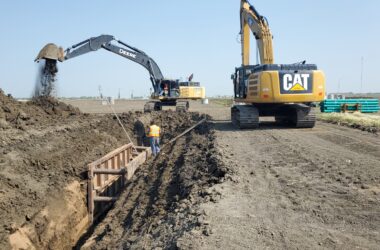
August 20, 2021 Wascana Golf & Country Club, Regina
Photos courtesy of Keith Hershmiller Photography
Thanks to everyone who came out for our golf tournament in August. It was a sell-out! The cool, rainy weather held until the last part of the day, but that did not dampen the spirits of SHCA members celebrating being back together again. The course was in great shape and the post-banquet dinner was delicious and lively.
Congratulations to the winning team from Brandt:
Mel Barilla
Shane Clark
Dean Miller
Andy Semple
Thanks to the Wascana Golf and Country Club for a fantastic day.
Hats off to our co-title sponsors again this year:
Business owners and representatives make difficult decisions every day about where to invest company dollars. In this section of Think BIG, current SHCA members sound off about the benefits of association membership.
Jeff Foster is the Saskatchewan operations manager for SMS Equipment Inc., an international dealer of construction, foresting, mining and utility equipment. This fall, he will celebrate five years with the company, which was formed in 2008 with the amalgamation of three Canadian equipment dealers: Federal Equipment, Coneco Equipment and Transwest Mining Systems.
Foster is a big believer in SHCA membership. In fact, he thinks it’s essential to belong to an organization that is the established voice of his customers. Think BIG caught up with him to hear more.
Why did your company originally decide to join SHCA?
Jeff Foster: It is important for SMS Equipment to support leading heavy construction associations, such as the Saskatchewan Heavy Construction Association. The SHCA represents a diverse group of large and small companies working together within the industry. As a supplier of heavy equipment, supporting an association that reflects our customers and workforce is essential.
In what ways do you participate in SHCA?
JF: In a typical day, I will review tender results and industry news as it is sent out. I also like to get out and attend the networking events, golf tournaments and the annual fall convention that the SHCA hosts, which bring the membership together.
Why does your company renew its SHCA membership each year?
JF: The opportunity to support and network with delegates, members and customers is highly valued. The association also provides members with current news and events, provincial updates and vital information that enables us to connect with like-minded professionals.
Can you think of anything you may have missed out on if you were never an active member of SHCA?
JF: We definitely would have missed out on all the great networking events that the SHCA hosts. They allow us the opportunity to strengthen relationships with many of the respected contractors in the industry.
Do you think that SHCA members have business advantages over non-members?
JF: The industry resources the SHCA provides its members have advantages. These include access to daily updates, industry-related articles, and tender release and award data that allow businesses to make informed decisions.
If someone in the Saskatchewan industry wasn’t participating in SHCA because they didn’t think it would benefit them, what would you say to them?
JF: I would share that the SHCA is an association committed to the heavy construction industry and advocates for businesses of all sizes. The investment is worthwhile as you can join your peers and participate in various networking opportunities.
In your opinion, what is the single greatest benefit of belonging to SHCA?
JF: No matter what type of business you are in, relationships are critical for success. The SHCA provides a platform where members can connect and enhance partnerships.
Fall Tender Plan Includes $157 Million in Highways Projects
The Government of Saskatchewan is looking to build and protect more of our provincial highway system with $157.3 million in new highway projects included in the 2021 Fall Tender Plan. These projects will continue the Ministry of Highways’ efforts to help stimulate the economy and improve the safety and reliability of Saskatchewan’s transportation network.
“Early notice of our construction plans to the road building industry ensures we can secure contractors and achieve value for money for taxpayers,” Highways Minister Fred Bradshaw said. “I am grateful to the road building industry for the good work they do and I look forward to seeing more work completed next year.”
Some of the significant projects included in the Fall Tender Plan include:
Highway 1 – repaving more than 13 kilometres west of Moose Jaw;
Highway 11 – bridge rehabilitation over the Qu’Appelle River east of Lumsden;
Highway 11 – bridge rehabilitation over Highway 20 east of Lumsden;
Highway 11 – bridge replacement over Highway 6 north of Regina;
Highway 16 – resurfacing nearly 15 kilometres at Saskatoon; and
Highway 46 – installation of traffic signals on bypass lanes at Prince of Wales Drive in Regina.
Tender releases are published in the spring and fall so the industry can thoroughly prepare and bid on upcoming projects, mitigating the risk of price increases and delivering the best possible value for taxpayers.
“The government made an important investment in our highway transportation network at a critical time for our economy,” Saskatchewan Heavy Construction Association President Shantel Lipp said. “Our members delivered on that investment and kept many people working during a very difficult time, and we will continue to build upon that investment in the years to come. Done right, a sustained, long-term, robust investment program for Saskatchewan’s highways and trade corridors can help secure for generations to come the standard of living Saskatchewan taxpayers have come to expect.”
The Government of Saskatchewan is improving more than 1,350 km of provincial highways this year, the second of its 10-year Growth Plan goal to build and upgrade 10,000 km of highways. With this year’s projects, the province is ahead of the pace needed to meet this target.
Five New Passing Lanes Opened East of Asquith
The completion of five new passing lanes on Highway 14 west of Saskatoon will provide safer roads for motorists in the area. Work began in June 2021 to build five passing lanes and resurface two and a half kilometres on Highway 14 between Saskatoon and Asquith. This $8.8 million project is part of a significant investment by the Government of Saskatchewan to construct 30 sets of passing lanes over two years, building on the addition of 27 sets of passing lanes in the last four years.
“Our government remains committed to improving the safety and efficiency of our key highway corridors,” Highways Minister Fred Bradshaw said. “Residents and motorists have let us know how effective passing lanes are and I am very proud of this government’s commitment to build new lanes this construction season.”
Passing lanes are typically a minimum two kilometres in length and are strategically designed to allow motorists to safely pass, reducing congestion and improving traffic flow. Studies have shown passing lanes can reduce collisions by as much as 25 per cent. Highway 10, the province’s first major passing lane pilot project, has seen 75 per cent fewer fatal accidents over the five years since its completion.
“This near $9-million investment in Highway 14 is greatly appreciated and will benefit not only residents, but also local businesses and industry in the area,” Biggar-Sask Valley MLA Randy Weekes said. “Safety is a big priority in rural Saskatchewan and these passing lanes make good on that priority.”
Other passing lane projects planned for the 2021-22 and 2022-23 construction seasons include:
Highway 2 north of Prince Albert;
Highway 3 west of Prince Albert;
Highway 5 east of Saskatoon;
Highway 7 west of Kindersley;
Highway 12 north of Martensville;
Highway 16 west of Yorkton to Springside;
Highway 16 east of Clavet to Highway 6 junction; and
Highway 39 between Milestone and the U.S. border.
The Government of Saskatchewan is improving more than 1,350 km of provincial highways this year, the second of its 10-year Growth Plan goal to build and upgrade 10,000 km of highways. With this year’s projects, the province is ahead of the pace needed to meet this target.
Another $300 million in highways stimulus funds is being invested over several years in thin-membrane surface upgrades, passing lanes and improvements to municipal roads and airports. The Government of Saskatchewan has invested more than $10.6 billion in highway infrastructure since 2008, improving more than 17,100 km of Saskatchewan highways.
Saskatchewan Chamber of Commerce Partners with the University of Regina’s Centre for Continuing Education to Deliver High-Priority Programming
The Saskatchewan Chamber of Commerce (SCC) is pleased to announce a partnership with the University of Regina’s Centre for Continuing Education to deliver programming to Chamber members across the province. With a focus on in-demand skills training, programming will focus on career and professional development through a suite of non-credit certificates, professional microcredentials, badges, prep courses, and customized corporate training. The University of Regina’s Centre for Continuing Education meets learning needs by offering high-quality, accessible, innovative and responsive education developed in collaboration with local industry experts and the community.
Dr. Christie Schultz, director for the Centre for Continuing Education, said, “Partnering with the Saskatchewan Chamber of Commerce is a perfect way to reach out and serve the professional development needs of businesses across the province.”
She added: “By providing valuable career development options to employers who need to fill skill gaps through employee training, we’re able to help build a stronger workforce and a more successful Saskatchewan.”
The University of Regina is a proud member of the SCC, and the two organizations continue to collaborate on identifying and meeting the training needs of the local business community. Recent U of R research shows employers and employees look to continuing education for training in areas such as project management, change management, leadership, collaboration, customer experience and stress management. Programming is currently delivered remotely.
“This partnership is an important step towards recognizing that lifelong learning is increasingly important to business. The University of Regina’s new professional microcredentials are a perfect example of education meeting workers where they are,” said Steve McLellan, Saskatchewan Chamber of Commerce CEO. “Through this partnership and others like this, we’re working to provide business with flexible and timely options for workers to upskill, reskill and boost those skills that are in demand by industry.”
The SCC’s partnership with the Centre for Continuing Education is part of a suite of programs that Saskatchewan’s network of chambers is building through the Training & Employment Network to provide clear and locally coordinated pathways for workers to be identified, as well as to present learning opportunities that enhance skills for employers.
Report Serious Injuries, Fatalities and Dangerous Occurence
Under The Occupational Health and Safety Regulations, 2020, there is a legal requirement to report all serious injuries, fatalities and dangerous occurrences that occur in the workplace to the Occupational Health and Safety Division.
Call 1-800-567-7233 and select ‘1’ to make a report. The number is monitored for emergencies 24 hours a day, seven days a week.
Serious injury of fatality
An employer or contractor shall give notice to the Occupational Health and Safety Division as soon as is reasonably possible of every accident at a place of employment that:
causes, or may cause the death of a worker; or
will require a worker to be admitted to a hospital for 72 hours or more.
The notice must include:
the name of each injured or deceased worker;
the name of the employer of each injured worker or deceased worker;
the date, time and location of the accident;
the circumstances related to the accident;
the apparent injuries; and
the name, telephone and fax number of the employer or contractor, or person designated by the employer or contractor to be contacted for additional information.
In addition to reporting the incident, an employer or contractor shall provide a copy of the notice to each occupational health committee co-chairperson or the occupational health and safety representative.
Refer to sections 2-2 and 3-18 of the Regulations.
Dangerous occurence
A dangerous occurrence is any occurrence at a place of employment that did not result in, but could have resulted in, the death of a worker or required a worker to be admitted to a hospital as an in-patient for 72 hours or more, and includes:
the structural failure or collapse of:
a structure, scaffold, temporary falsework or concrete formwork; or
all or any part of an excavated shaft, tunnel, caisson, coffer dam, trench or excavation;
the failure of a crane or hoist, or the overturning of a crane or unit of powered mobile;
an accidental contact with an energized electrical conductor;
the bursting of a grinding wheel;
an uncontrolled spill or escape of a toxic, corrosive or explosive substance;
a premature detonation or accidental detonation of explosives;
the failure of an elevated or suspended platform; and
the failure of an atmosphere-supplying respirator.
An employer, contractor or owner shall give notice to the Occupational Health and Safety Division as soon as is reasonably possible of any dangerous occurrence that takes place at a place of employment, whether or not a worker sustains injury.
The notice must include:
the name of each employer, contractor and owner at the place of employment;
the date, time and location of the dangerous occurrence;
the circumstances related to the dangerous occurrence; and
the name, telephone and fax number of the employer, contractor, owner or a person designated by the employer, contractor or owner to be contacted for additional information.
In addition to reporting the incident, an employer, contractor or owner shall provide a copy of the notice to each occupational health committee co-chairperson or the occupational health and safety representative.
Refer to sections 2-3 and 3-20 of the Regulations.
Effective Sept. 1, 2021, partial benefits will no longer be granted for partial completion of the Saskatchewan Youth Apprenticeship (SYA) program.
Previously, if a student completed only one or two levels of SYA, they were eligible to receive 100 or 200 hours of trade time respectively when applying for apprenticeship. As of Sept. 1, 2021, these partial benefits will no longer be granted. Only students who complete the whole program will be eligible for benefits. This change has been made to encourage students to fully complete the program.
The purpose of the SYA program is to raise awareness of apprenticeship in Saskatchewan schools by helping young people discover what rewards come with working in the skilled trades.
The SYA program is well-established throughout Saskatchewan high schools and educational institutions, and students typically complete the SYA program over three years from Grades 10 to 12. (It is also possible for students to complete in less than three years if they start the program later than Grade 10.)
High school students who complete the SYA program are eligible for many benefits. When registering as an apprentice in Saskatchewan in a designated trade within five years of their SYA completion date, they receive:
Waiver of apprenticeship registration fee;
Waiver of first level of technical training tuition; and
300 hours of trade time credit.
Adult learners who complete SYA as non-high school students are eligible to receive trade time hours only. Only high school students are eligible for the additional financial benefits. These are the same benefits SYA participants have always been entitled to following full completion of the program.
Beginning Sept. 1, 2021, the SATCC will require employers to register employees when they are initially hired into the compulsory trades. A completed Employer Application for Registering an Apprentice Contract (Form 1) and Contract between an Apprentice and Employer (Form A) will be required by the employee’s first day of employment in a compulsory trade as well as the apprenticeship registration fee. This new process also applies to any current employees working in the compulsory trades who are not yet registered.
Registration marks the beginning of one-half of the number of hours in an apprenticeship year (approximately six months or 900 hours) an employee is permitted to work in a compulsory trade as outlined in The Apprenticeship and Trade Certification Regulations, 2020 before becoming indentured.
This registration process allows the SATCC to identify those individuals who intend to become indentured and will give the SATCC the ability to effectively monitor the number of hours an employee is working in a compulsory trade before becoming indentured. It also helps ensure that everyone on site in a compulsory trade is either registered with the SATCC, an indentured apprentice or a certified journeyperson. By registering, employees will have access to SATCC supports, such as learning supports and disability assessments.
For more information regarding the registration process for employees working in compulsory trades, clients are encouraged to contact us toll-free: 1-877-363-0536 or via email: apprenticeship@gov.sk.ca.
As I write this, Canada is still in the middle of a federal election, so I have my fingers crossed that I’m
not jinxing myself by assuming I will still be your MP.
Prior to the election, I had the honour to serve on the House of Commons Standing Committee on Transport, Infrastructure and Communities. In the aftermath of the election, I hope that I will continue to be able to serve in that capacity, since infrastructure will be an increasingly important aspect of how Canada rebuilds its economy in the post- pandemic world.
All the major parties made significant commitments to the infrastructure sector in their party platforms. For their part, the Liberals continued to re-announce and-re-promise action through their failed Canada Infrastructure Bank institution. This bureaucratic sloth consistently succeeded in generating more red tape than shovels in the ground.
In four years, the Infrastructure Bank completed precisely zero projects and left tens of billions in job creation dollars unspent while the economy stagnated.
During the campaign, the Conservatives’ plan for economic recovery included an aggressive approach to revamp how our country invests in infrastructure. This plan would include:
Immediately investing in critical projects that will put hundreds of thousands of Canadians to work, cut commute time and reduce emissions;
Providing more flexibility to municipalities and First Nations by removing onerous requirements to receive federal infrastructure funding;
Scrapping the failed Canada Infrastructure Bank and committing the money sitting unused on its books to infrastructure projects that can strengthen our economy;
Reprioritizing the Investing in Canada Plan towards infrastructure projects that would have the maximum benefit for economic recovery; and
Building digital infrastructure to connect all of Canada to high-speed internet by 2025.
No matter the outcome of the election, the Conservatives will employ all the leverage they have in Parliament to drive this plan forward. It is time to get Canada working again and the members of the Saskatchewan Heavy Construction Association will have a vital role to play.
It won’t be good enough to simply go back to pre-pandemic business as usual. The past year-and-a-half has shown that, in too many ways, our country has stagnated over the last few years from lack of investment.
As we move forward, we must ensure that we build in a way that is stronger and more secure for generations to come. Better vaccine production, manufacturing and supply chains are part of that, but an equally important part is to make sure we have shovels in the ground to build world-class roads, transportation, dams, power plants and pipelines to support our economy.
I look forward to continuing to work with the Saskatchewan Heavy Construction Association as we work together to build this better future.
It is time to get Canada working again and the members of the Saskatchewan Heavy Construction Association will have a vital role to play.
The deadline to reserve advertising space in the 2022 SHCA Equipment Rental Rates Guide & Membership Roster is quickly approaching.
Click here to download the 2022 Media Kit and assess your company’s options to advertise in this exclusive annual tool for SHCA members. [link to kit]
In addition to advertising in the SHCA Equipment Rental Rates Guide & membership Roster, plan the rest of your 2022 marketing to SHCA members and stakeholders. Review the media kit and contact a sales representative today to confirm your placements or to request additional information.
A new report out of Export Development Canada on the country’s potential for market growth in China adds urgency to the Western Canada Roadbuilders & Heavy Construction Association (WCR&HCA)’s call for the federal government to ramp up funding for trade-enabling infrastructure, the WCR&HCA board heard Dec. 9.
The WCR&HCA is working with federal and regional partners to promote the initiative that is premised on pressing the federal government to substantially increase investment within the National Trade Corridors Fund, which was announced at $1.9 billion in 2021’s budget.
Anything less than a $10 billion federal contribution would be inadequate to task, WCR&HCA president Chris Lorenc says, to attend to the regional corridors in the West and across Canada that need attention, not just coastal or Eastern Canadian ports.
The update to the WCR&HCA follows the circulation of a report on the need for recapitalization of the federal Trade Corridor Fund, which sits at $1.9 billion. The report summarizes a roundtable discussion, co-hosted by Export Development Canada (EDC), the WCR&HCA and the Canadian Construction Association (CCA), among regional and national stakeholder organizations Sept. 8.
Two panelists of the roundtable, EDC vice-president and chief economist Peter Hall, noted that Canada has to significantly boost its efforts to diversify its trade markets, not just to alleviate reliance on the United States, but to take advantage of growing middle-class demand in under-developed export markets.
Western Canada is a region with access to west coast ports is indispensable to Canada’s trade profile and productivity and, therefore, its economic health and prosperity. With CP’s pending acquisition of KCS and KCSM, the continent of North America is also very much in play for market growth.
“Today, the United States is the primary customer for Canadian products, accounting for about 75 per cent of all merchandise exports. Unlike Asia, the U.S and other traditional export markets are already quite mature, with demographics that are not favourable to high future growth that matches the scale in the Asian markets,” the report says, summarizing Hall’s comments.
“While China represents only five per cent of Canada’s current trade, if the growth rate seen over the last two decades holds, it will surpass the U.S. as the top destination for Canadian goods by 2048. And if Canada can achieve even just half of Australia’s market share for Chinese imports… the point at which China becomes our top destination could be reached much faster – by 2036.”
Guy Saint-Jacques, a former Canadian ambassador to China, says there is huge potential for expanding trade into Asia, particularly China. He cautions, however, that strengthening ties to China brings risk, noting the severe sanctions China has imposed on Australia.
Australia is among the countries concerned about the use of Huawei Technologies and expressed concerns about the limited access to potential sources of the COVID-19 virus during investigations in China.
Food products make up 31 per cent of Canada’s exports to China, so “there is an opportunity to diversify into other areas, such as energy and manufacturing, where Canada lags behind other countries,” the report says, summarizing Saint-Jacques.
“To capitalize on these and other market opportunities, Canada must build the infrastructure required to bring Canadian products to tidewater.”
The need for reliable trade infrastructure was not lost on the federal government, in its financial update presented Dec. 15.
Finance Minister Chrystia Freeland announced that supply chain problems, including port congestion, caused by the COVID-19 pandemic will trigger $50 million in special support for Canada’s ports, to be drawn out of the $1.9 billion National Trade Corridors Fund.
More detail is to come on what criteria such proposals will need to meet.
Lorenc says the perspective must be much wider, because the trade network across the West needs attention.
The WCR&HCA is working with the CCA, Business Council of Canada, Canadian Manufacturers and Exporters and the Canada West Foundation in its strategy to put the WCTG&CI on the agenda of Canada’s premiers, provincial governments, federal MPs and ministers.
The proposed Western Canada Trade Gateway & Corridor Initiative aims to boost domestic, continental and international trade, particularly in Asia, through a multi-year national program that brings both public and private investments to Western Canada’s multi-modal trade transportation network. That includes investments in existing trade gateways and corridors, plus the long-term build-out of new marine and inland ports as well as road, rail and air transportation assets that will support the freight and passenger flows required for international trade.
The Government of Saskatchewan has announced that the Builders’ Lien (Prompt Payment) Amendment Act, 2019 (the “Act”) will be proclaimed into force on March 1, 2022.
Click here to read about the purpose of the act as well as its key features and takeaways from the legal experts at Miller Thomson
The SHCA Annual Convention is taking place April 7–8, 2022 at the Delta Hotels Bessborough in Saskatoon.
SHCA members are encouraged to book their room at the Delta Hotels Bessborough as soon as possible; SHCA has secured a special room rate of $154 per night.
Members need to book their room before March 7, 2022.