U.S. President Donald Trump has said he will impose a 25 per cent tariff on Canadian goods exported to the U.S. (including aluminum and steel), along with a 10 per cent tariff on energy products, next month. In kind, the Government of Canada has responded with targeted tariffs, with some products having a direct impact on construction.
“Canada’s construction industry is disappointed to see the imposition of tariffs,” said Rodrigue Gilbert, president of the Canadian Construction Association (CCA). “We appreciate that the federal government has issued a strong response to President Trump’s senseless tariffs and will hold consultations with industry on further measures.”
The impacts of this trade conflict will be felt throughout the Canadian economy. These measures are likely to impact not only the ability of construction operators to meet their project requirements, but also the supply chains that the Canadian industries rely on all together. This limits the industry’s ability to combat the housing crisis, slows down its ability to build critical infrastructure, and so much more.
“This is a time where we need all Canadians to stand up for Canada. This is not the time to sit on our hands – we all have to work together to increase productivity and support Canadian businesses, so that we can all build a stronger Canada and surmount this trade conflict,” said Gilbert.
As all levels of government consider non-tariff measures to support Canadian businesses and stimulate our economy, the CCA urges all governments to consult with industry so that any and all measures can be targeted, effective and reflect the real needs of the industry.
CCA will continue to monitor the impact of these economic measures on the construction industry and will work with all levels of government to build a strong foundation for Canada’s future.
The Ministry of SaskBuilds and Procurement and Saskatchewan Polytechnic have issued a Request for Qualifications (RFQ) to procure a new Skilled Trades and Technology (trades) building. The new trades building is using a Design-Build procurement model for its delivery as the first building planned as part of the new Joseph A. Remai Saskatoon campus.
“This is an important next step in building the new Saskatoon campus,” SaskBuilds and Procurement Minister David Marit said. “We are pleased to work with our partners to make this happen. The Request for Qualifications shows our focus is on creating a top facility for students and industry. Starting this process will help us find the right team to build the new Skilled Trades and Technology building for Saskatchewan Polytechnic.”
The new trades building is the first building planned as part of a new and consolidated campus in Saskatoon. It will be built on a green field site, located at Innovation Place Saskatoon, adjacent to the University of Saskatchewan.
“Saskatchewan’s post-secondary institutions are crucial in positioning the province as a global research leader, further solidifying our reputation as a hub for innovation,” Minister Responsible for Innovation Saskatchewan Warren Kaeding said. “This new campus will open more opportunities for Saskatchewan students and aims to attract top talent to cultivate our future innovation leaders.”
The RFQ is the first step in a two-step process to evaluate and pre-qualify professional service providers for the building. Qualified teams from the RFQ process will compete in the second stage for the design and construction of the trades building.
“I am pleased to see the Saskatchewan Polytechnic, Joseph A. Remai Saskatoon Campus project moving forward,” Advanced Education Minister Ken Cheveldayoff said. “The campus will play a critical role in preparing students who will help meet Saskatchewan’s labour market needs. The Skilled Trades and Technology building will provide a high-quality learning environment for Saskatchewan students, helping keep our province competitive with other jurisdictions and attracting more students and instructors.”
Site preparation work began in September of 2024 and includes the removal or upgrading of underground infrastructure, tree relocation and grading. Site preparation is nearing completion, with substantial completion anticipated in the spring. The new campus will transform an existing network of several decentralized, outdated buildings into a revitalized, modern, technology-rich learning environment for students and greater opportunities for applied research and investment.
“We are excited to reach another momentous milestone for the Saskatchewan Polytechnic, Joseph A. Remai Saskatoon Campus with the launch of the procurement process for the Skilled Trades and Technology building,” Saskatchewan Polytechnic president and CEO Larry Rosia said. “We have undertaken extensive consultation with faculty, students, the City of Saskatoon and other key stakeholders, and we greatly appreciate everyone’s feedback. This campus will lead the way in applied learning across Saskatchewan, enhancing the student experience and expanding our capacity for applied research and collaboration.”
Since 2022-23, the province has provided $16 million for the project. The 2024-25 Provincial Budget included $6 million for design and pre-procurement work of the new campus. The Government of Saskatchewan announced in September 2023 that it would commit up to $200 million toward the new campus. The Ministry of SaskBuilds and Procurement and Saskatchewan Polytechnic are leading this procurement in partnership from the Ministry of Advanced Education, Innovation Saskatchewan and the University of Saskatchewan.
The Saskatchewan Research Council‘s (SRC) latest economic impact assessment shows it has contributed more than $15.5 billion in combined economic and employment impacts in Saskatchewan since it began assessing such in 2003 – including a combined impact of $887 million in this latest fiscal year.
SRC’s 2023-2024 economic impact assessment shows SRC’s impact on the provincial economy in the fiscal year was $785 million. SRC also assisted in creating or maintaining more than 1,682 jobs in Saskatchewan in 2023-2024, a contribution valued at an additional $102 million. These impact numbers were also accompanied by annual revenue of $83 million generated by SRC in 2023-2024. In 2023-2024, SRC had a mandate effectiveness of 38, which means that for every dollar the province invested in SRC, SRC’s work contributed at least a 38-times return to the growth of the Saskatchewan economy.
“The Saskatchewan Research Council is dedicated to growing and strengthening Saskatchewan’s economy through research, development and demonstration through the transfer of innovative technical solutions, applications and services,” Minister Responsible for SRC Warren Kaeding said. “SRC’s work is making an incredible impact on the province’s economic growth and is creating thousands of jobs for people across Saskatchewan.”
“At SRC, we are dedicated to strengthening Saskatchewan’s economy with quality private sector jobs and a secure environment,” SRC president and CEO Mike Crabtree said. “This is why our economic impact assessment is so important, as it truly demonstrates the value we can generate from the province’s investment in us.”
With 77 years of research, development and demonstration experience, SRC is Canada’s second largest research and technology organization with 1,400 clients in 22 countries around the world.
Another milestone has been reached as the Government of Saskatchewan, in partnership with Saskatoon Public Schools, announced that six construction contractors have been shortlisted to submit bids for the construction of the new Saskatoon City Centre School. This development shows that the project is progressing steadily toward construction.
The shortlisted contractors are:
Graham Construction
PCL Construction
Quorex Construction
VCM Construction
Westridge Construction
Wright Construction
Saskatoon Public Schools issued the Request for Qualifications and the shortlisted companies were selected through a competitive process, with the aim of ensuring high-quality and timely delivery of the project. These firms will now proceed to the tender stage, where they are invited to provide detailed submissions to bid on the construction contract.
The new Saskatoon City Centre School, funded by the Government of Saskatchewan, will bring together students from the Princess Alexandra, King George and Pleasant Hill neighbourhoods into a single, modern facility. Designed to accommodate up to 400 students from prekindergarten to Grade 8, the school will also include 74 childcare spaces and additional community services.
“This milestone brings us one step closer to delivering a modern learning environment for students in Saskatoon’s city centre area,” Education Minister Everett Hindley said. “This new school will not only provide high-quality education spaces, but will also serve as a hub for community engagement and collaboration, supporting the needs of students and families for years to come.”
Construction is expected to begin following the completion of the procurement process.
“We are excited to have a shortlist of teams for the Saskatoon City Centre School Project,” SaskBuilds and Procurement Minister David Marit said. “This is an important step towards construction that shows our province’s focus on building modern schools for future generations and supporting strong and growing communities.”
Since 2008, the Government of Saskatchewan has committed approximately $2.6 billion toward school infrastructure projects, including 69 new schools and 32 major renovation projects with seven projects approved through the Minor Capital Renewal Program.
CAI Capital Partners (CAI) is pleased to announce that its portfolio company, the Universal Group, and its related companies (together, Universal or the Company) has successfully closed the acquisition of Barricades and Signs Ltd. (Barricades).
Barricades, headquartered near Edmonton, Alta., was founded in 2004 by Robert and Fran van Bruggen and has grown into a leading traffic control company with operations across Alberta, British Columbia, Manitoba and Saskatchewan. Over the past eight years, the company has been successfully led by CEO Jan van Bruggen who, in partnership with Barrier Ridge Capital, has contributed to Barricades’ development and growth up to this point. As part of this exciting transition to the Universal Group, Bruggen will continue to lead Barricades and will also become a shareholder in the Universal Group.
“I am honored to be leading Barricades into this exciting next phase of growth and evolution,” said Bruggen. “Joining the Universal Group family aligns perfectly with our commitment to building healthy communities and supporting our employees and stakeholders as we strive to be our best. The alignment in vision and values between Barricades and the Universal Group is remarkable, and I look forward to seeing us thrive with their support and expanded network across Canada and the Pacific Northwest.”
The acquisition of Barricades marks a significant milestone in Universal’s strategy to expand its operations and presence in new markets across Canada. The acquisition of Barricades reinforces Universal as one of Canada’s preeminent providers of traffic control services, enhancing its ability to deliver unparalleled service and support for its clients nationwide, with coverage in nearly all provinces.
Barricades and Signs Ltd. is headquartered near Edmonton, Alta. Photo: Alicia Paydli/Unsplash
“We are thrilled that Barricades and Signs is joining the Universal Group of traffic management companies.” said Mike Menzies, CEO of the Universal Group. “This transaction is a major milestone for Universal as we continue to build on our national footprint of being the largest supplier of traffic management services and products across Canada. Barricades expands our footprint into new markets, enabling us to establish operations in Alberta, Manitoba and Saskatchewan. Barricades also brings to our group additional product lines, further expanding our one-stop-shop capabilities for all our customers’ needs. We are excited to welcome [Bruggen] and the Barricades team as we combine our expertise and drive forward our overall strategic plan.”
CAI’s equity co-investment partners in the combined organization include BDC Capital, Roynat Equity Partners and Frind Enterprises. Debt financing for the transaction was provided by Bank of Montreal, Canadian Imperial Bank of Commerce, The Bank of Nova Scotia and National Bank Financial. Universal was advised on the transaction by Lawson Lundell LLP (legal), MNP LLP (tax), Marsh Canada Limited (insurance) and HUB International Limited (benefits).
The Government of Saskatchewan has proclaimed Sept. 23 to 27 as Saskatchewan Construction Week. The week has been proclaimed to celebrate the extensive economic and social contributions made by the province’s dynamic construction industry.
“Saskatchewan’s construction industry is not only a major contributor to jobs in the province, but [it] also plays a crucial role in building the infrastructure necessary for a growing economy,” Trade and Export Development Minister Jeremy Harrison said. “As we work toward achieving and surpassing our Growth Plan goals of growing the provincial population to 1.4 million people and creating 100,000 new jobs, the construction industry will further excel this growth by building the offices, facilities, housing and more, which contribute to our strong and vibrant communities.”
The construction industry in Saskatchewan is a key driver of economic growth. Last year, real GDP for the sector grew by 13.6 per cent, with the sector’s real GDP reaching $6 billion. Currently, there are over 43,000 (seasonally adjusted) people employed in the province’s construction industry, making it one of the most important economic sectors in Saskatchewan in terms of job creation.
“During Saskatchewan Construction Week, we celebrate the dedicated professionals who form the backbone of our province’s economy,” Construction Associations of Saskatchewan co-CEO Shannon Friesen said. “These skilled workers, often behind the scenes, build the infrastructure that drives our communities forward.”
“Their contributions are vital, not just in constructing roads, schools and hospitals, but in shaping the very foundation of our future,” Construction Associations of Saskatchewan co-CEO Kevin Dureau said. “This week, we honour their commitment, resilience and the essential role they play in ensuring Saskatchewan remains strong and prosperous.”
The growth the construction industry has experienced recently has had an overall positive impact on Saskatchewan’s economy, with Statistics Canada’s latest GDP numbers indicating that the province’s 2023 real GDP reached an all-time high of $77.9 billion, increasing by $1.2 billion, or 1.6 per cent. This places Saskatchewan second in the nation for real GDP growth, and above the national average of 1.2 per cent.
Private capital investment is projected to reach $14.2 billion in 2024, an increase of 14.4 per cent over 2023. This is the highest anticipated percentage increase in Canada.
The Government of Saskatchewan also recently unveiled its new Securing the Next Decade of Growth – Saskatchewan’s Investment Attraction Strategy. This strategy, combined with Saskatchewan’s trade and investment website, InvestSK.ca, contains helpful information for potential investors and solidifies the province as the best place to do business in Canada.
Survey tool proves effective in predicting injuries and improving safety performance
maxxasatori/123rf
The Saskatchewan Construction Safety Association (SCSA) and EHS Analytics are proud to share the success of an innovative Safety Culture Survey tool, designed to predict injuries and enhance Occupational Health and Safety (OHS) performance. With the participation of almost 800 construction companies, making it the largest survey of its kind administered at an industry scale, the tool has proven to be an effective leading indicator for safety performance.
The survey tool uses the Institute for Work & Health Organizational Performance Metric (IWH-OPM), an eight-item questionnaire developed by IWH to assess values and beliefs around safety within workplace culture. The large-scale participation of the Saskatchewan construction industry provided data collected over three years, through six rounds of the survey. EHS analyzed the data to gain insights and further support the industry’s safety efforts.
Key findings include:
A strong correlation between high survey scores and lower future lost time injury rates.
Identification of areas where safety improvements can significantly reduce injury risks.
Enhanced ability for firms to benchmark their safety performance against industry standards and peers. Confirmation of the effectiveness of COR® certification.
Shortcomings in Canadian OHS performance are not highly related to a lack of tools or equipment.
“Our analysis has proven that the Safety Culture Survey is a true leading indicator of safety performance,” said Mohammad Khalkhali, data science team lead at EHS Analytics. “Finding easy-to-measure, effective leading indicators in safety is incredibly challenging, and the Safety Culture Survey provides companies with the ability to foresee and mitigate potential hazards before they result in incidents. Leading indicators are often considered the ‘Holy Grail’ in safety for predicting risk, and this tool achieves that goal.”
Every SCSA member company is invited to participate in the survey and view their results in a custom analytics dashboard. Companies can see how their score compares to peers, find follow-up questions to make proactive adjustments to their safety program and monitor their performance over time.
“Having insights into one’s own company in a way that can predict incidents is a game changer,” said SCSA president Collin Pullar. “We encourage all of our members to utilize this simple, but insightful culture survey to better understand where they are doing well, but also better recognize and address weakness in their culture to prevent potential injuries. This is a powerful Canadian-built tool, and we would love to see as many companies as possible use it and learn from it to prevent accidents within their workforces.”
“At the Institute for Work & Health, our mission is to conduct and mobilize research that supports policy-makers, employers and workers in creating healthy, safe and inclusive work environments,” said Peter Smith, president of IWH. “To that end, it is heartening to see health and safety organizations such as the SCSA use the IWH-OPM to both understand organizational health and safety practices over time, and to better understand the relationships between these practices and safety outcomes in Saskatchewan.”
The survey is delivered twice a year to SCSA members, each fall and spring.
Saskatchewan, Alberta and Manitoba continue collaboration on the joint memorandum of understanding
ronniechua/123rf
Ministers for highways and transportation in Saskatchewan, Alberta and Manitoba in Saskatoon to continue work to strengthen economic corridors that support Canada’s supply chains. It has been a year since a memorandum of understanding (MOU) was signed by the three provinces.
The MOU commits the partners to jointly working to improve the shared transportation system, to ensure the strength and competitiveness of the Prairie provinces.
Over the past year, the focus has been on regulatory harmonization, advocacy and regional planning. These priorities will continue with additional work on improving multi-modal transport infrastructure for the efficient movement of exports and imports.
The provinces are working on co-ordinated improvements that benefit the entire region, and they link producers more efficiently to markets across the globe. They are creating a prairie regional economic corridor to guide strategic investments in transportation.
The MOU commits the partners to jointly working to improve the shared transportation system, to ensure the strength and competitiveness of the Prairie provinces.
“By keeping the momentum of the Prairies’ MOU going, we can continue to improve western economic corridors that will enable the efficient movement of Prairie exports and imports to and from markets around the world,” Alberta Minister of Transportation and Economic Corridors Devin Dreeshen said.
“For Saskatchewan people, improving transportation efficiency with initiatives like these supports our strong and growing export-based economy,” Saskatchewan Highways Minister Lori Carr said. “A strategic approach helps the province invest in key services and helps build and protect our quality of life.”
Saskatchewan has already achieved its Growth Plan pledge to increase exports by 50 per cent. The province continues to expand export infrastructure to increase the mobility of Saskatchewan’s products to international markets over the next decade. Exports support a vibrant business community and ensure an improving quality of life for Saskatchewan people.
Seventy per cent of Saskatchewan’s economy is dependent on exports. In 2023, Saskatchewan exported $49.3 billion in goods. Saskatchewan goods reached 163 countries, with 32 of those countries receiving over $100 million in provincial exports.
Canada’s construction industry unveils critical report on climate resilience
smshoot/123rf
On Sept. 9, 2024, the Canadian Construction Association (CCA) released a report emphasizing the urgent need for increased investment and stronger policies to protect Canadians and their critical infrastructure from the increasing threats of climate change.
The report, titled Climate resilience in construction: Building for a sustainable future, stresses the importance of building resilient infrastructure that can withstand extreme weather events, protect lives and support community well-being. Recent incidents, like the flooding in Toronto and wildfires in Jasper, show these threats are real and disrupt the everyday lives of Canadians. Calgary’s broken water main signals even deeper problems with Canada’s aging infrastructure.
“Canada’s infrastructure is the backbone of our communities, but it’s under threats from climate-related disasters,” said Rodrigue Gilbert, CCA president. “With much of our infrastructure aging or in poor condition, we must act now to future-proof our infrastructure and meet our environmental goals.”
The construction industry is already working to build sustainably, but it cannot do it alone. Significant investment, strategic planning and collaboration are needed to build infrastructure that is both resilient and sustainable.
“The construction industry is making progress in reducing our environmental impact,” Gilbert said. “But to reach our net-zero objectives and protect our infrastructure, we need support from both stakeholders and all levels of government.”
Key points from the report include:
Urgent need for investment: To protect infrastructure assets and address the rising strain from increasing population and housing developments, substantial investment is essential.
Industry progress and challenges: The construction sector is actively working to reduce its environmental impact, but long-term sustainability requires broader support and collaboration. Incentives to pilot new processes and technologies are also needed.
Policy environment: We need effective policies to ensure infrastructure is built to last. This includes addressing issues like labour shortages, procurement, alternative delivery models and supply chain challenges.
“Too often, infrastructure investment decisions are based on what’s politically expedient, not what’s genuinely needed in a given region of Canada,” said Gilbert. “We need to focus on projects that are ‘shovel-worthy,’ not just ‘shovel-ready’ to ensure Canadians have the infrastructure they depend on.”
Highway Hotline introduces new highway condition terminology
fierylily/123rf
Saskatchewan’s Highway Hotline has updated the terminology it uses to describe winter driving conditions.
The new terminology offers more clear and concise messaging that will help drivers make decisions about winter travel. The updated language is also more consistent with neighbouring provinces, which will make using the Hotline easier for people travelling across Western Canada.
“The construction industry is making progress in reducing our environmental impact. But to reach our net-zero objectives and protect our infrastructure, we need support from both stakeholders and all levels of government.”
– Rodrigue Gilbert, CCA president
“The Highway Hotline is used millions of times throughout the year to help travellers plan ahead,” Highways Minister Lori Carr said. “These changes will help drivers make an informed decision while having better consistency with our neighbouring provinces and national standards.”
The new primary conditions include:
Bare: Road appears black, meaning all wheels of a passenger vehicle are on a bare surface.
Partly Covered: Road appears yellow, meaning two wheels of a passenger vehicle are on a snow or ice-covered surface.
Covered: Road appears pink, meaning all wheels of the vehicle are on snow or ice.
Travel Not Recommended: Road appears blue, meaning that visibility is less than 250 metres and could become impassable.
Closed: Road appears red, meaning the highway is impassable.
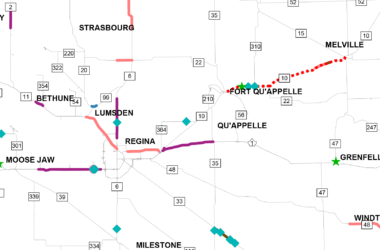
The colour white was removed because it did not show up well on the digital maps. The maps will continue to indicate poor visibility using a dotted line.
During the winter driving season, road conditions are updated a minimum of four times daily or whenever there are known changes that affect drivers.
The Highway Hotline has existed for more than 50 years. It provides information on highway conditions, road closures, construction zones, ferries and border crossings. As of February 2024, it now allows users to track the progress of plows involved in snow removal and ice treatment. This real-time information helps drivers make informed decisions to protect their safety.
Company Charged, Fined $100,000 for Serious Worker Injury
Adler Firestopping Ltd. was charged for contravening subsection 12-5 (2) (a) of the regulations (being an employer failed to ensure that every scaffold is designed, constructed, erected, used and maintained so as to perform safely any task that the scaffold is required to perform, resulting in the serious injury of a worker).
Three other charges were withdrawn.
As a result of this charge, the court imposed a fine of $71,428.57, with a surcharge of $28,571.43, for a total amount of $100,000.
The charge stemmed from a worksite incident that took place on Nov. 28, 2022, on the Thunderchild First Nation in Saskatchewan. A worker was seriously injured as a result of a fall from a work platform.
On Dec. 6, 2024, the Saskatchewan Apprenticeship and Trade Certification Commission (SATCC) celebrated outstanding achievement in the skilled trades at the 24th annual Apprenticeship Celebration Dinner.
Nearly 350 people attended this year’s event, sponsored by more than 30 organizations. Held at the Conexus Arts Centre in Regina, the Apprenticeship Celebration Dinner brought together industry partners and stakeholders, training providers and employers who help build a successful apprenticeship system in Saskatchewan to recognize award winners and celebrate their achievements.
“Skilled tradespeople in Saskatchewan play an important role in building a growing province, and our government is committed to creating more skills training and education opportunities, as guided by the Saskatchewan Labour Market Strategy,” Deputy Premier and Immigration and Career Training Minister Jim Reiter said. “Congratulations to those being recognized tonight for their contributions to Saskatchewan’s apprenticeship and trade certification system.”
Thirty-one journeypersons who achieved the highest mark on their trade’s certification exams between July 1, 2023, and June 30, 2024, received Outstanding New Journeyperson awards. Eleven additional awards issued by the SATCC included the First Nations and Métis Scholarship, the Scholarship for Journeypersons with Disabilities, the Outstanding Instructor and Employer awards and the Apprenticeship Lifetime Achievement Award.
In addition to the awards from the SATCC, industry partners including training providers, industry associations, employers and unions also issued scholarships and awards recognizing the achievements of apprentices and journeypersons.
“We are proud to honour and recognize the people who demonstrate excellence in the skilled trades,” SATCC Commission Board Chair Bryan Leier said. “On behalf of the SATCC and the Commission Board of Directors, congratulations to all the award winners for your outstanding achievements that contribute to a strong and successful apprenticeship system in Saskatchewan.”
The Saskatchewan Workers’ Compensation Board (WCB) announced the 2025 preliminary average employer premium rate will remain unchanged from the 2024 rate at $1.28 per hundred dollars of payroll. The announcement was made at the WCB’s annual preliminary rate information meeting with Saskatchewan employers, workers and stakeholders on Oct. 31.
“Year over year, the WCB aims to uphold a balance between stable rates and a fully funded compensation system,” said the WCB’s chair, Gord Dobrowolsky. “The two key drivers of the 2025 preliminary average premium rate are claim costs and payroll. While we are forecasting claim costs to increase, we expect these to be offset by rising employer payroll. This is why we are proposing the 2025 preliminary average premium rate remain at $1.28.”
Workers’ compensation is a no-fault insurance system based on collective liability, where all employers share responsibility for workplace injury insurance. Employers are grouped together to form an industry rate code. Premium rates are set for each rate code based on the collective claims experience of employers within each industry rate code. All employers within an industry rate code start with the same industry premium rate.
With the 2025 preliminary rate proposal:
The overall 2025 proposed average preliminary premium rate will remain at $1.28 per hundred dollars of payroll.
Industry premium rates for approximately 76 per cent of Saskatchewan’s employers covered by the WCB will see a decrease or no change for 2025.
Industry premium rates for approximately 24 per cent of Saskatchewan’s employers covered by the WCB will increase next year.
The WCB works to uphold a balance between stable rates that ensure fairness, transparency, collective liability and predictability, and a fully funded compensation system.
“While we are proposing the 2025 preliminary average premium rate remain consistent with last year’s rate, we are seeing claims getting more costly, which coupled with inflation, is expected to put long-term upward pressure on premium rates,” said the WCB’s CEO, Phillip Germain. “By working together to reduce the number of serious injuries and fatalities in our province, we can help to minimize the impact of factors that are pushing premium rates upward.”
In 2024, the WCB completed an optimization of its investment strategy to improve the long-term expected return on its investments. Increased investment income benefits employers by reducing the premiums needed to operate the compensation system.
Additionally, employers can influence their individual premium rate through effective injury prevention and return-to-work programs. The degree to which employers in an industry work to eliminate workplace injuries also affects industry premium rates. Employers who have a fully functioning safety program and a solid return-to-work program can help prevent and manage work-related injuries.
In 2023, for the fourth year in a row, 90 per cent of employers in the province achieved zero injuries and zero fatalities in their workplaces. On an annual basis, serious injuries account for approximately 11 to 14 per cent of total claims and more than 80 per cent of claim costs in the system.
Over the coming months, WorkSafe Saskatchewan, the partnership between the WCB and the Ministry of Labour Relations and Workplace Safety, will launch several programs designed to support employers and workers in making Saskatchewan the safest place in Canada to work. As part of its 2023-2028 Fatalities and Serious Injuries Strategy, these programs include several campaigns targeting rate codes with the highest injury rates.
“The WCB will continue to work to prevent work disability through active worker and employer contact, and collaborative return-to-work plans with workers, employers and health-care providers,” said Germain. “Through all of these efforts, we can work together to reduce the number of serious injuries and fatalities that significantly impact individuals, families and communities.”
“Since 2020, Ontario’s road safety performance has been going backwards. During this time, the number of collisions, injuries and deaths occurring on the province’s roads has increased – by a lot.”