by Erin Matthews Erin Matthews

Keeping Safety at the Forefront of Innovation

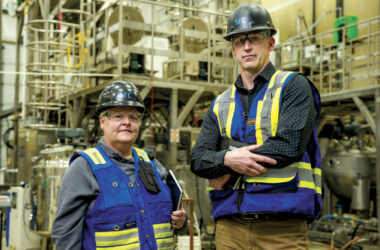
Two workers in safety equipment

From environmental remediation in the Athabasca Basin to renewable energy storage systems in southern Saskatchewan, the Saskatchewan Research Council (SRC) is committed to tackling every project, large or small, with the health and safety of its employees at the forefront.

Beginning in 1959, SRC’s safety program has evolved over the last several decades and continues to be shaped by the innovative and leading-edge work SRC undertakes.

Safety is everyone’s responsibility

“Safety is definitely a shared responsibility, with everyone having a role to play,” said Kenelm Grismer, director of health, safety and risk at SRC. “As an employer, SRC has the responsibility to establish and maintain an effective safety management system to enable people to work safely.”

The management system is driven by safety leadership and commitment at all levels of the organization, and includes upholding SRC’s organizational philosophy that safety is an overriding priority. With SRC providing the foundation for this safety culture, employees are empowered in their work environment to perform their tasks safely, ensuring they are confident in their understanding of the hazards and are equipped to do the job safely before proceeding. To ensure safety across SRC, it’s essential that employees are aware of and practice their rights, including the right to refuse any unsafe work.

“We want employees to be curious about safety, to ask questions and to challenge the way that we do our work to ensure it’s being done in the safest way practical,” said Grismer.

Managers and supervisors have a responsibility to ensure employees receive the appropriate training and tools for their roles, and that they are following established rules and procedures. They lead by example to reinforce SRC’s commitment to safety. SRC’s occupational health and safety committees provide a forum for the employer and employees to work together to continually improve safety.

“Collectively, these various roles create layers of defence to keep us all safe,” said Grismer. “Each of these roles is vital to developing and maintaining a strong safety culture across SRC.”

Varied service lines create unique safety requirements

From lab benches to field work to desk duties, every team at SRC encounters different risks and hazards, but Grismer says that doesn’t change the council’s philosophy. “Across SRC, safety is an overriding priority. All groups operate under the same overarching safety management framework, but how the tools are applied may change between groups,” said Grismer.

SRC has several laboratories that process samples, providing data and insight to clients around the world. In these spaces, employees often engage in routine work, drawing more heavily on well-established standard operating procedures and safe work practices.

As SRC evolves, new projects come together and new business units are established. Often, these growing and specialized teams need to develop new safety protocols for their work.

Other employees, such as those in the field conducting air quality testing, may encounter varying levels of uncertainty in their day-to-day tasks. These employees must conduct regular field-level risk assessments, and be comfortable identifying and mitigating hazards in varying conditions. Grismer says this is where safety training and experience are crucial.

As SRC evolves, new projects emerge, and new business units are formed. Often, these growing and specialized teams need to develop new safety protocols for their work. For instance, the developmental nature of the work that SRC’s research and development team undertakes in its rare earth element division comes with a certain amount of risk and uncertainty when doing something for the first time, which is why planning, training and having the correct tools for the job are critical.

“They’ve worked very hard to assess the hazards, develop standard operating procedures and safety protocols to mitigate the risk, and spend a significant amount of time and effort in training the team to conduct the work safely,” said Jackie Foord, SRC’s occupational health and safety lead. “They are continually reassessing the risks and refining the way they do the work to improve safety. The planning and development they’re doing now will benefit the operation in the long term.”

SRC’s safety management framework, driven by the organizational commitment to safety, positions SRC well to meet the various safety challenges encountered while working across several diverse service lines.

Safety evolves alongside SRC

In the last five years, SRC has expanded into growing sectors, including critical minerals. These new projects have not only required specialized knowledge and expertise, but also new equipment and facilities, such as SRC’s under-construction Rare Earth Processing Facility and its Minerals Liberation Sorting Centre.

“These types of projects have definitely been a catalyst to advance our safety program on a number of fronts,” said Grismer.

New skill sets and resources have been brought on to carry out these projects, enabling SRC to view work environments from a variety of perspectives. Teams work together to find solutions to challenges. “Working with tradespeople who have come from larger organizations, such as mining operations, brings a wealth of knowledge to the organization regarding safety,” said Foord.

These projects have unique safety needs. Foord says the extensive efforts invested in activities such as hazard assessment, planning and training have been critical to the success of these projects and ensuring everyone on-site goes home safe at the end of the day.

New safety innovations keep employees at the heart of safety

SRC’s safety team continues to innovate to meet the council’s needs for new and existing projects and facilities in 2025 and beyond. As SRC’s industrial process operations expand, so do its safety requirements. Tools like automation, robotics and AI will help improve safety by mitigating hazards, and provide opportunities for enhancing and streamlining data analysis and reporting.

“Innovation has been critical to working safely across SRC. As an organization, we are fortunate to have access to a wide range of expertise and skill sets, from engineers and scientists to instrument techs and electricians,” said Grismer.

Learning from employees’ experiences on-site, in the field and at the lab helps SRC improve its protocols and approaches to ensure they are robust enough to tackle any safety challenges. “We are continuously applying these resources to advance safety, both for our clients as well as our own operations. There are countless examples of situations where a team identified a hazard and developed an innovative approach that enabled them to do the job [safer],” said Grismer.

SRC’s goal is ultimately to eliminate workplace injuries. To achieve that goal, the focus is on continuing to ensure that all employees at SRC feel they are accountable for safety and are empowered to ensure work is done safely.


For more information on SRC’s services, visit src.sk.ca.

by Erin Matthews Erin Matthews

Air Quality Measurement and Monitoring Requires Innovation for Long-Term Results

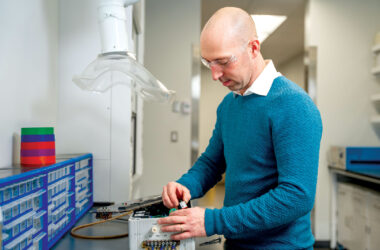
Man in safety goggles working on electrical device
Photo: Saskatchewan Research Council

From potash to oil and gas to manufacturing, industrial air quality measurement and monitoring has historically focused on reporting for regulatory purposes with an end goal of protecting people and the environment.

With industry and government focusing more on improving the environmental performance of industrial facilities, the ability to measure, monitor and model air quality is important to reporting and delivering on these goals. In the last decade or so, many operations have stepped up to the challenge and are employing new technologies and optimizing their processes, signalling that specialized air quality expertise, beyond just measurement, is needed to work on these more complex projects. Understanding the data and how to use it for a specific operation requires experience and technical know-how.

For more than 45 years, the Saskatchewan Research Council (SRC) has helped important economic sectors operating on the Canadian Prairies keep a close eye on their air emissions to ensure they meet environmental standards and regulatory requirements, as well as to implement process improvements for emissions reduction strategies.

With more than 17 years of experience in air quality at SRC, team lead Kent Orosz is at the helm of a group of specialized experts who help clients achieve long-term environmental and economic benefits through measuring, monitoring and modelling. “Our team is quite diverse in terms of skills and expertise,” Orosz said. “We offer a variety of services that can be integrated to meet a client’s needs.”

The air quality team offers a wide range of services, from industrial source testing to ambient air monitoring and industrial hygiene for a variety of industries, such as mining, manufacturing, biofuels, construction and electricity generation.

“While stack sampling makes up the majority of our work,” Orosz said, “we also work with clients on other aspects of measurement and monitoring, such as environmental protection plans under the Industrial Source (Air Quality) chapter of the Saskatchewan Environmental Code.”

Expertise in safe stack sampling

With highly trained and highly experienced team members, SRC is a trusted provider of stack sampling on the Prairies. While technology has changed, manual testing methods remain the most reliable approach to stack sampling. “Stack sampling is a unique job because it’s a mix of labour, very technical work and some science as well,” Orosz said.

A typical field day starts with an early morning trip to an industrial site. The team carries in a lot of heavy equipment and gets to work measuring the gases and particulates released from the facility. The team might climb ladders to reach high platforms or rooftops, and then pull their equipment up with a rope or carry it up many flights of stairs, often through a hot, noisy, dusty or dark facility. Once on the roof or platform, the team carries out their work, rain or shine, so long as the work can be conducted safely.

With highly trained and highly experienced team members, SRC is a trusted provider of stack sampling on the Prairies.

“Safety is an overriding priority at SRC,” Orosz said. “Because our work exposes us to numerous hazards, we are continually assessing and reassessing risk, implementing controls and monitoring whether our controls are effective to ensure we can finish the job safely. We are COR-certified, which is the industry standard in safety certification.”

Orosz has seen his fair share of challenges. Between equipment breakdowns, facility operational issues or inclement weather, many factors can delay the team’s work. Orosz says the team excels at developing quick, but effective, solutions that are safe and keep the job moving.

Insight into process refining and pollution control equipment

Generally, large facilities are required to test what is emitted from their stacks annually. SRC’s air quality team conducts this regulatory compliance testing at field sites. To help clients reduce their emissions, the team also works with their clients to refine their processes or test new types of pollution control equipment.

“Helping clients implement process improvements that reduce their air emissions is where our expertise really shines,” Orosz said. “Our expertise is unmatched in the province. A lot of companies can come in and do compliance testing, but we are able to take the data and use our air quality expertise and experience to help our clients improve their processes and navigate next steps.”

The potash industry is one place where this expertise has proven valuable. SRC works with nearly every potash mine in the province, conducting stack sampling, compliance testing, and creating or updating environmental protection plans (EPPs) under the Saskatchewan Environmental Code’s Industrial Source (Air Quality) chapter.

Large industrial container silos
Photo: Saskatchewan Research Council

“Potash mining requires complex processes related to air emissions,” Orosz said. “We have the skills, expertise and knowledge to give industry the information and resources needed to help them improve the environmental performance of their operations.”

Beyond testing and providing air quality reports, the team has measured dust from mine ventilation exhaust, sampled particulate and gases in stacks from dryers and other process equipment, and measured airflow, temperatures, and pollutant rates entering and exiting pollution control equipment.

“We’ve worked on a lot of different issues related to elevated emissions,” Orosz said. “Based on the data we measure, we can help a facility develop and implement a test plan based on their operational conditions, giving them the information they need to make informed decisions.”

Integrated services for managing air emissions

SRC provides clients with integrated services and advanced technologies that all work towards a goal of helping them manage their air emissions. The company can deploy customized mobile stations for ambient air monitoring, offering real-time data to clients. These stations can monitor gases like sulfur dioxide, hydrogen sulfide, carbon monoxide and weather data, such as wind speed and direction, temperature and more.

With services like trace analysis testing, SRC can measure the amount of volatile organic compounds, total hydrocarbons and metals in emissions. When it comes to indoor air quality, Orosz and his team can identify and measure gases, fumes and biological hazards, such as mould or bacteria, that can impact the health and safety of employees. The team has also taken the guesswork out of other monitoring services, such as measuring the visual opacity of emissions plumes.

“There are regulations and limits on how much light is blocked by the plume, so measuring that is very important,” Orosz said. “Traditionally, someone would stand there watching the plume and record the percentages of light blocked every 15 seconds for 15 minutes straight.” SRC has adopted a more accurate and more automated method to measure the opacity by using digital cameras that automate the analysis, providing precise data for clients.

Orosz has also witnessed big shifts in the government’s approach to regulating industrial activities. Saskatchewan has been a leader in a measurable, outcomes-based approach that benefits both industry and the environment. Part of that approach has been the requirement for industries to develop EPPs under the Industrial Source (Air Quality) chapter of the Saskatchewan Environmental Code. Having worked with Saskatchewan industries for decades, SRC is well-positioned to help industries develop an EPP that works for them.

“We can take all of our stack sampling knowledge and all of our air dispersion modelling capability and roll it into an EPP for our clients,” Orosz said. “Our work is not just about taking a sample, it’s understanding what our clients’ needs are and what information they require to make operational decisions.”

Helping to keep Prairie skies clear

With decades of experience, SRC’s air quality experts are working with industry to protect the environment, improve the quality of Saskatchewan’s air, and provide companies operating on the Prairies with the support and resources they need. SRC’s air quality team works closely with its Environmental Analytical Laboratories on field sample analysis and its Centre for the Demonstration of Emissions Reductions platform to support clients in transitioning to a low-carbon future.

The integrated services offered by SRC ensure that clients are receiving accurate and timely data, and are informed about their operations’ performance. SRC works with clients to provide them with a plan to improve their air emissions processes and help them meet their environmental performance goals.