by Jill Harris Jill Harris

Award-winning Advocacy

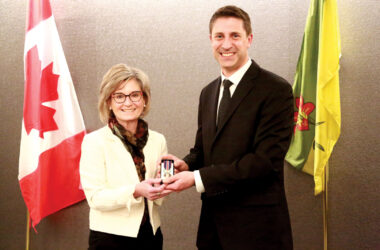
Shantel Lipp, receiving the King Charles III Coronation Medal
Keith Hershmiller Photography

As president of the Saskatchewan Heavy Construction Association for nearly 17 years, Shantel Lipp has developed a reputation as a fierce advocator for the industry.

“Shantel has grown with the association and made so many great contacts,” said Allan Barilla, the general manager of Morsky Construction Ltd., a director on the SHCA Board of Directors, and a member-at-large on the Western Canada Roadbuilders & Heavy Construction Association (WCR&HCA) Board of Directors. “I call her tequila in a teacup, she calls a spade a spade and she has a reputation for that. I think most government officials appreciate the honesty she brings to the table in our meetings.”

Barilla commends Lipp for the efforts she’s made to develop her network for the benefit of the association. “She has made amazing in-roads with government officials,” he said. “It’s nice to be able to text any MLA, including the premier’s staff, and get an immediate response. If the industry has issues, she has access to the right people to try to help with the situation.”

And, of course, the industry has had issues. With those issues, SHCA can point to advocacy wins that benefit not only SHCA members, but everyone working in heavy construction in Saskatchewan.

“Just after COVID hit and inflation started to go crazy, the diesel fuel prices started to climb,” said Lipp. “A lot of the suppliers – especially those producing the material to lay on the ground – use a lot of fuel in their operations. They were hemorrhaging cash. And the government said, ‘Well, that was your bid price. They were reluctant to provide any supplement to help offset the increased costs.’ But our members needed help, so we kept pushing and kept meeting with officials.

“I do my job like everybody else does theirs. You never do it thinking you’re going to get any kind of an award nomination out of it.”

Shantel Lipp

Finally, it got to the point where we were left no choice and took our plea to the radio, calling on the government to work with the industry, and to remind the public of how important safe, reliable transportation infrastructure is to the economy and to public safety. We asked the public to make their voices heard and to call their local MLA. We also shared this message with our members, and phones did ring.

“We were backed into a corner and had to poke them. That got their attention.”

But those efforts paid off. Officials came back to the table. “Together, we worked out what was reasonable,” said Lipp. “We said we understood that inflation was hitting everybody hard – not just us – and we weren’t asking for the moon. We asked to meet in the middle so that people could continue to work. Initially, they weren’t willing to do that, but sometimes you have to ruffle a few feathers to get the odd egg.”

In the end, SHCA worked with officials to revise industry consumption rates to reflect more realistic, mutually beneficial figures. The payment schedule was also changed to monthly instead of at the completion of each phase of a project. In another recent example of an advocacy win by SHCA, the Regina city council proposed a fair wage policy in 2022.

Lipp explained to city officials that a fair wage policy would hurt the heavy construction industry and was unnecessary given that competition for labour in the province was tight and, as such, employers already recognized the need to pay people well. Secondly, contracts awarded by the City of Regina are typically with a general contractor, who then enlists subcontractors. A general contractor would have difficulty providing wage information for the employees of its sub-trades. Third, mandatory apprenticeship requirements could not be applied to the industry, because heavy civil construction does not have apprenticeships or journeyman designations for occupations outside of heavy equipment mechanic positions.

Lastly, Lipp explained how employees in the industry are compensated, which is based on skill, training, experience and the type of work they undertake, and that those factors are also weighed against the market. Lipp’s submission to council ultimately led to the defeat of the motion.

Building relationships

Lipp says that her government relations strategy boils down to a common-sense approach. “It’s respectful conversation,” she said. “When we first go into a meeting, we never go into it confrontationally – it’s business. Sometimes we’ll disagree in a meeting, but you always need to maintain a level of respect, and if a conversation ever slides off the rails, it’s time to stop. Regroup and come back with a fresh perspective. I’ve tried hard to never be disrespectful, but I will make it known that I disagree, or I will give my opinion.”

Shantel Lipp speaking at podium
Keith Hershmiller Photography

If she feels like her message isn’t being heard, she’s willing to escalate. “When [we feel] the government stops listening, that’s when you start to have a problem, and then you have to decide how you need to get your message out. Sometimes, you have to poke them – it’s very rare, and we don’t like to do that, but sometimes you just have to.”

Driven by passion

Lipp points to one thing that fuels her when it comes to fighting for the industry.

“The members,” she said. “If you stop and talk to anybody who belongs to the association – whether they’re a supplier or a road builder – they’re inspiring people. They’re all so down to earth and relatable, and very humble. They just want to do a good job. They make a good living doing what they do, and I rarely come across anyone involved in the industry who doesn’t feel the capacity to give back to the communities they work in or that they come from. They’re humble, hardworking people – and it’s really easy to advocate for folks like that.”

A seat at the table

When Lipp first started working at SHCA in 2008, she says there was an “acceptance period.”

“When I first started, SHCA was going through a change,” she said. “They had an executive director, who managed the office, but SHCA revised the role and created a president role, which would be a CEO. This still included running operations, but it also included advocacy to the government and being the ‘face’ of the association. I became the person the government went to when they need to consult, or the person members went to when they needed to deal with the government. That was a transition.”

“Shantel Lipp is one of those people whose work is all around us, yet is seldom appreciated. The roads and infrastructure we all use and that keep our Saskatchewan economy strong are due, in part, to her nearly two decades leading SHCA.”

Michael Kram, MP for Regina–Wascana

Despite the occasional head-butting during board meetings, Lipp says she’s never felt like she wasn’t listened to or that her opinion wasn’t valued.

“When I look across the board, or across Canada at the other heavy construction or road building organizations, they’re all led by men. I’m the only woman at the table,” she said. “And I’ve never once been made to feel like I can’t share my opinion. As a matter of fact, I’ve been encouraged to be more vocal and that my input is valuable. It’s been great to have these working relationships with my peers.”

Recognized for advocacy

In January 2025, Lipp was surprised to learn she was nominated for the King Charles III Coronation Medal and that she would be a recipient of the award. The medal recognizes people who have made a significant contribution to their community. “I was totally unaware,” she said. “It was a bit of a surprise!” More important to Lipp is the person who nominated her – Member of Parliament for Regina–Wascana, Michael Kram.

“I’ve been honoured to have a close working relationship with Shantel since I was elected,” said Kram. “She’s an inspiring figure in Saskatchewan industry. I’m pleased to see her recognized for her dedication with the King Charles III Coronation Medal.” Lipp is grateful that Kram put the spotlight on the industry.

“I’m more impressed about the nomination than the award!” she said. “The fact that it came from one of our federal MPs. Somebody was paying attention and listening to what we have to say. For SHCA, that there’s recognition this industry is important – it’s important to the province, it’s important to the cities, it’s important to the country. To be recognized for the work we do, it’s really, really important.”

Kram gives credit to Lipp for the work she’s done for Saskatchewan. “Shantel Lipp is one of those people whose work is all around us, yet is seldom appreciated,” said Kram. “The roads and infrastructure we all use and that keep our Saskatchewan economy strong are due, in part, to her nearly two decades leading SHCA.” Barilla agrees.

“This recognition is well deserved for the work she has done in our province,” he said. “Our members sometimes don’t grasp how instrumental Shantel and the association are in making big changes in our province – changes that benefit our industry and the people in Saskatchewan.”

Lipp received the medal in a ceremony at the Atlas Hotel in Regina.

“I do my job like everybody else does theirs,” said Lipp. “You never do it thinking you’re going to get any kind of an award nomination out of it. But it was really nice to be recognized – and more so from an industry standpoint, to have someone at the federal level acknowledge the efforts that I put forth on behalf of the association. It’s also recognition of the association and the industry overall, which is a bigger feather.”

by Jill Harris Jill Harris

Woman of Asphalt

Engineering, science and construction have historically been male-dominated industries – and while that continues to be true today, change is happening. The asphalt industry is no exception; men comprise the majority of the workforce, and women working in the industry saw a need to support one another.

Amy Miller, P.E., MBA, is the president of the Asphalt Contractors Association of Florida. In 2017, she discussed the idea of forming Women of Asphalt, a platform to help recruit, educate and promote women in the asphalt community. “For me, I’ve often found myself being the only woman in the room or the only woman on a team,” said Miller. “I have a great appreciation of working with men but was missing the collaboration and opportunity to bounce ideas and thoughts off of other women.”

Miller connected with a group of ladies who believed the asphalt industry needed an established group to support women. The group hosted a couple of events during World of Asphalt in 2017 – a roundtable and an expo mixer – which sparked a lot of interest. “We knew we needed to move forward,” said Miller. “[Today,] Women of Asphalt is an established 501c-6 organization that focuses on empowering women in asphalt careers.”

Miller says that the challenges women face in the asphalt industry pivot around working in a male-dominated field. “Women tend to think differently than men and often have personal responsibilities different than men,” she said. “Women of Asphalt provides support through our ‘Lead and Inspire’ webinar series, mentoring program and through state branches that give women opportunities to create relationships and friendships with other women facing the same challenges.”

Local branches

Miller says the state branches of Women of Asphalt are the organization’s greatest achievement. “After starting the national organization, we quickly realized we needed [local presence],” said Miller. “At the national level, we bring a host of resources, but we felt people needed face-to-face interaction. The branches provide opportunities for relationship growth and career enhancement, and many of these branches are hosting philanthropic activities to help their communities.”

Currently, there are 22 state branches, representing 26 states, with the organization’s goal being to reach all 50 states. And eyes are on Canada. Canadian women have been involved in Women of Asphalt since the organization’s inception, and over the years, interest has continued to grow. Ania Anthony, M.Sc., P.Eng., is the director, Materials and Surfacing for the Ministry of Highways in Saskatchewan. She, too, knows how challenging it can be to be the only woman on a crew, on a project, in a meeting or in an office. “It’s especially hard when you are new to the industry,” she said. “Even when you’re made to feel welcome, it’s a different dynamic than when there are more women present.”

Ania Anthony, M.Sc., P.Eng.

“It’s getting more and more challenging to attract and retain skilled workers, and competition for good people is high. The trick is not only to hire [women], but to create an environment where women want to come and work, where they feel like they belong, feel valued, want to stay, and can grow and thrive.”

– Ania Anthony, M.Sc., P.Eng., Saskatchewan Ministry of Highways

Anthony met a U.S. colleague during a technical conference in 2022, who, after hearing about her background in asphalt pavements and materials, suggested that she connect with Women of Asphalt. Anthony reached out to Miller, and with more than 50 Canadian members of Women of Asphalt at the time, the pair agreed it would be beneficial to form an official Canadian chapter.

“As an active and long-time member of the Canadian Technical Asphalt Association [CTAA], I immediately saw the opportunity to partner – with mutual benefits to both organizations – to create a Canadian chapter of Women of Asphalt under the CTAA umbrella,” said Anthony. “After pitching the idea to several CTAA board members – four of whom are women – we put forward a written proposal for the CTAA board’s consideration.”

The board approved the proposal and is currently in the process of finalizing the branch’s structure. “We are so excited to be starting the Canadian chapter,” said Anthony. Their first official event took place during the CTAA 2023 conference in Charlottetown, P.E.I., in November 2023. CTAA plans to hold a Women of Asphalt event annually during CTAA’s conferences. “CTAA conferences are known for quality technical content and excellent networking opportunities,” said Anthony. “The conferences are held in a different province each year. The 2024 conference is in Edmonton – consider sending your staff and spread the word!”

Women of Asphalt will also host its first “Women of Asphalt Day” in conjunction with the 2024 World of Asphalt event in Nashville, Tenn., which takes place March 25–27. 

Benefits to industry

It’s not only women who benefit from groups like Women of Asphalt. “Supporting women in the Canadian asphalt industry promotes diversity of our workplaces,” said Anthony. “Countless studies confirm that diversity – at all levels, including in senior leadership roles – is good for business.” She points out that women are an untapped well of capable workers in the asphalt industry.

 Amy Miller, P.E., MBA

“I have a great appreciation of working with men but was missing the collaboration and opportunity to bounce ideas and thoughts off of other women.”

– Amy Miller, P.E., MBA

“It’s getting more and more challenging to attract and retain skilled workers, and competition for good people is high,” said Anthony. “The trick is not only to hire [women], but to create an environment where women want to come and work, where they feel like they belong, feel valued, want to stay, and can grow and thrive.”

Miller agrees, adding that Women of Asphalt aims not only to increase the workforce, but also to improve it. “We network and create stronger relationships between people and companies, and we provide resources that enhance the industry’s employees through career and personal growth,” she said. “Knowing you are not alone, sharing interests and ideas, mentoring and learning from each other – these are all important supports to help women stay and thrive in the asphalt industry,” said Anthony.

Get involved

Women of Asphalt does not charge for membership – to join, simply visit womenofasphalt.org and click “Join Now!” Membership is open to women as well as men. “Our model is different than other organizations,” said Miller. “We have generous partners who provide funding to support our efforts, allowing us to extend membership to more than 3,000 people. We’re so appreciative of the financial support offered by our partners – we couldn’t exist without them.”

Anthony agrees, adding that the Canadian branch will need support. “We want to provide opportunities for interaction between our Canadian members, in person and online, and are already planning our activities for 2024 and beyond,” she said. “We welcome industry support and participation, and in fact, without it, I cannot imagine a successful and thriving branch.” Anthony says that the biggest form of support is to promote the organization internally within the workplace, and to support women and allies who want to become members and participate in Women of Asphalt activities. Miller also asks for current and future Women of Asphalt members to consider committee participation.

“We will be sending out a solicitation to our members asking for assistance in some of our committees,” she said. “The participation will be solely through online meetings. We would love to have some of our Canadian members participate. This will give us the opportunity to get help and input from our members and offer them the chance to meet other women. Keep your eyes open!”