by Paul Adair Paul Adair

Doka Builds the Future

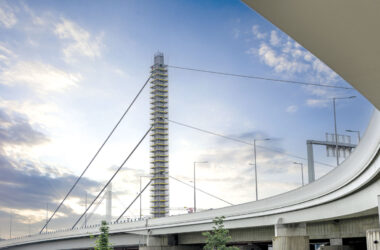
Building and scaffolding viewed from beneath an overpass

Evolving from humble beginnings in 1868 as a small sawmill and woodworking shop in Austria, Doka – part of the Umdasch Group – has since been involved with some of the most significant infrastructure projects around the world, from tunnels in Australia to high-rises in North America.

Doka built its reputation on cutting-edge, ground-breaking formwork systems used in power plants, bridges, tunnels, and skyscrapers, including Dubai’s Burj Khalifa, the tallest building in the world at 828 metres. However, since 2023, Doka has expanded its offerings and positioned itself as a one-stop shop for formwork and scaffolding solutions for construction companies. Now with more than 160 sales logistics facilities in over 50 countries and more than 8,000 employees, Doka has become an international leader in formwork and scaffolding solutions. Its highly skilled global team delivers advice, engineering, customer service and technical support for even the largest and most complex projects.

Doka had the opportunity to introduce and showcase the latest scaffolding offerings at Bauma 2025 in Munich, Germany. Two products and services of note were the innovative Ringlock system and the digital solutions for higher productivity on-site.

Making connections

Ringlock allows users to quickly and efficiently erect, use and dismantle temporary work structures to create a secure working area for various applications, from façade scaffolds, stair towers and rebar scaffolds to shoring and birdcage scaffolds. It also delivers shoring performance, with a capacity up to 540 kilonewtons. Based on the rosette and wedge-head locking mechanism, Ringlock has been continuously refined and enhanced, undergoing multiple iterations to meet the highest standards of performance and safety, and is designed to meet global standards, such as:

The Ringlock system is engineered to meet the highest quality standards based on three simple factors: material, fit and finish:

  • Material: Ringlock only uses the highest quality steel certified and tested, demonstrating qualities that conform to or exceed industry standards, regardless of location or climate.
  • Fit: Ringlock is engineered with versatility and usability in mind, which increases efficiency and productivity to save projects time and money.
  • Finish: Where applicable, Ringlock is finished and protected by hot-dipped zinc galvanizing, which maximizes the product’s utilization and extends its life.

“Engineered to international codes and independently certified, Ringlock ensures safe, efficient scaffolding solutions for projects of any scale,” said Doka Canada’s head of sales, Warren Calderone. “Available immediately to support construction companies with safe access solutions, it perfectly complements our formwork systems and serves as a flexible solution for day-to-day shoring projects.”

The strength of Ringlock is in its versatility. The system’s streamlined and straightforward connection method ensures all main components can lock securely into place with a hammer strike, which eliminates the need for bolts, screws or mechanical tools. Ringlock also supports a wide range of scaffolding assemblies by using primarily core components that can be easily adapted to different load requirements, ensuring flexibility and efficiency for projects of all scopes. In addition, Ringlock adjusts to intricate and irregular structures and fits seamlessly around tight corners, obstacles and unique architectural features for maximum site efficiency.

“Ringlock is designed to seamlessly complement Doka’s engineering expertise, providing a well-rounded and dependable solution,” said Calderone. “The Ringlock rosette and ledger connection is key to our system and has been engineered to optimize structural performance and reliability. Our modular system – including standards, planking and ledgers – is designed for easy handling, fast assembly and optimized transportation. With a broad portfolio of accessories, it can be adapted for every application, making it movable, versatile and safer on the jobsite.”

All primary components are also hot-dip galvanized, protecting against corrosion and extending service life in challenging environments. Together, these innovations deliver a system with enhanced stiffness, higher load capacity and consistent performance across applications.

A digital solution

Scaffolding is shifting from paper processes and percentage-based costs to a digitally managed discipline. While modular systems remain the backbone, digital tools like Building Information Modelling (BIM), the Internet of Things and software-as-a-service platforms drive greater cost predictability, safety and risk management. 

“We fully integrate scaffolding into BIM for planning and clash detection. In addition, clients looking for examples of deeper digital visibility, solutions such as AT-PAC’s Hi-Vis® demonstrate how forecasting, manpower planning and analytics can be achieved by pairing physical systems with digital oversight,” said Calderone.

Digital solutions are also transforming how scaffolding is managed on construction projects. Beyond traditional software or platforms, systems like AT-PAC’s Hi-Vis® demonstrate how a digital ecosystem can bring transparency, efficiency and control to scaffolding operations. Tools like these enable real-time electronic scaffold requests, resource tracking and material management, helping project managers deploy scaffolding more effectively and maximize productivity. By focusing on planning and process controls, these digital solutions show how scaffold management can scale to projects of any size.

Closeup of DOKA label on steel rod
Photo: DOKA

“Regulators today demand not only strength in scaffolding products, but also traceable compliance,” said Calderone. “Digital systems that incorporate rigorous testing, QR-coded tagging, inspection logs and safety reporting provide full accountability while giving crews and managers instant visibility into scaffold status and usage. This added transparency supports greater efficiency, safer operations and more predictable outcomes on complex projects.”

Doka is a pioneer in integrating digital engineering, operations and site solutions to drive smarter, safer and more efficient construction. One example of this is Doka Concremote, which uses sensors to measure temperature and calculate the compressive strength of concrete in real time.

“By combining a selection of sensors tailored to diverse project challenges with powerful software, Concremote provides a reliable decision-making basis directly on site,” said Calderone. “Through its native app and web portal, teams gain instant access to real-time data and advanced functions, enabling forward-thinking construction processes and boosting overall productivity.”

Doka also provides hands-on training, e-learning, BIM support and onboarding for digital tools tailored to the specific needs of a project or the customer. With Doka 360, Doka takes the customer journey digital, making every step seamless and transparent. The new customer platform connects every stage of the formwork process, from planning and ordering to delivery and return. Real-time data from sensors embedded in formwork or concrete flows directly into the system. This gives customers complete visibility and supports informed, data-driven decisions. Doka 360 was launched in July 2025 with an exclusive early access phase for selected partners in Germany and the U.S.

AI on the worksite

Doka’s modular systems are reusable and long-lasting, and most of its products are also rentable, an attractive option for many concrete contractors because of its efficiency and flexibility. Rented material can also re-enter the supply chain, and contributes to a more circular economy where materials are reused rather than replaced.

However, rented material presents significant logistical challenges, as rented equipment returned to Doka facilities is inventoried and made ready for redeployment. These returned materials have traditionally been counted by hand, requiring a significant investment in time from Doka team members. To speed up the process, Doka has developed its own in-house AI tool, “AI Counting and Identification,” which is supported by Microsoft’s technology expertise. 

AI takes all the work out of manual counting in three steps:

  1. A team member takes a photo of the materials with a mobile device.
  2. The AI tool recognizes the product, suggests a count and, once confirmed, records the result along with the image.
  3. A precise and reliable digital record is created.

“We’re excited to begin exploring the use of AI to improve how we manage counting in the yard and warehouse,” said Jeremy Jeffries, head of operations for Doka Canada. “These tools give us new ways to reduce manual effort, improve accuracy and bring more consistency to our inventory processes.”

Although the system is currently being used internally at Doka yards, the company sees strong potential for future use directly on construction sites. Live demos and early feedback from Bauma 2025 have highlighted where the service could create added value, especially on large-scale projects with high material turnover.

Safety: Prevention through Design

Doka’s Prevention through Design (PtD) philosophy redefines how safety is engineered into every scaffold, formwork and workflow, not as an afterthought or merely to check a box, but as a proactive design principle. The engineering and quality that goes into each of Doka’s products ultimately deliver safer scaffolding solutions.

“Load, geometry and re-use are critical, and all our products are designed with the customer in mind,” said Calderone. “For example, on major energy projects, pairing Ringlock with our digital inspection tools has been shown to cut scaffold-related incidents by nearly a third. Crews have clear instructions, supervisors have real-time compliance and their projects run safer and more efficiently.”

Doka applies its PtD philosophy in three ways:

  • Engineering formwork and scaffolding systems that minimize fall risks, collapse hazards and manual handling injuries.
  • Designing intuitive, modular and tool-free componants, reducing the chance of misuse or assembly errors.
  • Integrating guardrails, access platforms and anti-slip surfaces directly into their systems so that safety isn’t optional; it’s built in.

The company is proud of the engineering and operational expertise it brings to each project and product. As part of this, Doka provides contractors with the hardware and know-how they need to use its formwork and scaffolding safely and effectively.

“Every Doka component is engineered for safety, and we design the workflow – from digital work packages to inspection logs – to be safe, embedding prevention before crews even step on site,” said Calderone. “We also engineer beyond code requirements and certify independently. On top of that, our digital protocols ensure safety data is visible and verifiable in real time.”

Sustainability going forward

Sustainability is not a trend for Doka. It is a mindset. With a clear strategy, shared vision and innovative solutions, the company supports its customers in achieving their sustainability goals.

Doka understands that to reduce emissions effectively, the company must first identify the greenhouse gas emissions its products generate throughout their lifecycle. To accomplish this, Doka has set new standards for climate-friendly product design by calculating the product carbon footprint for more than 7,000 products, as well as providing customers with independently authenticated data to make informed decisions. Because of this, Doka designs its products to last in the Canadian climate, even under the harshest jobsite conditions. 

“We are very conscious of the lifecycle of our products and their impact on the environment. The advanced materials and metallurgy used in our scaffolding are built to last a lifetime, delivering long-term reliability that benefits us, our customers and the planet,” Calderone said.

Doka’s expertise in professional refurbishment and repair also helps extend its product’s lifespan and reduce the need for new resources. Looking ahead, Doka is also working on bringing recycled materials into its products’ life cycle to mitigate the company’s carbon footprint further. 

“But there’s a lot going on behind the scenes, too,” said Calderone. “As an organization, we have set an ambitious goal of achieving net zero emissions by 2040. In 2024, we became the first formwork and scaffolding company worldwide to commit to the Science Based Targets initiative, and we will have our targets scientifically validated within the next 24 months.” 

by Paul Adair Paul Adair

From Farms to Far-Off Lands

How Ritchie Bros. Auctioneers transformed equipment auctions

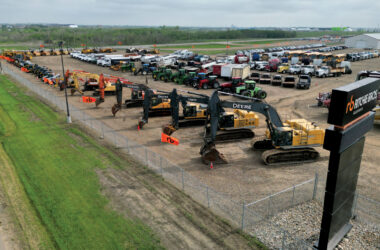
Rows of vehicles in Ritchie Bros. Auctioneers compound
Photo: Ritchie Bros. Auctioneers

In 1958, the three Ritchie brothers – Dave, Ken and John – owned and operated a furniture store in Kelowna, B.C. At the time, the store was having financial challenges, so they decided to liquidate the store’s inventory to pay off some debt. This was the brothers’ first auction.

Now, after more than 65 years since closing the furniture business, Ritchie Bros. Auctioneers has grown to become one of the largest heavy equipment auctioneers in the world, as well as a premier destination for pre-owned construction equipment.

“The brothers went through a couple of iterations auctioning off a variety of commodities until they found their niche and landed on the heavy equipment side of things,” said Jason Huber, Ritchie Bros. regional sales manager – Saskatchewan and Manitoba Industrial Division. “Ritchie Bros. recognized a need in Western Canada for someone to form a marketplace where sellers could part with equipment that they no longer needed, and buyers could acquire that equipment through a public, transparent and unreserved auction.”

“The reality is, because we are not tied to a specific brand, type or industry, nobody sells more heavy yellow iron and heavy trucks and trailers than we do at Ritchie Bros., thanks in large part to the support of SHCA members.”

– Jason Huber, Ritchie Bros. Auctioneers

In the 1980s, Ritchie Bros. went through a period of expansion, setting up shop in the United States in Texas, California and Florida. To this day, the company’s February Orlando Sale is one of the largest events of its kind in the world, seeing thousands of pieces of equipment and hundreds of millions of dollars of transactions occurring over a six-day period. Building on its success over the years, Ritchie Bros. now has operations across North America, Europe, Asia, Australia and the Middle East.

Global reach, local perspective

Despite its growth, Ritchie Bros. maintains a strong Prairie presence. The company has three major yards in Saskatchewan at Saskatoon, North Battleford and Rouleau. Ritchie Bros. employs approximately 100 people in the province.

“Because of our agricultural background, Western Canada is probably the most auction savvy market in the world,” said Huber. “There’s no question that farmers, as a rule, love auction sales. They remember their dads dragging them to sales when they were kids. They remember the smell of pies and burgers in air and the sounds of auctioneers calling out, and for many it was just a big community social event. This nostalgia for auctions continues to be strong across the Prairies, especially in Saskatchewan, which remains a very dominant market share in our auction space – rivalling anywhere else in the world.”

Dozens of vehicles lined up in Ritchie Bros. Auctioneers compound
Photo: Ritchie Bros. Auctioneers

This global presence is what sets Ritchie Bros. apart from the competition. There are a lot of auction houses that can find homes for equipment, but their reach is generally limited to a local audience. This is not the case for Ritchie Bros., where equipment can be sold in Saskatchewan and potentially be sent anywhere in the world.

“It’s not unusual to see our sales end up in another country – we often see something like older Caterpillar equipment ending up in the Middle East,” said Huber. “It’s always a highlight when we see far away places pop up on the map whenever the bidding happens. It’s a real treat when we go back to our customers and say, ‘You know that piece of equipment that you had in your fleet that you got rid of? It’s going to Vietnam or it’s going to Mexico City, or Dubai.’ They usually get a kick to hear where it all ends up.”

Working with members

Ritchie Bros. has long been a member of the Saskatchewan Heavy Construction Association (SHCA), its members often seen at auctions bidding on equipment.

“The members of this association are, by and large, our customers and people who we go to see and visit with on a regular basis,” said Huber. “The reality is, because we are not tied to a specific brand, type or industry, nobody sells more heavy yellow iron and heavy trucks and trailers than we do at Ritchie Bros., thanks in large part to the support of SHCA members.”

Rows of tractors lined up in Ritchie Bros. Auctioneers compound
Photo: Ritchie Bros. Auctioneers

Ritchie Bros. is not only a source of equipment. Because the company is not just a single dealer with a specific brand, and sells all brands, makes and sizes, Ritchie Bros. has a unique vantage to see where the market is going. As such, many of the questions Ritchie Bros. receives from SHCA members and customers revolve around how the market is doing and when the best times to buy and sell might be. Answering those questions is a team in the background of Ritchie Bros that has its finger on the pulse of emerging trends in dealer inventory or Original Equipment Manufacturer output, as well as an eye on which direction prices are heading.

This expertise was especially useful in the face of the extreme supply and demand disruption caused by the COVID-19 pandemic.

“We are still coming out of what is likely the most chaotic market that we’ve ever been a part of,” said Huber. “There was such a scarcity of equipment during COVID-19 that, no matter the condition, everything for sale brought in top dollar and the sellers were kept very happy. In recent months, however, the pendulum has swung and the companies that paid inflated prices are being hit by heavier interest rates – in some cases that results in bankruptcies and more equipment going to auction. This means we are seeing prices levelling off as the supply of yellow iron and core construction gear goes up and, while prices remain strong, it’s nowhere as crazy as it was during the pandemic.”

The evolving auction

With customers becoming accustomed to online applications like eBay, Kijiji and Facebook Marketplace, Ritchie Bros. has been watching the auction space slowly evolve for years. However, the pandemic accelerated the pace of that evolution.

Where the local auction was once a must-attend event that drew crowds, much like a travelling circus, the trend today sees people wanting to go online on their computers and smartphones to bid on equipment. Ritchie Bros. has made it simple for people to bid at RBauction.com from their homes and offices, the front seat of their trucks and even their combines, as auctions today have become more of a transactional activity as opposed to a social event.

“The auction business has certainly changed post-COVID,” said Huber. “Auctions used to be a party that we would hold multiple times a month. Now, they have people watching what’s going on from their computer screens and there’s not a lot of interacting with other human beings.”

“It’s not unusual for us to run into a second or third generation contractor that still [has] the very first grader that their dad bought to start the business, and there is an absolute emotional attachment to the past – we help them work through that and make the auction a positive experience.”

– Jason Huber, Ritchie Bros. Auctioneers

While the day of sale may be different in the business of auctioneering, there is still a very human element behind the scenes in the leadup to auction day. The real thrill for those working at Ritchie Bros. is getting to work one-on-one with the contractors who may have excess equipment or – better yet – are at a point in their career where they’re eyeing retirement. When that happens, Ritchie Bros. works with the customer to make sure they can end their careers on a proper note and, whether it’s been five years or 50 years, the auction house takes pride in giving them the public fanfare they deserve for a career well lived.

“And at the end of the day, if we’ve done our job right, the conversation post sale with the customer, more often than not, leads to tears or gratitude from the person or their spouse or their family, and sometimes a little sadness,” said Huber. “It’s not unusual for us to run into a second or third generation contractor that still [has] the very first grader that their dad bought to start the business, and there is an absolute emotional attachment to the past – we help them work through that and make the auction a positive experience.”

The road forward

Looking ahead, Ritchie Bros. aims to continue providing the same global reach and personalized service that has brought it success over the years. Part of this means continuing its strategic expansion into new areas. In 2023, Ritchie Bros. completed a significant acquisition of IAA, Inc. (IAAI), which brought the company into the salvaged car business.

“IAAI was the number two salvage car company in North America,” said Huber. “So, we now have this whole division of salvage car that opens up other opportunities for us throughout North America – and around the world – in terms of our ability to come to scale, in terms of a real estate footprint, and in terms of what we’re able to offer our customers when it comes to service levels and the ability to remarket their equipment, whether that’s an auto or a bulldozer.”