by Pat Rediger Pat Rediger

Paving the Way Forward

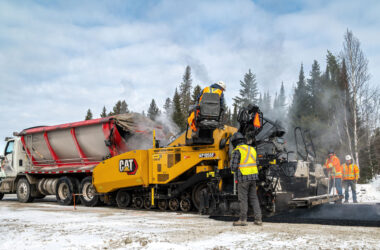
Construction crew paving road
Photo: Red River College POLYTECHNIC

From scorching heat in the summer to blasting winter cold, road builders in the Prairies have some of the toughest paving conditions to contend with. Asphalt is more than just a surface layer; it’s a material that must endure the full force of nature over a long period of time.

This is one of the subjects that’s under close scrutiny at the Centre for Applied Research in Sustainable Infrastructure (CARSI) at Red River College Polytechnic in Winnipeg, Man. CARSI provides applied research and education, connecting the classroom with real-world challenges in the construction industry.

The centre is structured into three main areas: pavement materials, structural construction materials and building construction innovation. The lab was originally focused on supporting the aerospace and manufacturing industries, but it has a growing emphasis on asphalt concrete pavement research.

Bahador Barbod, a municipal engineering instructor at the college, says CARSI’s mission is to prepare students for industry while generating practical knowledge that benefits public and private stakeholders. “Students who take our pavement materials courses don’t just study theory,” he said. “They engage in asphalt mix design, evaluate the challenges that come with it and conduct tests using the lab’s advanced equipment.”

Barbod says CARSI delves into a wide range of research projects, including comparative studies on asphalt density testing methods, investigations into self-healing asphalt using calcium alginate and the development of cold mix asphalt, suitable for low-temperature applications. One area of his particular areas of interest involves incorporating recycled materials such as reclaimed asphalt pavement into new mixes, a direction that aligns with sustainability goals while meeting industry demands.

The real-world implications of this research are significant. Much of the lab’s work is driven by the goal of enhancing the durability of construction materials and reducing long-term maintenance costs. Barbod says that while asphalt is widely used, its performance over time – especially under the unique freeze-thaw cycles common to the Prairies – remains a challenge. CARSI’s testing equipment contains a large programmable environmental chamber capable of simulating both high and low temperature conditions.

This chamber is divided into two separate spaces, allowing simultaneous tests at vastly different temperatures. Asphalt samples placed in the chamber undergo rigorous freeze-thaw cycles, mimicking the real-life stressors found on prairie roads.

Much of the lab’s work is driven by the goal of enhancing the durability of construction materials and reducing long-term maintenance costs.

Barbod and his students use the equipment to examine how new asphalt formulations behave under the harshest conditions. By observing how materials crack, deform or deteriorate, CARSI researchers can make more accurate predictions about long-term performance and help shape better material specifications. It should be noted that the chamber isn’t limited to asphalt since it’s large enough to accommodate concrete beams, window frames and other structural components for testing.

As this research continues, Barbod says he hopes to build stronger relationships with the private sector. Although CARSI maintains ties with Manitoba Transportation and Infrastructure, its connections with private road builders have been limited. “One thing that’s a little bit challenging for bringing the industry into our research is that students go through the co-op program in the summertime, and asphalt construction is usually shut down in the winter. That’s when students are in college, so we don’t always have that connection between the industry and the college,” he said.

Still, Barbod sees plenty of opportunities for collaboration, such as increased relationships between academic researchers and industry stakeholders, where student-driven projects can address real-world problems and inform construction decisions. Final reports and presentations are already shared with any interested partners, and Barbod invited road building companies to attend student presentations or propose research topics that align with their needs.

Various learning tools inside the classroom
Photo: Red River College POLYTECHNIC

CARSI’s impact also extends into workforce development. Students involved in pavement research gain experience in both Marshall and Superpave mix design methods. They learn how to troubleshoot mix performance, test various additives and compare results using industry-standard lab technologies. Graduates leave the program with a comprehensive understanding of construction materials testing, as well as practical experience that gives them a competitive edge in the job market.

The lab’s commitment to skill-building is especially important as the construction industry continues to face a growing demand for technically trained professionals. Barbod says students leave the program with both theoretical knowledge and extensive hands-on experience in asphalt and concrete mix design.

“Students come out from the CARSI lab usually with a complete understanding of construction material testing,” he said. “They experience all of those tests themselves and get the theory and practical knowledge of the mixed design for asphalt and concrete both.”

Looking ahead, the lab has ambitious goals. Barbod says he is interested in researching the use of nanomaterials in asphalt mixes and how these microscopic additives could improve performance properties like elasticity and resistance to cracking. He’s also interested in further research of cold mix asphalt solutions, which remain underused in the Prairies despite their potential to reduce costs and enable off-season construction. If CARSI can demonstrate consistent performance under lab conditions, Barbod says he hopes to help shift industry perceptions and encourage broader adoption of these alternative materials.

Another priority is securing new testing equipment to enhance CARSI’s analytical capabilities. With enhanced tools, the lab could provide even more detailed insights into mix performance and lifecycle costs. This is information that would be valuable to municipal planners, contractors and engineers looking to stretch their infrastructure budgets further.

As CARSI continues to grow, Barbod hopes this will lead to closer ties between the institution and the heavy construction industry. “There’s tremendous value in aligning what we do in the lab with what’s happening in the field,” he said. “We want to be a resource for road builders. Whether it’s improving asphalt durability, reducing maintenance needs, or training the next generation of professionals, we’re here to support the industry.”

by Pat Rediger Pat Rediger

Redefining Work-Life Balance for Men in Construction

A worker in safety gear is kneeling on dirt, focused on laying a foundation as the sun sets in the background.
yourapechkin/123RF

Working in the deep foundation construction industry is not for the faint of heart. There can be intense demands and long hours, and balancing professional and personal lives can be challenging for men in these situations.

But Trevor Mayoh suggests that fostering a culture that supports work-life balance for men is being increasingly recognized as crucial for both well-being and productivity.

Mayoh is a principal consultant at Equity Leaders, the consulting arm of the not-for-profit organization Next Gen Men, which supports companies in building equitable workspaces. His experience working with firms of all sizes across male-dominant fields has shown that while the need for these initiatives is apparent, overcoming cultural and systemic barriers is essential.

One of the most significant barriers to achieving work-life balance is the deeply embedded notion of masculinity. There is often a “tough guy” culture in male-dominant industries, which promotes hard work with self-worth, pushing men to prioritize their jobs above personal well-being.

“There are these pressures to conform to traditional or really rigid ideas of what masculinity is,” Mayoh said. “These are norms that men have learned from various sources over the years, making it difficult for them to prioritize anything outside of work.”

This emphasis on traditional masculinity not only makes men reluctant to seek balance, but can also contribute to mental health struggles when they feel unable to meet these high, often unachievable standards. Mayoh says that while taking time off to recover from physical injuries is considered routine, men in construction jobs often face stigma around taking mental health or personal leave so they often don’t request it.

“If someone blows out their knee, we recognize they need time off. But when someone needs time for mental health, it’s often viewed as a vacation,” he said.

For many men in the industry, this stigma creates a significant hurdle to addressing personal well-being. Mental health leave or flexible working arrangements are often misunderstood or undervalued, leaving men to choose between appearing “weak” or pushing through challenges at the expense of their own health. Without role models who visibly balance work and personal life, men in junior positions often struggle to develop work-life balance in their careers. Senior leaders frequently model overwork, perpetuating a culture where long hours are seen as a badge of honor.

By offering programs that teach stress management, resilience and healthy communication skills, companies can help men feel more empowered to find balance.

Although some leaders tell younger employees to “do what works best for you,” their own behaviour often contradicts this advice. When leaders fail to demonstrate balanced approaches, younger workers may feel pressure to mimic their habits, so the cycle continues. Many male-dominant industries also create the perception that self-care is selfish, so they tend to prioritize work over personal health and time with family. As the main wage-earner in their families, they can feel that they primary role is to be the provider and their own needs become less important.

“They feel it’s selfish to invest in their health or energy when their number one priority is providing for their families.” Mayoh said.

This mindset makes it hard for men to justify a work-life balance, even when it benefits their long-term health. In a culture that equates masculinity with self-sacrifice, choosing self-care can feel like the wrong decision. Addressing these challenges requires companies to foster an environment where work-life balance is encouraged and normalized. One successful strategy Mayoh recommends is to develop flexible work arrangements.

Companies can explore flexible scheduling options or implement “mental health days” to give workers more control over their time. In industries where rigid schedules are common, even small shifts toward flexibility can make a significant difference. Allowing workers to manage their hours, perhaps through compressed work weeks or scheduled rotations, can ease the physical and mental demands of the job.

Mahoy says that role modeling from senior leaders is also crucial to change. When leaders practice and demonstrate balance in their own lives, it gives permission for others to do the same. He says there’s a need for leaders to go beyond verbal encouragement by setting an example.

“Even if leaders tell people to take breaks, their behaviour speaks louder than words. Employees look to their managers for cues, and that’s why the culture is set with them,” he said.

A structured program that encourages senior leaders to model balanced work habits could help reshape perceptions and practices. Setting explicit guidelines, like limiting after-hours emails, can reinforce these norms at all levels of the company.

Boy and man wearing rpotective helmets at a construction site
hannatw/123RF

In collaboration with groups like Equity Leaders, companies can offer workshops on mental health and well-being, specifically tailored to the needs of men in male-dominant fields. By offering programs that teach stress management, resilience and healthy communication skills, companies can help men feel more empowered to find balance. Pairing these workshops with mentorship opportunities where experienced employees share their thoughts on managing work-life balance can also be valuable.

Mayoh says he has seen companies make significant strides by implementing these approaches. For instance, some construction firms have introduced mental health “toolbox talks” at the start of the workday, creating a routine space for open discussion. Others have instituted mentorship programs where senior leaders advise younger employees on balancing professional and personal concerns, helping to bridge the gap between generations.

However, Mayoh says that even well-designed policies can fall short without active engagement. For example, companies may offer workshops that address stress management, fatherhood and mental health. But if people within the organization don’t actively engage in conversations and mutual support, these policies often fail to make a real impact.

Mayoh suggests that leaders can play a crucial role in areas such as parental leave by shifting the conversation from “Are you going to take a leave?” to “When are you taking a leave?” This simple change in language normalizes the idea of taking leave, encouraging more men to take advantage of these benefits without fear of judgment or career repercussions.

This approach not only benefits male employees, but also contributes to gender equity. As more men take leave, organizations become better equipped to handle these absences, and women, who often take longer parental leaves, benefit from a more inclusive, balanced workplace environment.

When companies invest in work-life balance initiatives, both employers and employees experience measurable benefits. For organizations, inclusive and healthy teams have lower turnover, higher productivity and better collaboration, creating a positive return on investment. For employees, participating in these programs fosters stronger relationships with family and friends, better mental health and higher job satisfaction. In fact, engaging in such programs often aligns with career advancement, increased chances of bonuses and overall job satisfaction. Mayoh stresses that support for work-life balance in male-dominant industries should not only come from company leaders but also from within the workforce itself.

“Everyone knows someone impacted by addiction, mental health issues, or work-related stress,” he said.

By framing these initiatives around mutual care and support, companies can encourage employees to see these programs not as a sign of weakness, but as a way to “do right by” their colleagues and friends. 

This article first appeared in Piling Canada magazine and is reprinted here with permission.

by Pat Rediger Pat Rediger

From Hamlet to Big City

McDougall Auctioneers: successful auctions, liquidations and consignment sales across North America

Row of heavy machinery in front of McDougal's Auctioneers facility
Photo: McDougall Auctioneers

The hamlet of Langbank was the backdrop of what would eventually become one of the largest auction houses in the country. In 1982, brothers Terry and Loren McDougall began holding farm auctions in their hometown in southeastern Saskatchewan, and before long, they were doing 30 farm auctions a year. In 1985, Loren decided to move to Regina to pursue commercial auctions as well as farm auctions.

Today, McDougall Auctioneers has upwards of 90 employees with facilities in Regina, Saskatoon, Brandon, Winnipeg, Edmonton, Toronto and Montreal. It is one of the leading auctioneering and appraisal companies in Saskatchewan and has developed a solid reputation for reliable appraisals and for successful auctions, liquidations and consignment sales.

Chad Guay, vice president of sales, says the company stems from humble origins, with consignment sales in various industries and has grown and developed into a broad spectrum of categories ranging from commercial equipment, business inventory and liquidations to real estate and industrial equipment.

“Regina is still our headquarters, and I would say that a lot of our sales still come from the Regina office. We just started Alberta about two years ago. Does Alberta have the potential to surpass Regina? It might someday because there’s much more equipment. That being said, Toronto has a lot of equipment, so that could become more important. But as of right now, Regina is still the predominant leader in our locations,” said Guay.

He says that McDougall is pleased to be an SHCA member and has managed numerous auctions of heavy equipment in the province. Most construction auctions are usually in the $6 million to $7 million range, but the company has had sales of up to $20 million. However, that large of a sale is rare, as a company with that value of equipment would likely be merged or acquired into an existing company rather than sold piecemeal.

Aerial view of McDougal's Auctioneers

Online auctions provide the company with the option to sell equipment where it sits. This enables McDougall to serve customers in remote locations as well as urban centres, regardless of whether or not McDougall has a physical location there.

The biggest change in the industry has been the development of online auctions. Guay says McDougall was a pioneer in this development and introduced its own software in 2011. At that time there was no commercially-available online auction software, so the company had to develop its own, which McDougall maintains.

“Loren was the first one in Canada to use online bidding,” said Guay. “He always jokes around that he should have patented it, as he ended up paying for the software, which made quite a big difference. There are lots of other auction houses out there that use software that is not their own and there will be thousands of companies using that software. We use our own bidding software on our own website.”

Online bidding has continued to increase in popularity since its inception and the COVID-19 pandemic accelerated this approach. As each generation becomes increasingly attached to virtual events, the demand of in-person auctions has diminished. In fact, Guay says McDougall has not held an in-person auction since 2018.

“It’s hard to get people to commit to an entire day for a sale, let alone a five-day sale,” said Guay. “Right now, we are prepping for a five-day sale and it’s almost impossible to get people to commit to attending a sale that is that long. People just don’t have the time or attention to attend that long of an event.”

Online auctions provide the company with the option to sell equipment where it sits. This enables McDougall to serve customers in remote locations as well as urban centres, regardless of whether or not McDougall has a physical location there. In the case of heavy construction equipment, which can come with a steep price tag, Guay says the company makes every effort to ensure that buyers have every tool at their disposal before making a decision. That means providing photos, pertinent information and, if necessary, buyers can still come in-person to see the equipment first-hand.

Row of heavy machinery in front of McDougal's Auctioneers facility
Photo: McDougall Auctioneers

“We take about 75 pictures per asset, and we also have video. Obviously, our video of a backhoe is the backhoe driving forwards, backwards and lifting, but it doesn’t show it digging a hole or a ditch, but you can see if it works or not,” he said.

The other recent significant issue for the heavy construction industry has been high prices due to supply chain issues. As new equipment was difficult to obtain, the demand for used equipment has grown considerably, leading to increased prices at auction sales. Although this appears to be levelling off, Guay says that the numbers will likely remain strong for the coming months. With oil and gas prices remaining high, and U.S. shale oil production on the rise, the demand for equipment should continue.

With online bidding now the norm, the number of international buyers has also been increasing. Even with shipping costs, Guay says the company is selling equipment to buyers from as far away as Pakistan and the United Arab Emirates. McDougall will help facilitate the shipping, but the buyer is ultimately responsible for making their own arrangements. Although there are a number of auction houses in the province, Guay says that McDougall stands apart because of its transparency.

“Anyone can be an appraiser, or sales broker or an auctioneer,” he said. “However, not everyone is transparent, or they won’t back up their appraisals with proposals. We pride ourselves on doing that. When we jot a number down, we’ll back it up.”

Guay says that the company also provides plenty of advice and counselling to customers, especially those who have not gone through an auction process before. There are also various issues and circumstances that can come up and customers often turn to McDougall for their suggestions. “We pride ourselves on providing an answer. A lot of people don’t know what to do in certain situations, so we like to consult as best as we can with the skill sets we have available,” he said. Over the years, the company has been involved in several unique auctions. For example, it auctioned vehicles from the popular television series, Corner Gas, and it sold the giant Saskatchewan Roughriders sign that was removed from the old Mosaic Stadium in Regina.

As for the future, Guay says the company intends to concentrate on expanding its Alberta operations, increasing its presence in Ontario and Quebec, strengthening its market share of the agricultural sector on the Prairies and potentially expanding into the U.S. 

by Pat Rediger Pat Rediger

Paving the Way

In a rapidly evolving construction landscape, where optimism about the industry’s future co-exists with challenges that demand innovative solutions, the release of the How We Build Now: Technology and Industry Trends Shaping Canadian Construction in 2023 report by Procore Technologies, Inc. has significant implications for Saskatchewan’s construction sector.

As the province grapples with its unique set of circumstances, ranging from labour shortages to technology adoption, this comprehensive report sheds light on the road ahead, emphasizing the need for diversity and inclusion programs and the integration of cutting-edge technologies to navigate the industry’s transformation. “Although Saskatchewan may be less of a hotbed compared to the total construction that is going on across the country, we see that the province is essentially experiencing the same issues as elsewhere,” said Brandon Lee, senior manager of customer success at Procore.

Image courtesy of Procore Technologies Inc.

The report, a result of extensive surveys and analyses, underscores the industry’s overall positive sentiment. Out of the over 500 respondents, consisting of owner/developers, general contractors and subcontractors, nine out of 10 expressed confidence in the industry’s conditions for the coming year.

This optimism can be attributed to several factors, including the initiation of large-scale projects such as the Ontario Line subway and clean energy ventures in British Columbia. The growing immigrant population is also driving demand for housing and infrastructure. These factors, coupled with an existing labour shortage, are adding to the industry’s backlog of projects. Lee says that despite industry optimism, the data indicates there is a clear call for embracing technology to address crucial challenges. The survey shows 27 per cent of the total time spent on a project is used for rework or rectifying issues.

Image courtesy of Procore Technologies Inc.

Other findings revealed that almost half of all projects go over budget and over schedule, and over 30 per cent of respondents identified needing new technology to improve operational efficiency and cost controls amid economic volatility. In fact, paper remains a common medium for Canadian construction decision-makers. About a quarter of respondents still use paper-based records or non-digital processes as part of their workflows.

The construction sector has historically faced hurdles in integrating technology tailored to its needs, but the advent of technologies like smartphones and the internet has paved the way for software developers to create solutions that streamline on-field operations.

Data access

The report highlighted that 41 per cent of respondents believe real-time and historical data accessibility would enable them to make better decisions. They also believe they could save up to 12 per cent of their total spending on projects if they captured, integrated and standardized data more efficiently. Notably, a significant 17 per cent of project costs are spent on data and information searches, showing a pressing need for more efficient data management systems.

Image courtesy of Procore Technologies Inc.

Lee says that the transition to new technologies isn’t a one-size-fits-all endeavour. The challenge lies in successfully implementing these changes across a company, particularly in organizations with diverse roles and responsibilities. To mitigate these challenges, the report advocates for proactive problem-solving approaches, emphasizing the importance of leadership at all levels to effectively navigate obstacles that may occur.

“Process change management takes time,” he said. “You also have to hold the project teams accountable to leverage the system so that the people who need to make decisions at any point in the company have that understanding of what they need to double down on, or where they are running into issues in a project. This is a more proactive approach to problem solving.”

Image courtesy of Procore Technologies Inc.

One of the most critical issues facing the construction industry nationwide, including Saskatchewan, is the labour shortage. The report reveals that nearly 29 per cent of respondents faced challenges accepting new projects over the past three to six months due to the scarcity of skilled labour. With the impending retirement of many experienced workers, the industry faces an urgency to attract younger talent who are already tech-savvy. Lee says that these individuals will soon be at the helm of these companies, making it crucial to create an environment that appeals to their career goals.

Diversity, inclusion and sustainability

The report noted that labour shortages can be addressed through diversity and inclusion initiatives to attract women, minorities and historically marginalized groups. The report indicated that 38 per cent of decision-makers recognize the need for such improvements in construction workplaces. One of the most underrepresented groups in the construction workforce is women, particularly in executive roles. “If there is an underrepresentation of [women], not only at the field or the office levels, but more importantly, in the management chain, you’re going to struggle to find the right talent, and in a time of labour shortage, to be able to deliver those projects,” said Lee.

The industry is also keen to adopt more environmentally conscious and sustainable building practices. Approximately half of the respondents have started to focus on strategies like prefabrication and improved material selection to reduce the carbon footprint of their projects. Four in 10 are either currently tracking or plan to start tracking (within the next 12 months) carbon emissions on their construction projects.

Image courtesy of Procore Technologies Inc.

As the construction industry grapples with these multifaceted challenges, the report offers a blueprint for progress. The five recommended steps include effective preconstruction practices to enhance productivity, diverse hiring strategies to alleviate labour shortages, streamlined data management for enhanced insights, proactive data management to improve payment processes and the use of construction platforms for a competitive edge. Lee says that undertaking these steps won’t be easy and it will require company-wide acceptance to move forward. “I think it’s really important to have a realistic understanding of the appetite for change within an organization, and what can actually be achieved through that effort from top to bottom,” he said.

Despite these challenges, Lee says he is encouraged to see the Canadian construction industry’s leaders express optimism as they look to consolidate and build on post-pandemic progress. In particular, this survey shows half of the respondents see a need to embrace greater collaboration in projects among stakeholders, and half of them are well on their way in their digital transformation journey. Some also recognize the opportunity to leverage the massive amounts of data generated through the use of technology to make more data-driven decisions across every phase of the construction life cycle. Ultimately, smarter construction empowers construction businesses to have better control of their projects and deliver higher quality builds.

by Pat Rediger Pat Rediger

Protecting Canadian Businesses

EQUA provides customized insurance and risk management solutions

Although the start of a pandemic is probably not the best time to begin a new business, that didn’t stop David Richards and Andy Bates. They knew the risks when they began EQUA Specialty Risk Partners Corporation (EQUA), an insurance brokerage that specializes in managing construction risks that leads to improved coverage and competitive pricing for its clients.
Despite the economic pressures brought on by the pandemic, Richards and Bates were confident that they had the right approach that would allow them to start and grow the brokerage. They wanted to create a business that would focus on clients and provide customized insurance and risk management services.

The duo already had a track record of success. Richards was the former chief executive officer of Jardine Lloyd Thompson Canada Inc. (JLT Canada) and an executive vice president of Aon Canada, while Bates had been the chief operating officer of JLT Canada, and a senior vice president with Marsh Canada Ltd.

“We wanted to provide true customer service and get to know our clients as individuals and not just clients.”

– Greg van Ginkel, Managing Partner/Construction Leader

Richards and Bates wanted to attract the right team to make this vision a reality and Greg van Ginkel was one of the cornerstones in that approach. With nearly 40 years of experience in insurance and risk management, he was a natural fit for EQUA. He previously served as a managing director for a large multinational broker, where he became the national construction and design leader. Afterwards, he was a co-owner and CEO of a regional brokerage in Regina.

“We were founded under the premise of serving those businesses, which were the next level down to Fortune 500 businesses, but providing them with the service that a Fortune 500 business would receive,” said van Ginkel, EQUA’s managing partner of the Saskatchewan office and construction business lead. “We wanted to provide true customer service and get to know our clients as individuals and not just clients.”

“For the most part, advice is usually what our clients need the most.”

– Greg van Ginkel, Managing Partner/Construction Leader

He adds that EQUA provides expertise to a select number of industries, such as the construction sector, which enables the company to better understand its clients and the risks they face. They believe in being honest and upfront about potential risks associated with potential opportunities and what could happen if the client decides to move forward.

EQUA is led by a board of directors and nine managing partners, and has offices in Regina, Calgary, Ottawa, Toronto and Vancouver. All nine managing partners are insurance and risk management experts, which creates employee owners across the entire team and leads to an incredible level of dedication to their clients. The company is also supported by a robust administrative team that ensures its leaders and client executives are free to focus on building solutions and creating value while clients enjoy an incredibly high level of support and service.

Looking at construction in Saskatchewan

For Saskatchewan, van Ginkel says the company is focussed on the construction sector.

“We plan to continue to grow and to serve the construction community here,” he said. “Our team members have incredibly deep roots in Saskatchewan. We want to connect with the local business community to learn about your needs. We want to work together to build solutions that support Saskatchewan’s businesses and economy. We are here to help protect this industry and to do what we can to help it thrive.”

The Saskatchewan office provides insurance and risk management solutions for the local construction community, using highly specialized knowledge, its local presence, national support and a global network. It offers the full suite of risk management advice – including assessing and allocating risk – and insurance procurement.

The local office is connected to the talent elsewhere in the company. When clients present their specific issues, the brokerage accesses expertise from other departments to ensure they understand the possible risks that a client may face with a particular project and who is going to take responsibility for those risks through the process.

It’s this connectivity that served them well during the pandemic. EQUA was founded as a digital company with no legacy systems that needed to be maintained. This helped them better respond to the restrictions set in place when the pandemic hit. The brokerage is paperless and cloud-based, which made them naturally remote from the moment they opened their doors and that has benefited them through the entire pandemic.

Their experience with digital systems has led them to be experts in the growing field of cyber insurance. They recognize the importance of having highly secure access to fields and information from anywhere in the world using secure systems.

van Ginkel says EQUA has grown, and will continue to grow, because of the value they provide to their client.
“The value could mean something different for each client,” he said. “For some it could be advice, for others it could be a price. But, for the most part, advice is usually what our clients need the most.”

Connections are also very important to the company and that’s a key reason why the company joined SHCA. Staff pride themselves on reaching out and making the calls so they can better connect with the people in the communities they serve.

“Our membership with SHCA provides us with access to important conversations and the opportunity to learn about the challenges that the industry is facing here,” said van Ginkel. “For us, that is fundamental. We pride ourselves on offering relevant solutions and creating unprecedented value, which is only possible when we work closely together with our community. SHCA is the right place for us to grow our network and listen to the voices that make up this industry.” 

by Pat Rediger Pat Rediger

Making the Transition

GCL makes the switch from construction to sales, rental and repair

No one knows the ups and downs of the Saskatchewan economy better than Treverr Poole. When the oil and gas industry was booming and potash was thriving from 2008–13, his company, Garry’s Construction Ltd. (GCL) was thriving with 50 employees and upwards of 70 pieces of equipment. After oil and gas dried up, potash took a downturn and then the pandemic hit, his crews and equipment sat idle at his facility in Edam.

That’s when he made the crucial decision to pivot into a new business. GCL now specializes in heavy equipment sales and rentals and he formed a complimentary company, Garry’s Heavy Repair (GHR), which provides heavy duty mechanics for truck and trailer sales.

“There was a time when we were making good money and my crew were getting well paid, but it was very stressful. Then in 2014 the oil and gas industry crashed and big projects were cancelled. It got really quiet for about nine months and we didn’t have much income coming in. It was pretty scary. I’d been through ups and downs before but I could tell that this was different and there wasn’t going to be a big comeback like before,” said Poole.

With the construction side fading, the company’s heavy duty mechanical work began to take on more importance. GHR was operating in a 15,000 square foot facility with an overhead crane for repairing his equipment. Poole began expanding into repairing other equipment, such as farm trucks and trailers, and that seemed to be the future.

Another factor that led him to exit the construction business was the death of his two long-term foremen within a few months of each other. One succumbed to cancer and another to a heart attack. Some of the members of his crew found other jobs while the company waited for other work to come in, and while the pay may have been less, they were assured of a paycheque. This discouraged them from returning to the construction industry.

Poole contacted his friends at Ritchie Bros. Auctioneers and decided to sell his construction equipment. Once he recognized the tax implications from the sale, he agreed to keep about 20 pieces that he could use as rentals. The equipment includes dozers, track hoes, scrapers, compactors, rock trucks and much more. Today, his equipment can be found at a provincial government irrigation project near Swift Current, at an elevator site near Kindersley and at various road construction projects in different areas of the province.

Although GCL has been involved in numerous heavy construction projects over the years and Poole has been asked to bid on other projects that have come up, he’s content to stay focused on sales, rentals and repair. He has no intention of returning to the construction side of the business.

“Now I don’t have to deal with projects and timelines that impact my weekends. Now it’s like any other business and we can shut the door at the end of the day. Before it could be seven-days-a-week and sometimes 24-hours-a-day,” he said.

“Now it’s like any other business and we can shut the door at the end of the day. Before it could be seven-days-a-week and sometimes 24-hours-a-day.”

– Treverr Poole, GCL and GHR

GCL Origins

GCL traces its roots back Poole’s father, Gary, who started in the industry in the late 1960s by building roads for a local construction company. After serving as foreman for a while, he decided to strike out on his own and formed GCL in 1974.

“He probably started with five pieces of equipment and had about 10 guys working at any given time. It was all road construction work and a bit of oil. He didn’t go looking for work but rather took work when it came to his door,” said Poole.

Poole started working at the company while just a teenager and began running things when he turned 22 in 1994. Over the years, the company worked on a variety of major projects including Husky Oil fields, the Kramer Tractor facility and an industrial park – all near North Battleford. GCL also constructed the road between Highway 16 and Battleford and did considerable work for the BHP Jansen Potash Mine site.

“We were doing potash work here and then over here we were doing oilfield work. We were really, really busy. I remember those days because people asked me if you’re busy and I would say that it just couldn’t get any busier. There just weren’t any more operators and equipment to work on more projects.”

But by 2015, it was becoming clear to Poole that the days of the major projects were coming to an end. He had also reached many of the goals he had set up for himself when he became the owner – hitting his sales targets and achieving financial independence. So it was time to move onto the next opportunity.

His cousin Darcy took charge of GHR and it has become a successful operation since large vehicles in the area always need to be maintained and repaired.

“There are still trucks going up and down the highway and they need to be repaired. Even combines need to be serviced. Farmers run large operations and they don’t want to fix large equipment so we are able to do that for them.”

The Next Generation

Just like when Poole took over from his father, his own son has shown an interest in the business. Trayton can often be found lending a hand at GHR and visiting auction sales to see if there is equipment that can be purchased and repaired so it can be either rented or sold. As the next generation becomes more involved in the business, Poole says his father still enjoys visiting the company and seeing how things are progressing.

GCL has been a SHCA member for many years and Poole said they likely joined when his father was still in charge. He says it is important to be a member to get the latest information and to know that the industry is being supported and promoted.

“This is a new and exciting time for our business,” he said. “It’s even a little bit scary, but it’s also exciting to see what can be done with this new venture and to see how it will turn out.” 

All photos courtesy of GCL

by Pat Rediger Pat Rediger

Opening EYES to STEM opportunities

More than 30,000 kids each year experience engineering and science camps through the University of Regina

Little did a group of University of Regina engineering students realize that when they developed a summer camp for kids more than 25 years ago, they were laying the foundation for a program that would engage more than 30,000 kids annually on science, technology, engineering and math (STEM) programming.

That initial idea has grown to become EYES: Educating Youth in Engineering and Science. Not only does it deliver annual summer camps in an inclusive and safe space, but it has also expanded to provide satellite programs in other communities as well as on-reserve locations. The program also features workshops, all-girls camps, field trips, maker days and professional development for teachers.

“Our primary reach is in the summer and that’s where we have between 30 and 40 full-time undergraduate students and between five and seven high school students who assist with the program,” said Megan Moore, manager, engineering outreach. “During May and June, under normal circumstances, we conduct school workshops all over the province. In 2019, we did more than 18,000 km worth of travel.”

The Faculty of Engineering and Applied Science provides space for the summer camps and EYES works with community partners on delivering the program in local schools and community centres. The program has been delivered in communities such as Estevan, Weyburn and Swift Current as well as Indigenous communities including Kawacatoose, Ocean Man, Kahkewistahaw, Whitebear and Cote.

Moore says EYES places an emphasis on diversity and inclusion, and it provides financial assistance to children for whom the camp fee is a barrier. It also provides free camps and workshops to selected community schools in Regina, which are situated in neighborhoods with low household incomes and a high Indigenous population. EYES also works with the Open Door Society to provide a weeklong camp for newcomers to Canada.

Although the university faculty is supportive of the program as it encourages students to consider STEM careers, EYES is self-supporting and relies on corporate support, donations and registrations for its operating costs. Moore says EYES also recognizes that every community is different and strives to ensure that as many students can participate in their programming as possible.

For Regina community schools, for example, Moore says EYES worked with the Regina Public Library to provide technical equipment and curriculum materials so teachers could sign out these materials through their library cards. Other communities may require corporate partners in order to deliver the camps.

“On-reserve camps may be completely sponsored in that community. We recognize that there may be barriers so we provide things like breakfast and lunch, and bring our tech out there so the kids can use them,” explained Moore.

Instructors develop programming

The program is targeted at students in Grades 2 through 9 and the programming varies per age group. The instructors can develop their own projects based upon a base curriculum, but typically students will be involved in creating their own experiments such as growing their crystals, creating forensic fingerprinting and developing marble rollercoasters.

When they start their program, the instructors will review their program goals, decide what they want the kids’ experiences to be like, and discuss their own strengths and weaknesses in developing a camp. It also means that each camp will be a unique experience for both the instructors and the participants.

When Pokémon hunting was at its height in 2019, an instructor adapted Pokémon cards into cards featuring different flora and fauna, which the kids had to find. They even got to battle each other, just like in the real game. Students also have the opportunity to dissect frogs, use 3D printers and place table tennis balls in garbage cans filled with liquid nitrogen to watch them explode.

“We take all of these projects and then make sure that they are applicable to real life,” said Moore. “It’s one thing to blow up a garbage can, but it’s another thing to attribute that experiment to exothermic explosions in Saskatchewan mining. We need to explain the importance of these explosions so when they go home they will understand how the cracks in stone allow miners to extract potash.”

“We take all of these projects and then make sure that they are applicable to real life.”

– Megan Moore, Manager, Engineering Outreach

Moore says she can personally relate to how the program impacts young people. She came from a rural community and attended a two-day, all-girls EYES camp, which helped spark her interest in STEM. Many student instructors attended EYES camps and have now come full circle in delivering the program to other kids. One instructor has been involved with the EYES for 13 years – starting as an elementary student at a day camp and eventually becoming an instructor.

“When we pitch summer work to the university students, one of the questions we always ask is who has attended an EYES camp. It’s always surprising to see at least a third of the students raise their hands that they have been EYES campers,” said Moore.

She adds that now that the program has been in existence for so long, one of the new priorities is to better determine the impact that EYES is having on STEM recruitment at the university. EYES camps help students go beyond traditional school programs such as chemistry and biology and delve into areas such as geology, geography, epidemiology and other science and engineering fields.

Benefitting more than kids

But it’s not just the kids who benefit from the EYES program. Moore says the undergraduate students learn skills like managing programs, conducting risk assessments and understanding safety concerns, which they will be able to use after they graduate in their professional lives.

SHCA members can support the program in several different ways. Moore says they are always looking for mentors who can (virtually) meet with the kids and discuss what they do. The kids will know very little about construction so the chance to discuss the opportunities and challenges with someone in the profession will be a rewarding experience for the students.

And, of course, EYES is always on the lookout for corporate sponsors for any members who would like to lend their financial support. The program is particularly interested in organizations that would be willing to sponsor a camp in an Indigenous community. 

For more information on EYES, visit http://eyes.uregina.ca.

by Pat Rediger Pat Rediger

Q&A with the Saskatchewan Workers’ Compensation Board

WorkSafe Saskatchewan believes that all injuries are preventable, but unfortunately workplace injuries still occur. In some instances, employees must recuperate and make plans with their employer to safely return to work.

The Saskatchewan Workers’ Compensation Board (WCB) is typically involved in these situations and helps to develop solutions for the employee and employer while considering the opinions of healthcare professionals. It can be a difficult process for SHCA members as they navigate what can be a time-consuming and unclear process. Phil Germain is the CEO of the Saskatchewan WCB and recently discussed industry relations with Think BIG, responding to questions submitted by members of the Saskatchewan Heavy Construction Association.

Phil Germain
Phil Germain, CEO, Saskatchewan WCB

What prompts an internal review of a file?

Phil Germain (PG): We have different ways to conduct quality assurance and quality control. We have a new risk-based quality assurance program in which we pick a data point, such as August, and look at average durations of claims based on the area of injuries, such as body type, shoulder or neck, for the prior year.

We then focus our review on the claims that are outside of the normal averages. If there’s a group of claims that are outside of the averages, we’ll look at those claims and figure out why they are taking longer than what would be considered typical. Our goal is to conduct about 20 reviews every month.

What quality checks are in place to minimize administrative errors that can not only cost employers on their account, but also where employers can incur additional costs to appeal the issue if using a third-party provider?

PG: There’s going to be some administrative costs for an employer to register with the WCB, report annual payroll, get clearances for contractors and manage injuries including disability management and return to work. We know that some employers hire third parties to help them with these activities. There’s no question that both employers and the WCB incur additional administrative costs associated with unintentional errors either by the WCB or employers. Our main objective is to understand the root cause of those errors and try to make the necessary process and/or system changes, so we can prevent these errors from happening in the first place.

How does the WCB work with a company’s modified program, particularly in cases where a worker has left their employment?

PG: Our goal is to have every worker recover and return to work. Modified programs available for injured workers who left their employment would be dependent on different factors. If the worker left because they were laid off, we would continue to manage that claim until the individual had recovered to their pre-injury work condition. The claim would then be closed, other than possibly some medical costs. If they were no longer working for that employer, and they had reached their pre-injury work ability, we would help them find a new job. If the injury is so severe that they needed permanent restrictions, we would wait until the claim stabilized so we could understand the nature of the restrictions. After that, we would start to consider different vocational options for the worker.

“Some employers hire third parties to help them with WCB-related activities, which is an indication that our processes probably need to be adjusted and made easier for our customers.”

– Phil Germain, WCB

If a worker voluntarily leaves a modified return-to-work program, or basically refuses a medically-approved modified work program, it could put their benefits in jeopardy. The only reason I’m saying “could” is because we’re assuming that individual would get their benefits cut off just by refusing to return to work. That’s not necessarily taking into account other complicating factors that can be a result of the injury, such as mental health issues. Sometimes people’s lives are turned upside down because of the impact associated with a work injury.

Many employers have good return-to-work programs that are not being utilized because case workers seem primarily focussed on the employee. What is being done to ensure physicians are aware of employer’s return-to-work programs so that they can prescribe the appropriate modified work duties and expedite a safe return to work?

PG: Ideally, we want to start with return-to-work as the end goal and work backwards to figure out how we’re going to get there. Getting the individual back to work, even in a modified work setting, is what’s best for both the worker and the employer. Our staff make every effort to ensure they keep healthcare providers aware that modified work is available and that we’re striving to get the current work restrictions from that healthcare provider. We get that information to the employer to help facilitate an early and safe return to work. Some of this is a constant back and forth between all the stakeholders and can take days to get sorted.

We’re reaching out to the worker, then we’re reaching out to the doctor, which can take a few days, and then we’re reaching out to the employer. We need to confirm with the employer if they have modified work duties available and then it’s back to the healthcare provider. It’s easy for four or five days to go by as we’re trying to connect with people and get the information to make a good decision with a focus on recovery and return to work.

“The frustrations employers feel are legitimate and there are things that need to change within our systems and processes that will better enable us to work with employers.”

– Phil Germain, WCB

Now, having said all that, we know our processes are not applied consistently 100 per cent of the time, and even at that, our processes can be more efficient. We agree that with the right processes and systems in place, it is possible the decisions could take hours, not days. This is why we are embarking on a claims transformation project, to completely reimagine our claims processes. We started this journey in 2020 with a value stream mapping event that included employer and injured worker representatives.

The current system seems to favour employees’ words over those of employers. This can result in what some believe to be fraudulent claims by some employees. It also makes employers feel like our side of the story is not being heard. Are you considering a fresh approach that better balances the needs of both employees and employers?

PG: The frustrations employers feel are legitimate and there are things that need to change within our systems and processes that will better enable us to work with employers. I think we’re learning what it takes to ensure overall better return-to-work outcomes, and there is no question employers need to be deeply involved with that process from day one.

An SHCA member hired a consultant to help with an appeal. While the appeal was denied, the consultant found that the member, because of a clerical error, had been overcharged in excess of $20,000 by the WCB. The member had to pay the consultant to find a costly error that the WCB created. What systems have you implemented to prevent this from happening again?

PG: Some employers hire third parties to help them with WCB-related activities, which is an indication that our processes probably need to be adjusted and made easier for our customers. In 2019, with the help from the heavy construction association, we launched the Employer Resource Centre to serve as a single point of contact for employers. Navigating our system at times can be hard, so by creating this centre, we can help provide the answers or internal connection you need to get the right answers quickly and efficiently. Having said that, we do have different processes that are intended to catch these anomalies and correct them.

Is the WCB open to creating an industry/WCB working committee or task force of SHCA and the WCB officials to address some of the membership’s ongoing concerns?

PG: Our approach is to tap into existing structures and not create new committees or structures if they are not necessary. We find it more efficient for us and our customers if we can utilize existing structures like industry human resources committees, board meetings or conventions to dialogue with industry and understand what’s working and what’s not working. These meetings would be over and above the development of our new Voice of the Customer program that we are launching in 2021. Finally, as many in the heavy construction industry have done, we encourage employers to reach out to any of our senior leadership team if they have specific questions related to their business.