by Saskatchewan Research Council Saskatchewan Research Council

Deploying Reliable Power

Hybrid energy containers
Photo: Saskatchewan Research Council

Whether it’s powering remote industrial sites or off-grid communities, the Saskatchewan Research Council’s (SRC) Integrated Energy Systems team provides customized resilient smart-grid solutions for those looking to lower their carbon footprint and increase reliability.  

Since 2014, SRC’s Hybrid Energy Containers (HEC) have delivered custom decentralized energy solutions, delivering a combination of conventional and renewable power generation along with energy storage and remote monitoring and control.

“Depending on the application, the solution typically consists of a diesel generator, energy storage and renewable sources, including solar and wind power, integrated in a proven and reliable microgrid,” Integrated Energy Systems team lead Ryan Jansen said. “The system can be customized to withstand harsh climates and weather events without outages while maintaining reliable remote monitoring and control capabilities.”

Developing an energy efficient RTC for military missions 

In 2023, SRC’s Integrated Energy Systems team joined forces with a group of tech companies to tackle the Innovation for Defence Excellence and Security Program – Pop-up City contest, held by Canada’s Department of National Defence. The goal was to demonstrate an improved Relocatable Temporary Camp (RTC) for the Canadian Armed Forces (CAF), with improved energy, water and waste management systems. 

For this demonstration, Innocorps Research Corporation, a Saskatoon-based water-purification company with the mandate of delivering clean water to everybody, formed the Circular City Consortium, teaming up with Eco-Growth Environmental Inc., Harmony Desalination Corp., Southern Alberta Institute of Technology and SRC to take on this challenge. SRC was responsible for powering the camp and it fulfilled this obligation through a customized HEC for this project. 

The Circular City Consortium won the competition following a demonstration of the RTC at the Canadian Forces Base in Suffield, Alta., in August 2023. According to Innocorps Research Corp., the central component to the victory was the world-first demonstration of a mobile direct potable water reuse system, which safely recycled wastewater back to drinkable water.  

“The Pop-up City contest was the most complicated project that we have ever worked on. We greatly appreciate the hard work and dedication from SRC and its ability to deliver in short order to complete our microgrid subsystem with the seamless integration of the HEC,” said Innocorps Research Corp. CEO Aarya Shahsavar. “With that, we were able to successfully demonstrate how rapidly deployable solar panels and battery storage can be hybridized with diesel generation and used in military and remote applications to reduce fuel.” 

Wall-to-wall technology and hybrid solutions provide reliable power

With nearly a decade of experience in customizing alternative power and energy containers, SRC had the knowledge and expertise to develop a container for the consortium that fits the project’s specific needs. “The basic building blocks are similar, but the amount of storage that you need for a project will depend on what the loads are, what your generation sources are and what the goal of the project is,” Jansen said.  

Because this HEC was customized for a military application, Jansen says his team focused on ease of transportation and rapid deployment to fit the needs of the CAF.

“We had the container insulated to endure harsh climates, and we installed tilt-up solar panels arrays on both the top and side of the container. The idea was to make it rapidly deployable so you can move this on site, pop up your solar panels and you’ve got instant power at the site,” Jansen said. “Everything is pop up, it’s modular and ready to go.”

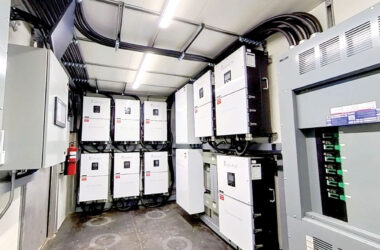
The inside of the HEC is wall-to-wall technology that’s broken down into three components: an integrated auxiliary power input, inverters and lithium-ion phosphate batteries with 135 kilowatts of power and pop-up solar arrays, which provide the backbone of the microgrid. “It’s enough to power an average household for about 10 hours,” Jansen said.  

The Integrated Energy Systems team opted for a smaller battery storage capacity for this military demonstration, with the ability to boost the power and storage supply significantly depending on the application. “Had they needed something to power an RTC for two weeks, we would’ve delivered a HEC to do exactly that. We’d bring in another container and install additional batteries so it could sustain the camp much longer,” Jansen said. 

Building a self-contained system that adapts to outside conditions  

Jansen says his team integrated an advanced heating and cooling system so the HEC could efficiently supply power to a microgrid in the harshest environments. The HEC adapts accordingly in locations blanketed in extreme heat or stifled by a polar vortex. While the Pop-Up City contest didn’t specifically require the RTC to be able to withstand extreme heat or cold climates, Jansen says the team went above and beyond, delivering a microgrid with the ability to operate under both extremes.  

The inside of the container adapts to the conditions outside, with air source heat pumps that can provide both heating and cooling. Custom forced-air fans can draw hot or cool air in to maintain the inside temperature without relying on more power-hungry options such as conventional air conditioning and electric heating.  

“It’s controlled electronically by our programmable logic controller, which is the brain of the HEC’s system. It chooses which method of heating or cooling is most beneficial at the time and automatically turns on and heats or cools the container,” Jansen said. Allowances have been made within the temperature control system to utilize excess renewable energy to preemptively heat or cool the container to further increase the system’s efficiency. “If the batteries are full and there is excessive renewable power in cold weather, our system automatically turns on multiple heat sources to heat the container up to 30 degrees Celsius, even if it’s minus 40 outside,” Jansen said.  

“SRC understands what it means to operate in austere environments, with past experience deploying HECs for northern Saskatchewan. We were able to work together to advance the HEC platform with new capabilities through this project that we hope can benefit a wider audience,” Shahsavar said.  

Knowing the customized HEC helped elevate the Circular City Consortium’s pitch for a new and improved RTC, Jansen says he’s thankful Innocorps Research Corp. recognized SRC’s expertise and included them in the project.  

“They came to us because they noticed, just like themselves, that we’ve got something novel. We have capabilities and capacities that complemented the project team, so I think they chose their team well,” Jansen said. “Ultimately, we all delivered on what we had promised to do, and what we had promised to do is make something that was novel, effective and reliable.” 

You can learn more about SRC’s Integrated Energy Systems teams and its Hybrid Energy Containers by visiting src.sk.ca/services/hybrid-energy-container.

by Saskatchewan Research Council Saskatchewan Research Council

Meet Our Experts

Mark Calette

As a member of the Métis Nation-Saskatchewan, Mark Calette knows the importance of building strong relationships. “For Indigenous people, relationships mean everything to us,” said Calette. “That’s the fundamental backbone of how we want to work with anybody. We want to build those relationships first and then trust can start and we can move forward.”

Over the years, Calette has been a leader in community engagement and has helped the Saskatchewan Research Council (SRC) build trust between Saskatchewan communities and industry partners. 

Calette started his career at SRC working with Indigenous communities in northern Saskatchewan as part of a multi-year project called Project CLEANS (Cleanup of Abandoned Northern Sites). This work involves remediating 37 abandoned uranium mine and mill sites. Calette’s new role as director of Indigenous relations expands his work in community engagement to other areas across SRC. He is excited to engage in collaborative discussions and help make new connections, build trust and maintain relationships with Indigenous communities across the province.

Communication is key to fostering trust 

Calette believes that listening to and learning from communities is the starting point for any industry project. “Industry often makes the mistake of speaking with communities after they have made important decisions,” said Calette.

The first steps toward a successful approach are establishing communication, building trust and taking time to foster relationships that are collaborative. Calette says that finding out the community’s needs is an important step in the process and can make a world of difference for everyone involved in the project. This important feedback can inform any project-related decisions and the process through which they’re made. For example, the Project CLEANS team meets regularly with different communities in the Athabasca Basin, whether in person or checking in by phone or email. 

“Spending as much time as possible talking with community leaders and members, and in a variety of different ways, is a great way to facilitate strong relationships,” said Calette.

Looking towards the future of community engagement

After his work with Project CLEANS, Calette left SRC to join Métis Nation-Saskatchewan as senior director of administration. Now back at SRC, Calette is entering his ninth, non-consecutive year with the organization and is excited for the future. “It’s a great place to be and I think it’s a special time,” said Calette, “I think how we’re going to engage with the Indigenous communities is going to be really exciting and important.”

Calette brings his passion and expertise to his new role and hopes to expand on the work that SRC has done over the years. His goal is to continue to help Indigenous communities connect with SRC on new and existing projects. Collaboration between SRC and Indigenous communities is an ongoing process. “When I first joined SRC, the Indigenous engagement piece was moving along but it was still pretty new,” said Calette. “So, we were able to build this very robust plan together.”

“For SRC, it was important to let communities know that we were going to be there for the long haul, and we were going to listen, and we were going to learn.”

– Mark Calette, Saskatchewan Research Council

While strong foundations have been laid, Calette believes there is room to improve. “We certainly tried to follow the good work we saw around Canada, and I think, in terms of Saskatchewan, what we did was best practice,” said Calette. “I believe that’s a good starting point, but there’s an opportunity to really expand and grow and improve on the work we did.”

SRC’s work with communities in the Athabasca Basin on Project CLEANS set a precedent for future engagement between business, industry and Indigenous communities in the province. “For SRC, it was important to let communities know that we were going to be there for the long haul, and we were going to listen, and we were going to learn,” said Calette. “We just took that approach from the start, and I think that served us well and continues to serve us well.”

Communities were able to give their input on different areas of work at all stages of the process. For example, SRC helped to facilitate Elder–youth workshops that assisted the revegetation and reclamation portion of the project.

Moving forward together

Calette is focusing his energy on cultivating Indigenous engagement throughout SRC and hopes to expand relationships between the council, industry and communities. 

“Any industry, whether it’s mining, oil and gas, forestry, anything to do with the environment – I think you need to work with Indigenous communities and really learn from them,” said Calette. “They have been stewards of the land for centuries and have a lot of knowledge to share. It’s important to learn from impacts experienced from previous development and to avoid the pitfalls of the past.”

Working together on key strategies can help grow relationships. Calette believes that clear communication is crucial for reaching future goals and he is focused on a collaborative approach that will benefit everyone involved.

A stronger Saskatchewan

Saskatchewan is important to Calette. His family came to the province from Red River, Man., in the 1860s. His community, the Round Prairie Métis, settled just south of Saskatoon near Whitecap Dakota First Nation. After the events at Batoche in 1885, the community began migrating to the city, leaving the area behind by the early 20th century. Today, the Round Prairie Cemetery marks the area of an important historic Métis settlement. Calette has spent some time living and working in Prince Albert and Buffalo Narrows but calls Saskatoon his home.

Creating a diverse and sustainable economy through research initiatives and technological innovation is an important part of SRC’s mandate. Calette believes that focusing on helping people succeed will make Saskatchewan even stronger. “I think when we’re working with a significant demographic of the province, and if we find ways to help each other, we are really achieving our mandate and helping Saskatchewan grow,” said Calette.

There is a great opportunity for SRC and Indigenous communities to work together, and get more people engaged with industry, by helping individuals gain more experience in skilled trades and take on leadership roles. Calette sees a lot of talent in these communities and a bright future for the province. He hopes that over the next few years, SRC can help many communities reach their full potential.

“I think we are seen as a leader in working with Indigenous communities in the Athabasca Basin. I would like to continue that right across the province,” said Calette, “and I’m really excited about that opportunity.”