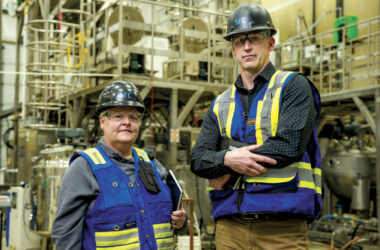
by Shantel Lipp Shantel Lipp

Built on Grit

Shantel Lipp

As we approach fall, our minds start to adjust to a regular routine. School begins again, vacationers return from the cottage and city streets start to get a little more crowded. For our industry, the routine does not change. It has been working hard throughout the season to ensure that road and infrastructure building and maintenance projects are done before winter.

Our industry goes through many ebbs and flows throughout a construction season, depending on the level of work and resources that have been approved. However, one factor we have little to no control over is the weather. Working through inhospitable conditions is something the heavy construction industry must do to get the job done. Our working timeframes have always been set by Mother Nature. Our industry relies on many factors to succeed, but the one that remains essential is the grit that heavy construction workers possess.

That is why the SHCA has recently launched a campaign called Built on Grit. The campaign highlights the work done by our industry and celebrates those who do the work. Built on Grit shows our industry is resilient and tough. The campaign also touts the benefits of considering a career in the heavy construction industry.

Working in the heavy construction industry is a choice for many, and SHCA, working with our members, makes sure that our workforce is prepared and ready. Even though jobs in our industry can at times be challenging, we want to ensure every worker on a crew is given the best information and guidance to do the job right. Our industry’s investments in training programs and partnerships with educational institutions help address the demand for skilled workers. With the proper guidance and training, our industry workers will show their true grit in getting the job done.

Built on Grit is more than a slogan. It lets people know there is a face behind the infrastructure we take for granted every day. It is also an acknowledgment of the toughness and resilience that define our industry and the people who make it work.

I encourage you to check out our Built on Grit campaign and let us know what you think. 

by Martin Charlton Communications Martin Charlton Communications

Membership Has Its Privileges

Team of laborers dressed in safety gear silhouetted against the glowing horizon

Belonging to the SHCA means many things to its members. Whether it is finding training opportunities for their employees, attending events to learn about the industry’s future or tapping into an industry-based benefit package for workers, SHCA members receive great value for their membership.

However, when it comes to maximizing the return on membership costs, SHCA advocacy delivers results through its effective and strategic advocacy efforts when engaging with the government.

“Our industry is no stranger to experiencing challenges caused by government action,” said Shantel Lipp, SHCA president. “Any decision that impacts the heavy construction industry negatively has to be countered and corrected; otherwise, the voice of the industry goes silent and our members have no say in determining the future of their companies.”

The SHCA has always approached advocacy as an opportunity to communicate with government, develop those relationships and, most importantly, ensure that industry interests are heard and acted upon. Advocacy on behalf of SHCA members is a proactive measure to help the industry avoid unforeseen government actions and educate decision-makers on what works to ensure the success of heavy construction.

A few years ago, the Alberta government introduced legislation that would have had a negative financial impact on the agriculture industry. Without consultation with stakeholders, the government announced new legislation as a fait accompli. The government decided what was best for the industry without talking to the industry. The government also underestimated the backlash their actions would receive. Rather than extending the conversation with the industry before proceeding to legislation, the government failed at governing 101: Talk before taking action.

“Our advocacy involves productive discussions with government, but also lets them know when they are on the wrong side of an issue.”

Shantel Lipp, SHCA

The SHCA, through its advocacy efforts, has fostered a healthy relationship with all levels of government. If changes were to be made that would impact the heavy construction industry, the SHCA would be included in the discussion before any action is taken. Years of building relationships with the government means the SHCA has a seat at the table when changes to the industry are being considered.

“Our advocacy involves productive discussions with government, but also lets them know when they are on the wrong side of an issue,” said Lipp. “Our track record has been strong when it comes to having the government move on our issues. We keep the conversations going and we always put our members’ interests first.”

However, the association’s advocacy does not stop there. SHCA has addressed numerous issues head-on to ensure they do not become barriers to its members. Worker retention, negotiating rates with the government and creating safer work environments are a few recent actions SHCA has successfully tackled. SHCA advocates for the industry as a whole. When SHCA negotiates with the government, it speaks on behalf of all heavy construction workers in Saskatchewan, not just its members. However, an SHCA membership has its perks, and when it comes to advocating for industry interests to the government, member companies have a say on what is ultimately decided.

“It is common for our association to receive enquiries from our members on a daily basis who have an issue that needs a quick resolution,” said Lipp. “Our decades-long relationship with the decision-makers gives us the ability to pick up the phone and speak directly to the government to find a solution to an issue brought forward by one of our members. Our association has the ability to react quickly to issues brought forward as well as to strategically approach solutions to long-running problems that impact the industry.”

Back in the ’80s, American Express coined the phrase, “Membership has its privileges,” as a slogan to sell its credit card to customers. That phrase still carries weight; an SHCA membership does have its privileges – the most important being that your voice is heard. 

by Martin Charlton Communications Martin Charlton Communications

Highway 956: A Path to Prosperity

Fields with bales off the roadway

Two Canadian economic powerhouses can be found beside each other in Western Canada: Saskatchewan and Alberta. Last year, Saskatchewan’s GDP reached an all-time high of $80.5 billion, while Alberta’s was $353 billion. That put Alberta’s growth among the highest in Canada, with only Saskatchewan exceeding Alberta’s 2.7 per cent growth rate with 3.4 per cent.

Saskatchewan and Alberta have been tied together economically for decades. Both provinces share several similarities when it comes to the products they produce. Mining, oil and gas, forestry and agriculture are common industries that help each province thrive.Therefore, it is common sense for Saskatchewan and Alberta to establish avenues of transportation and trade that benefit both.

In 2005, both provinces celebrated their respective centennial. In the spirit of partnership, then Saskatchewan Premier Lorne and then Alberta Premier Ralph Klein signed an agreement to build an all-season road connecting the northern parts of the two provinces.

Highway 956, also known as the La Loche connector, is a 65-kilometre road connecting the northern Saskatchewan community of La Loche to Alberta’s Fort McMurray Wood Buffalo region. Movement of goods between provinces usually takes a north-to-south route before continuing east to west or vice versa. Having a northern link like Highway 956 opens up a new world of opportunities for each province to move goods back and forth. It will provide resource-based industries with a better path to move goods, as well as bring new economic opportunities to local economies.

Although La Loche is landlocked, it is, in many ways, an island. Access for La Loche residents is not easy, and the isolation has had a significant toll on the community’s economic and social conditions. The connector would serve as a means to bring new opportunities to a community in need of change.

Construction site
Garson Lake Rd. during construction in September 2023

As it stands today, Saskatchewan has completed work on its side of Highway 956, but Alberta has yet to commence any construction on a permanent road. The Saskatchewan Ministry of Highways completed Saskatchewan’s portion of the La Loche to Fort McMurray all-weather road during the 2024 construction season, after investing about $13.7 million. Construction on the final segment began in August 2023, with a cost of roughly $9 million and was completed in the fall of 2024.

In a recent interview with Alberta Transportation and Economic Corridors Minister Devin Dreeshen, he stated the La Loche route is “a priority project for the province.” His hope is that construction on the Alberta side will begin in 2026.

Since the United States began discussing tariffs that would impact Canada, first ministers started to explore ways to reduce their reliance on trade with the U.S. One of the proposed solutions was to develop economic corridors spanning the country. The completion of Highway 956 would help accelerate this proposal by opening up a new corridor, allowing resources to flow between Alberta and Saskatchewan more efficiently. Completion of the highway would foster growth for that area of the province by creating more opportunities through mining, forestry and tourism.

Fort McMurray sits within the Regional Municipality of Wood Buffalo (RMWB). According to the 2021 census, Fort McMurray has a population of just over 76,000 residents, and when considering the surrounding RMWB area, it is home to over 106,000 residents. In comparison, La Loche has a current population of just over 2,600 residents. La Loche, with the completion of the road, would have access to a market that is 40 times its size.

Growth within industries and trade between the two communities will also have a multiplier effect, with increased demand for local services such as accommodations, retail stores, restaurants and professional services. La Loche has the potential to experience a building boom once the connector is finally completed.

Northern Saskatchewan is the gateway to many of the world’s sought-after products. While it has the means to produce those products, Saskatchewan is still hampered in getting its goods to market due to a lack of critical infrastructure. Roads connect people to opportunities, and the opportunities presented in the completion of Highway 956 are vast: greater trade, growth of industries and building up a community in need of change.

Sometimes, the road to success is simply a road. 

by Paul Adair Paul Adair

Doka Builds the Future

Building and scaffolding viewed from beneath an overpass

Evolving from humble beginnings in 1868 as a small sawmill and woodworking shop in Austria, Doka – part of the Umdasch Group – has since been involved with some of the most significant infrastructure projects around the world, from tunnels in Australia to high-rises in North America.

Doka built its reputation on cutting-edge, ground-breaking formwork systems used in power plants, bridges, tunnels, and skyscrapers, including Dubai’s Burj Khalifa, the tallest building in the world at 828 metres. However, since 2023, Doka has expanded its offerings and positioned itself as a one-stop shop for formwork and scaffolding solutions for construction companies. Now with more than 160 sales logistics facilities in over 50 countries and more than 8,000 employees, Doka has become an international leader in formwork and scaffolding solutions. Its highly skilled global team delivers advice, engineering, customer service and technical support for even the largest and most complex projects.

Doka had the opportunity to introduce and showcase the latest scaffolding offerings at Bauma 2025 in Munich, Germany. Two products and services of note were the innovative Ringlock system and the digital solutions for higher productivity on-site.

Making connections

Ringlock allows users to quickly and efficiently erect, use and dismantle temporary work structures to create a secure working area for various applications, from façade scaffolds, stair towers and rebar scaffolds to shoring and birdcage scaffolds. It also delivers shoring performance, with a capacity up to 540 kilonewtons. Based on the rosette and wedge-head locking mechanism, Ringlock has been continuously refined and enhanced, undergoing multiple iterations to meet the highest standards of performance and safety, and is designed to meet global standards, such as:

The Ringlock system is engineered to meet the highest quality standards based on three simple factors: material, fit and finish:

  • Material: Ringlock only uses the highest quality steel certified and tested, demonstrating qualities that conform to or exceed industry standards, regardless of location or climate.
  • Fit: Ringlock is engineered with versatility and usability in mind, which increases efficiency and productivity to save projects time and money.
  • Finish: Where applicable, Ringlock is finished and protected by hot-dipped zinc galvanizing, which maximizes the product’s utilization and extends its life.

“Engineered to international codes and independently certified, Ringlock ensures safe, efficient scaffolding solutions for projects of any scale,” said Doka Canada’s head of sales, Warren Calderone. “Available immediately to support construction companies with safe access solutions, it perfectly complements our formwork systems and serves as a flexible solution for day-to-day shoring projects.”

The strength of Ringlock is in its versatility. The system’s streamlined and straightforward connection method ensures all main components can lock securely into place with a hammer strike, which eliminates the need for bolts, screws or mechanical tools. Ringlock also supports a wide range of scaffolding assemblies by using primarily core components that can be easily adapted to different load requirements, ensuring flexibility and efficiency for projects of all scopes. In addition, Ringlock adjusts to intricate and irregular structures and fits seamlessly around tight corners, obstacles and unique architectural features for maximum site efficiency.

“Ringlock is designed to seamlessly complement Doka’s engineering expertise, providing a well-rounded and dependable solution,” said Calderone. “The Ringlock rosette and ledger connection is key to our system and has been engineered to optimize structural performance and reliability. Our modular system – including standards, planking and ledgers – is designed for easy handling, fast assembly and optimized transportation. With a broad portfolio of accessories, it can be adapted for every application, making it movable, versatile and safer on the jobsite.”

All primary components are also hot-dip galvanized, protecting against corrosion and extending service life in challenging environments. Together, these innovations deliver a system with enhanced stiffness, higher load capacity and consistent performance across applications.

A digital solution

Scaffolding is shifting from paper processes and percentage-based costs to a digitally managed discipline. While modular systems remain the backbone, digital tools like Building Information Modelling (BIM), the Internet of Things and software-as-a-service platforms drive greater cost predictability, safety and risk management. 

“We fully integrate scaffolding into BIM for planning and clash detection. In addition, clients looking for examples of deeper digital visibility, solutions such as AT-PAC’s Hi-Vis® demonstrate how forecasting, manpower planning and analytics can be achieved by pairing physical systems with digital oversight,” said Calderone.

Digital solutions are also transforming how scaffolding is managed on construction projects. Beyond traditional software or platforms, systems like AT-PAC’s Hi-Vis® demonstrate how a digital ecosystem can bring transparency, efficiency and control to scaffolding operations. Tools like these enable real-time electronic scaffold requests, resource tracking and material management, helping project managers deploy scaffolding more effectively and maximize productivity. By focusing on planning and process controls, these digital solutions show how scaffold management can scale to projects of any size.

Closeup of DOKA label on steel rod
Photo: DOKA

“Regulators today demand not only strength in scaffolding products, but also traceable compliance,” said Calderone. “Digital systems that incorporate rigorous testing, QR-coded tagging, inspection logs and safety reporting provide full accountability while giving crews and managers instant visibility into scaffold status and usage. This added transparency supports greater efficiency, safer operations and more predictable outcomes on complex projects.”

Doka is a pioneer in integrating digital engineering, operations and site solutions to drive smarter, safer and more efficient construction. One example of this is Doka Concremote, which uses sensors to measure temperature and calculate the compressive strength of concrete in real time.

“By combining a selection of sensors tailored to diverse project challenges with powerful software, Concremote provides a reliable decision-making basis directly on site,” said Calderone. “Through its native app and web portal, teams gain instant access to real-time data and advanced functions, enabling forward-thinking construction processes and boosting overall productivity.”

Doka also provides hands-on training, e-learning, BIM support and onboarding for digital tools tailored to the specific needs of a project or the customer. With Doka 360, Doka takes the customer journey digital, making every step seamless and transparent. The new customer platform connects every stage of the formwork process, from planning and ordering to delivery and return. Real-time data from sensors embedded in formwork or concrete flows directly into the system. This gives customers complete visibility and supports informed, data-driven decisions. Doka 360 was launched in July 2025 with an exclusive early access phase for selected partners in Germany and the U.S.

AI on the worksite

Doka’s modular systems are reusable and long-lasting, and most of its products are also rentable, an attractive option for many concrete contractors because of its efficiency and flexibility. Rented material can also re-enter the supply chain, and contributes to a more circular economy where materials are reused rather than replaced.

However, rented material presents significant logistical challenges, as rented equipment returned to Doka facilities is inventoried and made ready for redeployment. These returned materials have traditionally been counted by hand, requiring a significant investment in time from Doka team members. To speed up the process, Doka has developed its own in-house AI tool, “AI Counting and Identification,” which is supported by Microsoft’s technology expertise. 

AI takes all the work out of manual counting in three steps:

  1. A team member takes a photo of the materials with a mobile device.
  2. The AI tool recognizes the product, suggests a count and, once confirmed, records the result along with the image.
  3. A precise and reliable digital record is created.

“We’re excited to begin exploring the use of AI to improve how we manage counting in the yard and warehouse,” said Jeremy Jeffries, head of operations for Doka Canada. “These tools give us new ways to reduce manual effort, improve accuracy and bring more consistency to our inventory processes.”

Although the system is currently being used internally at Doka yards, the company sees strong potential for future use directly on construction sites. Live demos and early feedback from Bauma 2025 have highlighted where the service could create added value, especially on large-scale projects with high material turnover.

Safety: Prevention through Design

Doka’s Prevention through Design (PtD) philosophy redefines how safety is engineered into every scaffold, formwork and workflow, not as an afterthought or merely to check a box, but as a proactive design principle. The engineering and quality that goes into each of Doka’s products ultimately deliver safer scaffolding solutions.

“Load, geometry and re-use are critical, and all our products are designed with the customer in mind,” said Calderone. “For example, on major energy projects, pairing Ringlock with our digital inspection tools has been shown to cut scaffold-related incidents by nearly a third. Crews have clear instructions, supervisors have real-time compliance and their projects run safer and more efficiently.”

Doka applies its PtD philosophy in three ways:

  • Engineering formwork and scaffolding systems that minimize fall risks, collapse hazards and manual handling injuries.
  • Designing intuitive, modular and tool-free componants, reducing the chance of misuse or assembly errors.
  • Integrating guardrails, access platforms and anti-slip surfaces directly into their systems so that safety isn’t optional; it’s built in.

The company is proud of the engineering and operational expertise it brings to each project and product. As part of this, Doka provides contractors with the hardware and know-how they need to use its formwork and scaffolding safely and effectively.

“Every Doka component is engineered for safety, and we design the workflow – from digital work packages to inspection logs – to be safe, embedding prevention before crews even step on site,” said Calderone. “We also engineer beyond code requirements and certify independently. On top of that, our digital protocols ensure safety data is visible and verifiable in real time.”

Sustainability going forward

Sustainability is not a trend for Doka. It is a mindset. With a clear strategy, shared vision and innovative solutions, the company supports its customers in achieving their sustainability goals.

Doka understands that to reduce emissions effectively, the company must first identify the greenhouse gas emissions its products generate throughout their lifecycle. To accomplish this, Doka has set new standards for climate-friendly product design by calculating the product carbon footprint for more than 7,000 products, as well as providing customers with independently authenticated data to make informed decisions. Because of this, Doka designs its products to last in the Canadian climate, even under the harshest jobsite conditions. 

“We are very conscious of the lifecycle of our products and their impact on the environment. The advanced materials and metallurgy used in our scaffolding are built to last a lifetime, delivering long-term reliability that benefits us, our customers and the planet,” Calderone said.

Doka’s expertise in professional refurbishment and repair also helps extend its product’s lifespan and reduce the need for new resources. Looking ahead, Doka is also working on bringing recycled materials into its products’ life cycle to mitigate the company’s carbon footprint further. 

“But there’s a lot going on behind the scenes, too,” said Calderone. “As an organization, we have set an ambitious goal of achieving net zero emissions by 2040. In 2024, we became the first formwork and scaffolding company worldwide to commit to the Science Based Targets initiative, and we will have our targets scientifically validated within the next 24 months.” 

by Procido LLP Procido LLP

Contract Law Training

Hard hat and gavel on stand

From May 5 to 7, Procido LLP delivered a sold-out, three-day seminar series on contracting and procurement law for SHCA. The sessions drew over 70 industry professionals, highlighting the growing demand for legal expertise in construction project delivery.

Led by Chad Eggerman, founding partner at Procido LLP and well-known project lawyer, the training offered a deep dive into the legal frameworks that underpin successful procurement and contracting. Eggerman was joined by Glenn Wright, a professional engineer and lawyer, and Kelsey Sonntag, then an articling student, both of whom contributed practical insights and legal analysis throughout the sessions.

Procurement strategy: Building strong foundations

The training began with a comprehensive overview of procurement methods, including competitive bidding, negotiating processes and directing awards. Attendees learned how to align procurement strategies with project goals while navigating trade agreements, such as the United States-Mexico-Canada Agreement (USMCA), and competitive procurement laws.

Key takeaways included:

  • How to structure RFPs to maintain flexibility and legal defensibility
  • Drafting clear, strategic RFP documents that reflect fairness and transparency
  • Understanding the legal implications of procurement choices and tailoring them to project needs

Participants were equipped with practical drafting tips and a framework for running effective, compliant and efficient procurement processes.

Evaluation practices: Fairness and legal risk

The sessions emphasized best practices for evaluating proposals, including:

  • Clear disclosure of evaluation criteria
  • Balancing technical qualifications with commercial terms
  • Avoiding rigid scoring systems and valuing informed evaluator judgement

Legal risks were also discussed, including the consequences of unfair RFP processes, potential litigation and the importance of aligning final contract terms with any amendments made during negotiations. Cross-border procurement considerations were highlighted, particularly when U.S. parties or goods are involved, reinforcing the need for legal counsel in such cases.

“Contract A” and the legal landscape of fairness

A key portion of the training focused on “Contract A,” a foundational concept in Canadian procurement law. The presenters reviewed the Supreme Court of Canada’s decision in Tercon Contractors Ltd. v. British Columbia, which introduced a three-part test for the enforceability of contracts and clarified the limits of exclusion clauses.

Emerging concerns were also addressed, including the trend of public owners removing “Contract A” provisions, which raises serious questions about fairness, transparency and bidder recourse.

Contract goals: Risk, certainty and dispute management

Attendees explored the three core goals of contracting:

  • Minimize risk through clauses such as indemnities, insurance and limitations of liability.
  • Promote certainty by using clear language and aligning terms with project scope.
  • Manage disputes with effective resolution mechanisms and change order procedures.

These principles were applied across various contract types, helping participants understand how to structure agreements that support project success.

Contract creation: Scope, templates and negotiation

The training emphasized the importance of defining and negotiating the scope of work. Poorly scoped contracts can lead to:

  • Budget overruns
  • Missed milestones
  • Disputes over deliverables
  • Unenforceable agreements

Attendees were encouraged to use appropriate contract templates based on risk, complexity and project type. The presenters stressed that while nearly every clause is negotiable, those related to cost and risk deserve special attention.

The role of legal counsel in the contracting process

Procido LLP clarified the role of legal counsel in the contracting process: advisors, not decision-makers. Teams should feel empowered to make routine decisions independently, while knowing when to seek legal input.

Common issues during the contracting process requiring legal review include:

  • Indemnities and exclusions of liability clauses
  • Intellectual property clauses
  • Restrictive covenants
  • Use of non-Canadian contract templates

A structured approach involving legal counsel can improve project efficiency and reduce risk.

Important clauses: Essentials for construction contracts

The final sessions provided a detailed overview of critical contractual clauses, including:

  • Indemnity provisions and their financial impact
  • Insurance requirements and collaboration with brokers
  • Representations and warranties for transparency
  • Incoterms for international risk allocation
  • Termination clauses and their implications
  • Alternate dispute resolution as a cost-effective alternative to litigation
  • Change order processes for managing scope adjustments
  • Payment terms and lien rights
  • Force majeure clauses for uncontrollable events
  • Intellectual property and confidentiality protections
  • Letters of intent and letters of award in procurement

The importance of careful drafting and legal oversight was emphasized to ensure enforceability and project alignment.

Procido LLP’s experience in construction

During the sessions, Procido LLP outlined how its lawyers draw on decades of experience advising contractors, engineers, architects, municipalities and project owners, combining legal knowledge with industry insight to assist clients with:

  • Drafting and negotiating contracts that protect their interests
  • Resolving disputes efficiently and cost-effectively
  • Ensuring compliance with procurement laws and trade agreements
  • Training internal teams to manage legal risk proactively

The sessions highlighted how Procido LLP supports clients in areas ranging from new project planning to RFP responses and contract dispute management, offering legal clarity and strategic guidance at each stage.

Looking ahead: More training, more support

Based on strong attendance and positive feedback, Procido LLP plans to offer additional training sessions in 2026, including customized workshops for companies and project teams upon request.

These sessions could cover advanced topics such as:

  • Contract negotiation strategies
  • Risk allocation in multi-party agreements
  • Legal considerations in joint ventures and public-private partnerships
  • Regulatory compliance and occupational health and safety obligations

Organizations interested in these advanced topics or in tailored training for their teams are encouraged to reach out to discuss scheduling and content options.

To learn more about Procido LLP’s legal services or to book a custom training session, visit procido.com.

by Erin Matthews Erin Matthews

Keeping Safety at the Forefront of Innovation

Two workers in safety equipment

From environmental remediation in the Athabasca Basin to renewable energy storage systems in southern Saskatchewan, the Saskatchewan Research Council (SRC) is committed to tackling every project, large or small, with the health and safety of its employees at the forefront.

Beginning in 1959, SRC’s safety program has evolved over the last several decades and continues to be shaped by the innovative and leading-edge work SRC undertakes.

Safety is everyone’s responsibility

“Safety is definitely a shared responsibility, with everyone having a role to play,” said Kenelm Grismer, director of health, safety and risk at SRC. “As an employer, SRC has the responsibility to establish and maintain an effective safety management system to enable people to work safely.”

The management system is driven by safety leadership and commitment at all levels of the organization, and includes upholding SRC’s organizational philosophy that safety is an overriding priority. With SRC providing the foundation for this safety culture, employees are empowered in their work environment to perform their tasks safely, ensuring they are confident in their understanding of the hazards and are equipped to do the job safely before proceeding. To ensure safety across SRC, it’s essential that employees are aware of and practice their rights, including the right to refuse any unsafe work.

“We want employees to be curious about safety, to ask questions and to challenge the way that we do our work to ensure it’s being done in the safest way practical,” said Grismer.

Managers and supervisors have a responsibility to ensure employees receive the appropriate training and tools for their roles, and that they are following established rules and procedures. They lead by example to reinforce SRC’s commitment to safety. SRC’s occupational health and safety committees provide a forum for the employer and employees to work together to continually improve safety.

“Collectively, these various roles create layers of defence to keep us all safe,” said Grismer. “Each of these roles is vital to developing and maintaining a strong safety culture across SRC.”

Varied service lines create unique safety requirements

From lab benches to field work to desk duties, every team at SRC encounters different risks and hazards, but Grismer says that doesn’t change the council’s philosophy. “Across SRC, safety is an overriding priority. All groups operate under the same overarching safety management framework, but how the tools are applied may change between groups,” said Grismer.

SRC has several laboratories that process samples, providing data and insight to clients around the world. In these spaces, employees often engage in routine work, drawing more heavily on well-established standard operating procedures and safe work practices.

As SRC evolves, new projects come together and new business units are established. Often, these growing and specialized teams need to develop new safety protocols for their work.

Other employees, such as those in the field conducting air quality testing, may encounter varying levels of uncertainty in their day-to-day tasks. These employees must conduct regular field-level risk assessments, and be comfortable identifying and mitigating hazards in varying conditions. Grismer says this is where safety training and experience are crucial.

As SRC evolves, new projects emerge, and new business units are formed. Often, these growing and specialized teams need to develop new safety protocols for their work. For instance, the developmental nature of the work that SRC’s research and development team undertakes in its rare earth element division comes with a certain amount of risk and uncertainty when doing something for the first time, which is why planning, training and having the correct tools for the job are critical.

“They’ve worked very hard to assess the hazards, develop standard operating procedures and safety protocols to mitigate the risk, and spend a significant amount of time and effort in training the team to conduct the work safely,” said Jackie Foord, SRC’s occupational health and safety lead. “They are continually reassessing the risks and refining the way they do the work to improve safety. The planning and development they’re doing now will benefit the operation in the long term.”

SRC’s safety management framework, driven by the organizational commitment to safety, positions SRC well to meet the various safety challenges encountered while working across several diverse service lines.

Safety evolves alongside SRC

In the last five years, SRC has expanded into growing sectors, including critical minerals. These new projects have not only required specialized knowledge and expertise, but also new equipment and facilities, such as SRC’s under-construction Rare Earth Processing Facility and its Minerals Liberation Sorting Centre.

“These types of projects have definitely been a catalyst to advance our safety program on a number of fronts,” said Grismer.

New skill sets and resources have been brought on to carry out these projects, enabling SRC to view work environments from a variety of perspectives. Teams work together to find solutions to challenges. “Working with tradespeople who have come from larger organizations, such as mining operations, brings a wealth of knowledge to the organization regarding safety,” said Foord.

These projects have unique safety needs. Foord says the extensive efforts invested in activities such as hazard assessment, planning and training have been critical to the success of these projects and ensuring everyone on-site goes home safe at the end of the day.

New safety innovations keep employees at the heart of safety

SRC’s safety team continues to innovate to meet the council’s needs for new and existing projects and facilities in 2025 and beyond. As SRC’s industrial process operations expand, so do its safety requirements. Tools like automation, robotics and AI will help improve safety by mitigating hazards, and provide opportunities for enhancing and streamlining data analysis and reporting.

“Innovation has been critical to working safely across SRC. As an organization, we are fortunate to have access to a wide range of expertise and skill sets, from engineers and scientists to instrument techs and electricians,” said Grismer.

Learning from employees’ experiences on-site, in the field and at the lab helps SRC improve its protocols and approaches to ensure they are robust enough to tackle any safety challenges. “We are continuously applying these resources to advance safety, both for our clients as well as our own operations. There are countless examples of situations where a team identified a hazard and developed an innovative approach that enabled them to do the job [safer],” said Grismer.

SRC’s goal is ultimately to eliminate workplace injuries. To achieve that goal, the focus is on continuing to ensure that all employees at SRC feel they are accountable for safety and are empowered to ensure work is done safely.


For more information on SRC’s services, visit src.sk.ca.

by WorkSafe Saskatchewan WorkSafe Saskatchewan

Know Your Rights

A construction worker in an orange safety jacket watches the ongoing work at a construction site during the day

In heavy construction, every project comes with tight timelines, complex work sites and, at times, significant, but manageable, risks. Saskatchewan’s recent record-low injury rates show how far the province has come, but serious injuries and fatalities remain a challenge across the province.

As a result, WorkSafe Saskatchewan wants all workers to be aware of their rights on the job. That includes the right to work in a safe environment.

In 2024, the province recorded its lowest total injury rate in history at 3.91 injuries per 100 workers, down from 3.95 per 100 workers in 2023. Since the WorkSafe Saskatchewan partnership between the Saskatchewan Workers’ Compensation Board and the Ministry of Labour Relations and Workplace Safety was established in 2002, the province’s total injury rate has dropped by more than 65 per cent. The time-loss injury rate in 2024 also reached its lowest level in Saskatchewan’s history at 1.72 per 100 workers, down from 1.78 per 100 workers in 2023.

This data reflects the collective efforts of workers, employers, safety associations and safety leaders across the province. However, serious injuries remain high, averaging about 2,400 cases per year. They represent 11 to 15 per cent of all injuries, but account for approximately 80 per cent of compensation costs. Specific to the construction industry, from 2010 to 2024:

  • More than 51 per cent of fatalities were from occupational diseases in the construction industry.
  • 95 per cent of occupational disease fatalities in the construction industry were from exposure to asbestos.
  • 89 per cent of the public was not aware of the risk of asbestos exposure during home renovation work.

Learn more about commercial construction safety statistics on WorkSafe Saskatchewan’s website at worksafesask.ca/commercial-construction-stats. All workers in Saskatchewan are covered by three important rights that are intended to keep them safe on the job. Those rights are protected under the Saskatchewan Employment Act.

The right to know

If you are employed in Saskatchewan, you have the right to know about any safety hazards in your workplace. A hazard is anything that might cause an injury or illness. This knowledge is important in protecting yourself and your co-workers. As a worker, you have the right to receive the training, information and supervision needed to do your job safely. Your employer should provide you with instructions on how to stay safe before you start your job and before work begins on a new project.

Safety information, including training and instructions, can be given online, in writing or in person. The information and training may come from a supervisor, co-worker or someone outside of your workplace, but your employer must pay for all training that is part of your job. Clear communication is also a key component of the right to know. Your employer needs to give you the information you require to do your job safely in a way that you can understand. Ask questions whenever any safety instructions aren’t clear.

The right to participate

Each worker has the opportunity and freedom to get involved in their workplace’s health and safety activities. You have the right to share your concerns and ideas about how to make your workplace safer. If you encounter an unsafe situation on the job, this right gives you the opportunity to help rectify the situation, preventing injuries to you and your co-workers. There are several ways for workers to exercise their right to participate, including:

  • Reporting your concerns to your supervisor or manager about any health and safety issues that could cause harm to you or your co-workers.
  • Making suggestions to your supervisor or occupational health committee about how to make your workplace safer.
  • Joining your occupational health committee if your workplace requires one.
  • Acting as an occupational health and safety representative for your workplace if given the opportunity.

The right to refuse

Every workplace has hazards, most of which are not likely to cause serious injuries or fatalities. This right applies to the hazards that are considered unusually dangerous to yourself or others. An unusual danger or hazard could include:

  • A danger that would normally stop work, such as operating a forklift with a flat tire.
  • Something that is not normal for the job, like repairing a roof in bad weather with dangerous winds.
  • A situation you haven’t been properly trained for, or where you don’t have the right equipment or experience to do the work safely. For example, cleaning windows on a tall building without any training or fall protection equipment.

The right to refuse is only used when the first two rights have failed to protect your health and safety in the workplace. In other words, exercising your right to refuse is a serious matter and should not be taken lightly; it should be used as a last resort when other measures have been unsuccessful.

However, you should also not be afraid to speak up when you believe your work is unusually dangerous. If you or the people around you are at risk, you can say no. You absolutely cannot be disciplined or fired for exercising your right to refuse, as the right to refuse is protected under the Saskatchewan Employment Act. There are several steps to take when opting to refuse unsafe work, in this order:

  1. Stop performing the task. Tell your supervisor what you think is unusually dangerous about the task.
  2. Consult with your workplace’s occupational health committee if you and your supervisor can’t reach a solution.
  3. If the matter is still not resolved, contact the Ministry of Labour Relations and Workplace Safety’s Occupational Health and Safety Division at 1-800-567-7233. An occupational health officer will provide their decision in writing to you and your employer.
  4. If you don’t agree with the occupational health officer’s decision, you have a right to appeal.

Each year in Saskatchewan, approximately 21,000 workers are injured on the job. Working together, we can make Saskatchewan a safer place to work.

For more information on the three rights, including videos and other resources for workers and employers, visit the WorkSafe Saskatchewan website at worksafesask.ca.

by Rodrigue Gilbert Rodrigue Gilbert

Power in Unity

People, hands and outdoor stacked for support

In a year marked by political change and economic uncertainty, Canada’s construction industry is not standing still – we’re shaping the future, and at the core of that momentum is partnership. Thanks to the unwavering support and collaboration of partner association members, such as SHCA, CCA is not only elevating our industry’s national voice. We are turning that voice into action, influence and results.

Advocacy that delivers

When economic uncertainty hit and Canada-U.S. trade tensions escalated, CCA quickly recalibrated. We identified key issues affecting your business, including trade-enabling infrastructure, fair and transparent procurement and strengthening Canada-U.S. relations. We took those priorities straight to Finance Canada, Public Services and Procurement Canada, Canada’s U.S. ambassador and national business leaders. We joined the Canada-U.S. Trade Council to ensure construction has a seat at the table and a say in shaping continental trade. We also strengthened ties with groups like the Canadian American Business Council, forging alliances to tackle common challenges.

Thanks to the unwavering support and collaboration of partner association members like SHCA, CCA is not only elevating our industry’s national voice. We are turning that voice into action, influence and results.

Our national election campaign, Construction for Canadians, brought the industry’s voice to the national stage, with 74 candidate testimonials, 84 pledges of support, four billion media impressions and 165 national media hits. We put construction at the centre of critical policy debates around economic resilience, infrastructure investment and workforce development – exactly what Canada needs in this next chapter of nation-building.

These efforts are already making waves. Our priorities were reflected in the federal mandate letters, the speech from the throne and plans for a new Major Federal Project Office – a sign that the federal government is hearing our message loud and clear. CCA is already building relationships with newly elected MPs and ministers, laying the foundation for a powerful Hill Day and Meech Lake meeting in the fall. Together, we’ll advocate for the investments, policies and tools that Canada’s construction industry needs to drive our economic prosperity.

The road ahead

CCA is moving full speed ahead to ensure the momentum it built is not lost. The construction sector, backed by partners like SHCA, will continue pushing for the policies and investments that will move the industry forward. With strong partnerships, a united voice and a clear vision, we can build a more resilient supply chain, a stronger workforce and the modern infrastructure Canadians need. CCA is committed to advocating for the tools, policies and investments that will allow our industry to thrive – not just for today, but for generations to come. 

by Shantel Lipp Shantel Lipp

The Federal Election is Over – What’s Next?

Election Canada voters registration cards for federal elections
osarieme/123rf

The dust has settled on the April federal election and now is the time for our elected representatives to get to work. The campaign saw many issues discussed by party leaders and their candidates with varying opinions from all sides of the political spectrum. All campaigns experience competing interests and some voices are heard over others.

The heavy construction industry was one of those voices. Much like the Canadian electorate, our industry is at a crossroads. Will the future of Canadian infrastructure expand for the economy to grow? What does the result of the federal election mean for projects in Western Canada and, more importantly, for Saskatchewan?

During the campaign, there were many discussions on ways to advance the Canadian economy while, at the same time, becoming less reliant on the United States. The ebbs and flows of the tariff threats continue to have an impact on how we do business across the country and here in Saskatchewan.

Rather than looking south, Canada has started to look east and west to create opportunities by removing barriers that create stagnation in economic growth. All sectors are looking at ways to create solutions that bring mobility across the country on vital projects required to keep our economy on track.

Our industry adapts to change quickly, and the challenges facing it due to the tariff issue was one that we took on. The heavy construction industry here in Saskatchewan has been very vocal with all levels of government on action that needs to be taken to ensure our industry remains economically healthy. As an industry, we continue to advocate for long-term strategic funding for infrastructure that guarantees good jobs, safe roads and economic growth.

As the newly elected federal government begins to take shape, SHCA will be looking intently at what direction it takes with respect to the future of infrastructure funding. Hopefully, lessons have been learned and the misguided notion of not funding future projects of infrastructure that are tied to road building have been tossed into the dumpster of bad ideas.

As an advocate for the heavy construction industry, the SHCA will always put our members’ interests first and let governments know when they have been right and when they have been wrong.