by Pat Rediger Pat Rediger

Paving the Way Forward

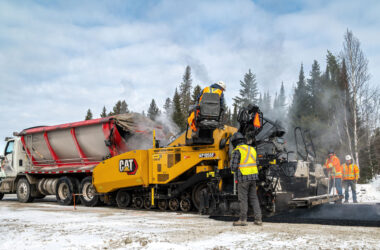
Construction crew paving road
Photo: Red River College POLYTECHNIC

From scorching heat in the summer to blasting winter cold, road builders in the Prairies have some of the toughest paving conditions to contend with. Asphalt is more than just a surface layer; it’s a material that must endure the full force of nature over a long period of time.

This is one of the subjects that’s under close scrutiny at the Centre for Applied Research in Sustainable Infrastructure (CARSI) at Red River College Polytechnic in Winnipeg, Man. CARSI provides applied research and education, connecting the classroom with real-world challenges in the construction industry.

The centre is structured into three main areas: pavement materials, structural construction materials and building construction innovation. The lab was originally focused on supporting the aerospace and manufacturing industries, but it has a growing emphasis on asphalt concrete pavement research.

Bahador Barbod, a municipal engineering instructor at the college, says CARSI’s mission is to prepare students for industry while generating practical knowledge that benefits public and private stakeholders. “Students who take our pavement materials courses don’t just study theory,” he said. “They engage in asphalt mix design, evaluate the challenges that come with it and conduct tests using the lab’s advanced equipment.”

Barbod says CARSI delves into a wide range of research projects, including comparative studies on asphalt density testing methods, investigations into self-healing asphalt using calcium alginate and the development of cold mix asphalt, suitable for low-temperature applications. One area of his particular areas of interest involves incorporating recycled materials such as reclaimed asphalt pavement into new mixes, a direction that aligns with sustainability goals while meeting industry demands.

The real-world implications of this research are significant. Much of the lab’s work is driven by the goal of enhancing the durability of construction materials and reducing long-term maintenance costs. Barbod says that while asphalt is widely used, its performance over time – especially under the unique freeze-thaw cycles common to the Prairies – remains a challenge. CARSI’s testing equipment contains a large programmable environmental chamber capable of simulating both high and low temperature conditions.

This chamber is divided into two separate spaces, allowing simultaneous tests at vastly different temperatures. Asphalt samples placed in the chamber undergo rigorous freeze-thaw cycles, mimicking the real-life stressors found on prairie roads.

Much of the lab’s work is driven by the goal of enhancing the durability of construction materials and reducing long-term maintenance costs.

Barbod and his students use the equipment to examine how new asphalt formulations behave under the harshest conditions. By observing how materials crack, deform or deteriorate, CARSI researchers can make more accurate predictions about long-term performance and help shape better material specifications. It should be noted that the chamber isn’t limited to asphalt since it’s large enough to accommodate concrete beams, window frames and other structural components for testing.

As this research continues, Barbod says he hopes to build stronger relationships with the private sector. Although CARSI maintains ties with Manitoba Transportation and Infrastructure, its connections with private road builders have been limited. “One thing that’s a little bit challenging for bringing the industry into our research is that students go through the co-op program in the summertime, and asphalt construction is usually shut down in the winter. That’s when students are in college, so we don’t always have that connection between the industry and the college,” he said.

Still, Barbod sees plenty of opportunities for collaboration, such as increased relationships between academic researchers and industry stakeholders, where student-driven projects can address real-world problems and inform construction decisions. Final reports and presentations are already shared with any interested partners, and Barbod invited road building companies to attend student presentations or propose research topics that align with their needs.

Various learning tools inside the classroom
Photo: Red River College POLYTECHNIC

CARSI’s impact also extends into workforce development. Students involved in pavement research gain experience in both Marshall and Superpave mix design methods. They learn how to troubleshoot mix performance, test various additives and compare results using industry-standard lab technologies. Graduates leave the program with a comprehensive understanding of construction materials testing, as well as practical experience that gives them a competitive edge in the job market.

The lab’s commitment to skill-building is especially important as the construction industry continues to face a growing demand for technically trained professionals. Barbod says students leave the program with both theoretical knowledge and extensive hands-on experience in asphalt and concrete mix design.

“Students come out from the CARSI lab usually with a complete understanding of construction material testing,” he said. “They experience all of those tests themselves and get the theory and practical knowledge of the mixed design for asphalt and concrete both.”

Looking ahead, the lab has ambitious goals. Barbod says he is interested in researching the use of nanomaterials in asphalt mixes and how these microscopic additives could improve performance properties like elasticity and resistance to cracking. He’s also interested in further research of cold mix asphalt solutions, which remain underused in the Prairies despite their potential to reduce costs and enable off-season construction. If CARSI can demonstrate consistent performance under lab conditions, Barbod says he hopes to help shift industry perceptions and encourage broader adoption of these alternative materials.

Another priority is securing new testing equipment to enhance CARSI’s analytical capabilities. With enhanced tools, the lab could provide even more detailed insights into mix performance and lifecycle costs. This is information that would be valuable to municipal planners, contractors and engineers looking to stretch their infrastructure budgets further.

As CARSI continues to grow, Barbod hopes this will lead to closer ties between the institution and the heavy construction industry. “There’s tremendous value in aligning what we do in the lab with what’s happening in the field,” he said. “We want to be a resource for road builders. Whether it’s improving asphalt durability, reducing maintenance needs, or training the next generation of professionals, we’re here to support the industry.”

by Jim Timlick Jim Timlick

Cenovus Energy

Contractors paving road
Contractors work with Cenovus Asphalt to pave a road using a hot in-place recycling technique, which is the process of rehabilitating deteriorated pavement

This Canadian-based integrated energy company has had a presence in Canada’s so-called breadbasket region dating back all the way to the mid-1940s.

That’s when Husky Energy established one of its very first oil fields in the northwest corner of Saskatchewan near the Alberta border. It was about the same time Husky opened its first asphalt plant to produce the paving material required to build many of the province’s roads.

Today, Cenovus, which purchased Husky in 2021, is one of Saskatchewan’s top employers with a workforce of more than 1,300 people in the province. The company is headquartered in Calgary, Alta., and has asphalt producing refineries in Lloydminster, Alta. and Superior, Wis. It also has asphalt terminals across Western Canada and the Midwest in the U.S., with Cenovus’ most recent addition being a new terminal near Denver, Colo.

“All of our network is supplied by crude oil produced in Saskatchewan and supported by the brilliant minds in our technical services and innovation lab based in Saskatoon,” said Martin Ray, director of the company’s asphalt and industrial products division. “We like to consider ourselves an integral part of the community and the economy in Saskatchewan.”

Lab technician wearing safety goggles
Cenovus’s Saskatoon lab performs quality testing on all the asphalt and industrial products sold in Canadian Downstream Terminals including asphalt binder, polymer modified asphalt and asphalt emulsions.

Asphalt and industrial products are part of Cenovus’ downstream division that refines crude oil into finished products. Cenovus is the third largest asphalt producer in Canada and the U.S. Other divisions include crude oil and natural gas production and midstream, which is responsible for the transportation of crude oil to the markets that require them.

“I think it’s a cool story and it’s a Canadian story,” Ray said. “We’re a fully integrated company. In other words, our operations involve activities that find, develop and unlock value from commodities that originate in Canada. In our downstream business, our team handles the marketing, transportation and sales of all of these commodities across North America.”

Cenovus provides two essential products to Saskatchewan’s heavy construction sector. The first is diesel fuel to power heavy equipment, which is processed at its upgrader on the Saskatchewan side of Lloydminster. The other is the asphalt used for road building, processed at the Lloydminster refinery and distributed through its terminals in Yorkton and Saskatoon. That asphalt is used in several different road building products, most commonly use as a binder for rocks in asphalt pavement. That same asphalt is also used to create an emulsion to help fill cracks and other imperfections in roadways. It’s essentially heated asphalt combined with water to create a liquid-like substance that can be sprayed on the road.

One of the more unique products the asphalt and industrial products division produces is a polymer-modified asphalt. It’s created by combining regular asphalt with rubber and rock to produce pavement that has elastic recovery properties and is able to better survive Canada’s harsh winters. “It’s a super cool technology,” said Ray. “It’s unique in that it can withstand our massive freeze/thaw cycles. It’s an engineered product that can stretch a little bit so it can absorb wear and tear. It’s more resistant to rutting and cracking.”

Something else that distinguishes Cenovus in Saskatchewan is its commitment to research in the province. To support this development, the company donated $2.5 million to Saskatchewan Polytechnic’s Time to Rise campaign in 2024. The campaign will fund the construction of the school’s new Saskatoon campus.

As part of this investment, Saskatchewan Polytechnic’s new centralized chemical technology lab, power engineering lab and instrumentation engineering lab will be named the Cenovus Energy Labs. The labs will provide students with the latest technology for hands-on training, something the company says it will need in its future workforce.

The company also recently made a $1.5 million donation to the University of Saskatchewan as part of that institution’s Be What the World Needs campaign. Those funds will be used to help develop the Cenovus Energy Makerspace that will play a key role in advancing engineering innovation and design and provide students access to advanced tools such as polymer 3-D printers and laser cutters.

Exterior view of refinery
Cenovus’s Lloydminster, Sask., refinery supplies the company’s network of terminals and direct to customers via truck and rail.

Ray says it’s all part of a team approach taken by Cenovus to help advance research and create new products that benefit the people of Saskatchewan and the rest of the country. “With academia, the private sector and government, you create a nice triangle of innovation to build the infrastructure that we all use,” he said. “Our role is to be able to build the best quality of roads at the lowest possible cost so that our tax money can go as far as it can. It’s all about industry partnering with academia and with governmental agencies, to provide Canadians better and safer access to commercial and human movement.”

Cenovus’s asphalt division has worked closely with the Saskatchewan Ministry of Highways on several projects throughout the province over the years. Ray says it has been a great partnership due in large part to the fact the province is committed to engaging in constructive dialogue with the private sector. “Saskatchewan Highways is excellent,” he said. “They engage their contractors, they engage their suppliers and they’ve been really innovative. I give Sask Highways a lot of credit. They’ve been quite progressive in a lot of ways.”

The company also engages in conversations regularly with the many contractors it works with in the province. Many of those conversations centre on technical questions such as which materials may be best suited to rebuild a road or deal with “alligator” cracking or a high-water table.

Another popular topic with those clients is the infrastructure deficit facing the province and what can be done to address the situation. “The infrastructure deficit is always a challenge,” Ray said. “I think Saskatchewan road builders play a big role in helping moderate discussions around infrastructure and [investing] in infrastructure versus other places to invest in the province. They help create an environment in which industry can speak with government to try to manage investment in the road system and bridges.”

“We like to consider ourselves an integral part of the community and the economy in Saskatchewan.”

– Martin Ray, Cenovus

Tariff uncertainty is something that the industry is dealing with now. Tariffs don’t impact asphalt since it’s one of the CUSMA-compliant products protected through the Canada-U.S.-Mexico trade agreement, but Ray points out that tariffs could mean increased costs to acquire the heavy machinery required to build roads. “Contractors utilize a lot of road building equipment, whether it’s yellow iron [heavy equipment] or trucks. I’ve got to imagine there’s some pressures that [contractors] like all of us are feeling,” he said.

Despite this, Cenovus plans to continue to focus on being a “worldclass” operator of its assets. The company recently completed several planned maintenance upgrades at its asphalt terminals in Yorkton and Saskatoon as part of a 10-year plan. It also has scheduled maintenance planned for its refineries in Lloydminster. Those improvements are all intended to drive a combination of cost, reliability and environmental improvements. “We are proud of our footprint and we’re going to keep investing in that footprint,” Ray said.

Cenovus is also continuing to work with its partners to develop several new and innovative technologies. One of those products is a softer form of asphalt that features different chemical properties that allow more of it to be recycled and incorporated in new roadways rather than shipped to landfills. The company is also involved in research looking into how consumer waste, including plastic polyethylene and other items, can be incorporated into asphalt used to build roads.

Something that isn’t likely to change is the value Cenovus sees in being an SHCA member. “We actively want to be part of associations that have influence in the industry and [SHCA] is brilliant at that,” Ray said.

“They pull together a range of stakeholders in this industry. You’ve got contractors, you have suppliers, you have governments at various different levels. They work collectively to create a forum by which we can be innovative, we can address challenges, we can work with governments to address industry-specific issues and we can advocate for infrastructure spending.”

by Martin Charlton Communications Martin Charlton Communications

Member Benefits

How to play the game – and win!

Yellow hard hat
kittiyaporn1027/123RF

Football fans know that the view of the game is much different up in the stands compared to what you can see on the sidelines of the field.

Football coaches know this even better. The value of having an eye in the sky to have a view of the entire field can be exactly what some coaches need to figure out a way for their team to win. Having someone in the booth to call plays based on that vantage point can make a big difference in the outcome of their team’s game.

Getting a different view of the field can be advantageous when running a business, too, but that can be easier said than done. Running a business can take up so much time and attention, and it can be hard to find the occasions and resources to get an accurate perspective about what is happening beyond the business.

However, it is crucial for the success of the business to pop your head up, look around and observe, to get a view of what is happening on the field. Seeing beyond what is immediately going on can give the perspective a business owner needs to find solutions to overcome current challenges and recognize issues that are on the way.

The easiest way to get an in-depth view beyond the day-to-day activities of a business is to be a member of an industry association, such as the SHCA. An industry association has a view of the broader industry and more, and is set up to share that outlook with members to help them be more successful.

Industry associations provide important context to their members who are trying to understand and cope with the forces and challenges each of them encounters in business. Those forces and challenges could be understanding evolving customer interests, navigating human resources and labour issues, securing valuable partnerships or any one of the many complex and evolving situations a member might find themselves in.

Getting a team on the field

SHCA members run businesses that are about more than building roads and infrastructure. These businesses contribute to building the economy. Collectively, the businesses that make up the heavy construction industry add more than $6 billion to Saskatchewan’s gross domestic product, supporting tens of thousands of jobs and providing $1.5 billion of income.

These figures come from the most recent economic impact analysis that was done by Praxis for the SHCA. Research like this benefits the industry and members by establishing the scale and significance of the work they are doing.

Collectively, the businesses that make up the heavy construction industry add more than $6 billion to Saskatchewan’s gross domestic product, supporting tens of thousands of jobs and providing $1.5 billion of income.

Research lends added credibility to members’ interests and experiences, but it also serves customers of the industry by helping them better understand it and the businesses that form it. Other research, such as collecting and analyzing data that can help the industry come up with answers and propose influential solutions for major economic challenges, is also important.

An example of this was the work done to produce the Canada West Foundation (CWF) report titled From Shovel Ready to Shovel Worthy: The Path to a National Trade Infrastructure Plan for the Next Generation of Economic Growth. That work was done through a collaboration between the Canada West Foundation and the Western Canada Roadbuilders and Heavy Construction Association (WCR&HCA), along with other national industry associations and business organizations.

Having access to the major leagues is possible through a membership with the SHCA. Becoming an SHCA member auto­matically provides an integrated membership to the WCR&HCA as well as the Canadian Construction Association (CCA), both of whom were a part the Shovel Worthy report and advocacy.

Getting in the game

The Shovel Worthy report was developed to get it in front of and be seriously considered by the federal and provincial governments as a plan for how Canada can return to its place in the top 10 of global trade infrastructure rankings, which is needed to restore the confidence of Canada’s trade customers.

Getting in the game and playing the best game possible is more likely when one deeply understands the sport. All governments have competing interests and concerns that must be addressed, as well as their own policy priorities. They have a process for advancing priorities and those who can best engage in the process will have their voices heard. Those who choose not to engage will have no say in decisions that could fundamentally impact their ability to do their job.

Panel of people on stage
Photo courtesy of SHCA

There is more success to be found playing as a team than going solo. The SHCA brings a voice on behalf of its members to key stakeholders and decision-makers. The association advocates on behalf of members who in turn benefit when their businesses grow.

The SHCA currently has several active working groups with the Ministry of Highways and the Water Security Agency, the Association of Consulting Engineers of Saskatchewan, the Saskatchewan Association of Rural Municipalities, the Saskatchewan Urban Municipalities Association, including: the Roadway Technical Committee, the Contract and Specification Committee, the Safety Committee, the Best Value Procurement Committee, the Bridge Construction Committee, the Urban Committee, the Rural Committee, and the Sand and Gravel Committee.

The SHCA has also been on the board of the Saskatchewan Common Ground Alliance, where the association joins the ranks of the major Crowns as well as major mining and development companies. The SHCA also participated on the board of directors for the Saskatchewan Center of Excellence of Transportation and Innovation at the University of Saskatchewan. Once a year, the SHCA also meets with the federal members of parliament to talk about the importance of infrastructure on a national level.

Learning the sport

There are also opportunities for players to learn to play at a higher level and find more opportunities to put points on the board. Each player in the game is going to perform better when they dedicate themselves to learning the sport. This begins with knowing the most current information and status of government regulations, specifications and legislative changes affecting the industry.

The SHCA provides all current members with updates with the most recent information available. Delivered daily are e-news and tender information notifications. These notifications include information about the association events, news updates and technical notices for all members.

Strong players know who is who and what is what when it comes to their sport. The SHCA produces a popular rental rate guide, which is the definitive reference tool used by both the user and purchasers of SHCA’s members’ services. This guide can be accessed electronically, which makes it even more useful. While it comes out annually, the SHCA knows people are using it daily to inform and connect them to the people and services they require.

At least five times a year, members are invited to gather and network with others in the industry. At these events, such as the annual general meeting and the new Infrastructure Summit, speakers share valuable knowledge and viewpoints that will help members as they consider and conduct their own business. Each year, the calibre of speakers and events keep increasing.

Think BIG also continues to be a great tool for getting the industry’s messages out to the people and government. Through this publication, the SHCA promotes their vision, mandates and services, providing members with information related to what’s happening not only in Saskatchewan, but around the world.

Between Think BIG issues, the association’s social media accounts keep members and the public up to date about the latest industry developments. Follow SHCA’s Facebook and LinkedIn accounts to be notified about training opportunities and events, and see the industry and the people working in it celebrated.

Being a member also provides access to networking opportunities. At least five times a year, members are invited to gather and network with others in the industry. At these events, such as the annual general meeting and the new Infrastructure Summit, speakers share valuable knowledge and viewpoints that will help members as they consider and conduct their business. Each year, the calibre of speakers and events keep increasing.

It is important to consider who else attends these events. The SHCA has formal opportunities to listen to and be heard from, such as the panel of guests hosted from SaskBuilds, Priority Sask and the Ministry of Highways at SHCA’s 2024 spring meeting to talk about capital budget planning and procurement.

There are informal opportunities as well. Governments and key stakeholder groups often have their representatives attend SHCA events, such as the annual industry summit, giving members an opportunity to meet and casually discuss their interests.

Developing players

High-performing players also need to be strongly skilled and well-conditioned. That is where education and training come into the picture in helping members become high performers. The SHCA works with those who develop and provide education and training opportunities, so members and their employees have the skills and knowledge they need to be at the top of their game.

For example, the SHCA collaborates with the Asphalt Institute, which provides full days of training, such as the paving inspector certification session. Ministry of Highways officials have attended those sessions to explain why the ministry is making such training a mandatory requirement for paving crews working on their projects.

Think BIG also continues to be a great tool for getting the industry’s messages out to the people and government. Through this publication, the SHCA promotes their vision, mandates and services, providing members with information related to what’s happening not only in Saskatchewan, but around the world.

Watch SHCA’s social media to learn of upcoming opportunities to participate in training sessions. In June, SHCA’s sessions provided information and insight into procurement and contracting, contract law and risk management as well as Construction 101, which is training for introducing people interested in construction to the industry.

The SHCA also shared and supported opportunities for longer training courses to qualify people for careers in the industry. For example, there is the 36-week Heavy Equipment & Truck & Transport Technician Certificate program available through Southeast College in Estevan, which gives participants basic training in two high-demand mechanical trades at the same time as a heavy-duty equipment technician or transport mechanic.

To continue to develop players, coaches must keep adding people to the roster. They must send the message to those not yet in the game that they would enjoy playing and be welcomed onto the team. The SHCA actively encourages people to consider careers in the industry, working to demonstrate that heavy construction is a viable option for women, new Canadians and others who may wonder if they are a fit.

Practice how you play: how members can get make the most of their membership

How you practice is how you play. Approaching practice as an opportunity to strategically develop technically, mentally and socially will prepare SHCA members to play a stronger game. The benefits and resources offered by the SHCA empower members to stay competitive, adapt to industry changes and thrive in their market.

Those who are in business know they must invest money, time and energy to give the business the best chance at success. Investing time and effort to participate in what the association has to offer will also return a result.

There are many functions and services provided to the membership. Several have already been described, but another to take note of is SHCA’s affinity program. There are several opportunities for members to benefit from discounts on office supplies, work site supplies, shipping services, tires, and access to communication services and meeting facilities.

However, for the association to be as strong as it can be, members need to be active, engaged and involved. It takes a strong team to come together to bring forward ideas and information to formulate plans and put them into action. It requires people showing up in person to engage with one another to build the relationships needed to advance the industry’s interests.