by Paul Adair Paul Adair

From Farms to Far-Off Lands

How Ritchie Bros. Auctioneers transformed equipment auctions
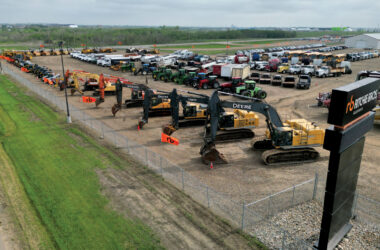

Rows of vehicles in Ritchie Bros. Auctioneers compound
Photo: Ritchie Bros. Auctioneers

In 1958, the three Ritchie brothers – Dave, Ken and John – owned and operated a furniture store in Kelowna, B.C. At the time, the store was having financial challenges, so they decided to liquidate the store’s inventory to pay off some debt. This was the brothers’ first auction.

Now, after more than 65 years since closing the furniture business, Ritchie Bros. Auctioneers has grown to become one of the largest heavy equipment auctioneers in the world, as well as a premier destination for pre-owned construction equipment.

“The brothers went through a couple of iterations auctioning off a variety of commodities until they found their niche and landed on the heavy equipment side of things,” said Jason Huber, Ritchie Bros. regional sales manager – Saskatchewan and Manitoba Industrial Division. “Ritchie Bros. recognized a need in Western Canada for someone to form a marketplace where sellers could part with equipment that they no longer needed, and buyers could acquire that equipment through a public, transparent and unreserved auction.”

“The reality is, because we are not tied to a specific brand, type or industry, nobody sells more heavy yellow iron and heavy trucks and trailers than we do at Ritchie Bros., thanks in large part to the support of SHCA members.”

– Jason Huber, Ritchie Bros. Auctioneers

In the 1980s, Ritchie Bros. went through a period of expansion, setting up shop in the United States in Texas, California and Florida. To this day, the company’s February Orlando Sale is one of the largest events of its kind in the world, seeing thousands of pieces of equipment and hundreds of millions of dollars of transactions occurring over a six-day period. Building on its success over the years, Ritchie Bros. now has operations across North America, Europe, Asia, Australia and the Middle East.

Global reach, local perspective

Despite its growth, Ritchie Bros. maintains a strong Prairie presence. The company has three major yards in Saskatchewan at Saskatoon, North Battleford and Rouleau. Ritchie Bros. employs approximately 100 people in the province.

“Because of our agricultural background, Western Canada is probably the most auction savvy market in the world,” said Huber. “There’s no question that farmers, as a rule, love auction sales. They remember their dads dragging them to sales when they were kids. They remember the smell of pies and burgers in air and the sounds of auctioneers calling out, and for many it was just a big community social event. This nostalgia for auctions continues to be strong across the Prairies, especially in Saskatchewan, which remains a very dominant market share in our auction space – rivalling anywhere else in the world.”

Dozens of vehicles lined up in Ritchie Bros. Auctioneers compound
Photo: Ritchie Bros. Auctioneers

This global presence is what sets Ritchie Bros. apart from the competition. There are a lot of auction houses that can find homes for equipment, but their reach is generally limited to a local audience. This is not the case for Ritchie Bros., where equipment can be sold in Saskatchewan and potentially be sent anywhere in the world.

“It’s not unusual to see our sales end up in another country – we often see something like older Caterpillar equipment ending up in the Middle East,” said Huber. “It’s always a highlight when we see far away places pop up on the map whenever the bidding happens. It’s a real treat when we go back to our customers and say, ‘You know that piece of equipment that you had in your fleet that you got rid of? It’s going to Vietnam or it’s going to Mexico City, or Dubai.’ They usually get a kick to hear where it all ends up.”

Working with members

Ritchie Bros. has long been a member of the Saskatchewan Heavy Construction Association (SHCA), its members often seen at auctions bidding on equipment.

“The members of this association are, by and large, our customers and people who we go to see and visit with on a regular basis,” said Huber. “The reality is, because we are not tied to a specific brand, type or industry, nobody sells more heavy yellow iron and heavy trucks and trailers than we do at Ritchie Bros., thanks in large part to the support of SHCA members.”

Rows of tractors lined up in Ritchie Bros. Auctioneers compound
Photo: Ritchie Bros. Auctioneers

Ritchie Bros. is not only a source of equipment. Because the company is not just a single dealer with a specific brand, and sells all brands, makes and sizes, Ritchie Bros. has a unique vantage to see where the market is going. As such, many of the questions Ritchie Bros. receives from SHCA members and customers revolve around how the market is doing and when the best times to buy and sell might be. Answering those questions is a team in the background of Ritchie Bros that has its finger on the pulse of emerging trends in dealer inventory or Original Equipment Manufacturer output, as well as an eye on which direction prices are heading.

This expertise was especially useful in the face of the extreme supply and demand disruption caused by the COVID-19 pandemic.

“We are still coming out of what is likely the most chaotic market that we’ve ever been a part of,” said Huber. “There was such a scarcity of equipment during COVID-19 that, no matter the condition, everything for sale brought in top dollar and the sellers were kept very happy. In recent months, however, the pendulum has swung and the companies that paid inflated prices are being hit by heavier interest rates – in some cases that results in bankruptcies and more equipment going to auction. This means we are seeing prices levelling off as the supply of yellow iron and core construction gear goes up and, while prices remain strong, it’s nowhere as crazy as it was during the pandemic.”

The evolving auction

With customers becoming accustomed to online applications like eBay, Kijiji and Facebook Marketplace, Ritchie Bros. has been watching the auction space slowly evolve for years. However, the pandemic accelerated the pace of that evolution.

Where the local auction was once a must-attend event that drew crowds, much like a travelling circus, the trend today sees people wanting to go online on their computers and smartphones to bid on equipment. Ritchie Bros. has made it simple for people to bid at RBauction.com from their homes and offices, the front seat of their trucks and even their combines, as auctions today have become more of a transactional activity as opposed to a social event.

“The auction business has certainly changed post-COVID,” said Huber. “Auctions used to be a party that we would hold multiple times a month. Now, they have people watching what’s going on from their computer screens and there’s not a lot of interacting with other human beings.”

“It’s not unusual for us to run into a second or third generation contractor that still [has] the very first grader that their dad bought to start the business, and there is an absolute emotional attachment to the past – we help them work through that and make the auction a positive experience.”

– Jason Huber, Ritchie Bros. Auctioneers

While the day of sale may be different in the business of auctioneering, there is still a very human element behind the scenes in the leadup to auction day. The real thrill for those working at Ritchie Bros. is getting to work one-on-one with the contractors who may have excess equipment or – better yet – are at a point in their career where they’re eyeing retirement. When that happens, Ritchie Bros. works with the customer to make sure they can end their careers on a proper note and, whether it’s been five years or 50 years, the auction house takes pride in giving them the public fanfare they deserve for a career well lived.

“And at the end of the day, if we’ve done our job right, the conversation post sale with the customer, more often than not, leads to tears or gratitude from the person or their spouse or their family, and sometimes a little sadness,” said Huber. “It’s not unusual for us to run into a second or third generation contractor that still [has] the very first grader that their dad bought to start the business, and there is an absolute emotional attachment to the past – we help them work through that and make the auction a positive experience.”

The road forward

Looking ahead, Ritchie Bros. aims to continue providing the same global reach and personalized service that has brought it success over the years. Part of this means continuing its strategic expansion into new areas. In 2023, Ritchie Bros. completed a significant acquisition of IAA, Inc. (IAAI), which brought the company into the salvaged car business.

“IAAI was the number two salvage car company in North America,” said Huber. “So, we now have this whole division of salvage car that opens up other opportunities for us throughout North America – and around the world – in terms of our ability to come to scale, in terms of a real estate footprint, and in terms of what we’re able to offer our customers when it comes to service levels and the ability to remarket their equipment, whether that’s an auto or a bulldozer.”

by Pat Rediger Pat Rediger

From Hamlet to Big City

McDougall Auctioneers: successful auctions, liquidations and consignment sales across North America

Row of heavy machinery in front of McDougal's Auctioneers facility
Photo: McDougall Auctioneers

The hamlet of Langbank was the backdrop of what would eventually become one of the largest auction houses in the country. In 1982, brothers Terry and Loren McDougall began holding farm auctions in their hometown in southeastern Saskatchewan, and before long, they were doing 30 farm auctions a year. In 1985, Loren decided to move to Regina to pursue commercial auctions as well as farm auctions.

Today, McDougall Auctioneers has upwards of 90 employees with facilities in Regina, Saskatoon, Brandon, Winnipeg, Edmonton, Toronto and Montreal. It is one of the leading auctioneering and appraisal companies in Saskatchewan and has developed a solid reputation for reliable appraisals and for successful auctions, liquidations and consignment sales.

Chad Guay, vice president of sales, says the company stems from humble origins, with consignment sales in various industries and has grown and developed into a broad spectrum of categories ranging from commercial equipment, business inventory and liquidations to real estate and industrial equipment.

“Regina is still our headquarters, and I would say that a lot of our sales still come from the Regina office. We just started Alberta about two years ago. Does Alberta have the potential to surpass Regina? It might someday because there’s much more equipment. That being said, Toronto has a lot of equipment, so that could become more important. But as of right now, Regina is still the predominant leader in our locations,” said Guay.

He says that McDougall is pleased to be an SHCA member and has managed numerous auctions of heavy equipment in the province. Most construction auctions are usually in the $6 million to $7 million range, but the company has had sales of up to $20 million. However, that large of a sale is rare, as a company with that value of equipment would likely be merged or acquired into an existing company rather than sold piecemeal.

Aerial view of McDougal's Auctioneers

Online auctions provide the company with the option to sell equipment where it sits. This enables McDougall to serve customers in remote locations as well as urban centres, regardless of whether or not McDougall has a physical location there.

The biggest change in the industry has been the development of online auctions. Guay says McDougall was a pioneer in this development and introduced its own software in 2011. At that time there was no commercially-available online auction software, so the company had to develop its own, which McDougall maintains.

“Loren was the first one in Canada to use online bidding,” said Guay. “He always jokes around that he should have patented it, as he ended up paying for the software, which made quite a big difference. There are lots of other auction houses out there that use software that is not their own and there will be thousands of companies using that software. We use our own bidding software on our own website.”

Online bidding has continued to increase in popularity since its inception and the COVID-19 pandemic accelerated this approach. As each generation becomes increasingly attached to virtual events, the demand of in-person auctions has diminished. In fact, Guay says McDougall has not held an in-person auction since 2018.

“It’s hard to get people to commit to an entire day for a sale, let alone a five-day sale,” said Guay. “Right now, we are prepping for a five-day sale and it’s almost impossible to get people to commit to attending a sale that is that long. People just don’t have the time or attention to attend that long of an event.”

Online auctions provide the company with the option to sell equipment where it sits. This enables McDougall to serve customers in remote locations as well as urban centres, regardless of whether or not McDougall has a physical location there. In the case of heavy construction equipment, which can come with a steep price tag, Guay says the company makes every effort to ensure that buyers have every tool at their disposal before making a decision. That means providing photos, pertinent information and, if necessary, buyers can still come in-person to see the equipment first-hand.

Row of heavy machinery in front of McDougal's Auctioneers facility
Photo: McDougall Auctioneers

“We take about 75 pictures per asset, and we also have video. Obviously, our video of a backhoe is the backhoe driving forwards, backwards and lifting, but it doesn’t show it digging a hole or a ditch, but you can see if it works or not,” he said.

The other recent significant issue for the heavy construction industry has been high prices due to supply chain issues. As new equipment was difficult to obtain, the demand for used equipment has grown considerably, leading to increased prices at auction sales. Although this appears to be levelling off, Guay says that the numbers will likely remain strong for the coming months. With oil and gas prices remaining high, and U.S. shale oil production on the rise, the demand for equipment should continue.

With online bidding now the norm, the number of international buyers has also been increasing. Even with shipping costs, Guay says the company is selling equipment to buyers from as far away as Pakistan and the United Arab Emirates. McDougall will help facilitate the shipping, but the buyer is ultimately responsible for making their own arrangements. Although there are a number of auction houses in the province, Guay says that McDougall stands apart because of its transparency.

“Anyone can be an appraiser, or sales broker or an auctioneer,” he said. “However, not everyone is transparent, or they won’t back up their appraisals with proposals. We pride ourselves on doing that. When we jot a number down, we’ll back it up.”

Guay says that the company also provides plenty of advice and counselling to customers, especially those who have not gone through an auction process before. There are also various issues and circumstances that can come up and customers often turn to McDougall for their suggestions. “We pride ourselves on providing an answer. A lot of people don’t know what to do in certain situations, so we like to consult as best as we can with the skill sets we have available,” he said. Over the years, the company has been involved in several unique auctions. For example, it auctioned vehicles from the popular television series, Corner Gas, and it sold the giant Saskatchewan Roughriders sign that was removed from the old Mosaic Stadium in Regina.

As for the future, Guay says the company intends to concentrate on expanding its Alberta operations, increasing its presence in Ontario and Quebec, strengthening its market share of the agricultural sector on the Prairies and potentially expanding into the U.S.