by SHCA SHCA

$777 Million Highways Budget Delivering for Saskatchewan Motorists and Economy

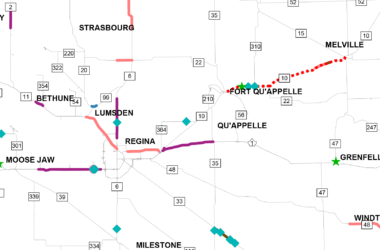
Closeup of map
Click image to download full map (501 KB)

The Ministry of Highways 2025-26 Budget of $777.0 million is a road map to enhance driver safety and invest in strategic infrastructure to sustain Saskatchewan’s export-based economy.

“Our government will continue to deliver on improving our transportation network to build an even better Saskatchewan for all who call it home,” Highways Minister David Marit said. “Our ongoing work will help families, businesses and industries better reach their destinations.”

A $421.0 million investment for capital projects will improve transportation corridors with multi-year initiatives such as:

  • Passing lanes for Highway 10 between Fort Qu’Appelle and Melville, and Highway 17 north of Lloydminster;
  • Highway 39 twinning at Weyburn; and
  • Ongoing corridor improvements on Highway 5 east of Saskatoon.

More than 1,000 kilometres (km) of provincial highways will be improved for a total of more than 7,000 km over six years. Improvements include:

  • 200 km of repaving;
  • 245 km of medium treatments, like micro surfacing;
  • 480 km of pavement sealing;
  • 95 km of Thin Membrane Surface and rural highway upgrades; and
  • 30 km of gravel rehabilitation.

The Safety Improvement Program will invest $25.4 million toward intersections, guardrails, lighting and other assets. Northern Saskatchewan will see $122.3 million to build, operate and maintain highways and airports. Across the province, an $81.6 million investment will repair or rebuild 18 bridges and more than 100 culverts.

This work includes:

  • Starting construction of overpass replacements on Highway 2 over Highway 1 at Moose Jaw; and
  • Replacing the bridge on Highway 2 over Montreal River near La Ronge.

Key municipal road, short line railway infrastructure and related investments include:

  • $18.4 million to support economic growth and safety on rural municipal roads ($1.0 million increase);
  • $8.6 million for construction and maintenance partnerships with urban municipalities;
  • $2.2 million for the Strategic Partnership Program to enhance safe movement of large trucks;
  • $850,000 toward community airport improvements; and
  • $1.0 million for the Short Line Railway Improvement Program ($470,000 increase).

With this year’s budget, the Government of Saskatchewan has invested more than $13.8 billion in transportation infrastructure since 2008, improving more than 21,800 km of highways across the province.

by Martin Charlton Communications Martin Charlton Communications

Election 2024

Paving the way for Saskatchewan’s construction future

Ballot being placed in ballot box, with Canadian flag in background
gioiak2/123RF

This was an election year for our province, and for the Saskatchewan Heavy Construction Association (SHCA), it’s an opportunity. Elections are a chance to draw attention to significant issues in Saskatchewan’s communities and province. Candidates are busy convincing voters to choose them, and voters are paying attention to decide who to support.

It’s an ideal time to have matters important to the construction industry seriously considered by both. The SHCA board wants all members to know the issues it advocated for during the election campaign and to help add their voices to its calls for change.

There were three primary issues impacting our industry that the SHCA focused on during the lead-up to the 2024 provincial and municipal elections. These issues were chosen by the SHCA’s board because they have the most significant impact on the financial certainty of the industry.

They are:

  • Budget planning and procurement
  • Inflation
  • Labour

What members should know

Before these issues are explained, it’s important for members to understand why the SHCA was active during the election campaign. The SHCA is always working to secure improvements for the construction industry. Members may not see a win every time the SHCA engages with the government, but the SHCA always grows stronger as an association through the effort and collaboration it takes to raise and press an issue. By working together, all members benefit.

Voters should care about the issues raised by the SHCA because the taxes they pay go toward building and maintaining infrastructure. Those taxes should be spent in ways that enhance their quality of life.

The SHCA raised these issues to benefit its members, and also to better the province and the quality of life experienced by those living and working in its communities. That focus helps the industry maintain the respect and appreciation of the public, who politicians must pay attention to if they are to win votes. Addressing these issues strengthens not only the industry, but also contributes to a healthier economy and a growing province that can afford to maintain and improve the quality of life for its residents.

Why voters should care

Voters should care about the issues raised by the SHCA because the taxes they pay go toward building and maintaining infrastructure. Those taxes should be spent in ways that enhance their quality of life.

Ask any voter who lives on a pothole-riddled street if improving that road is worth the local improvement tax they pay. Talk to the Regina resident who uses a filtration system on their tap water because they still have lead pipes, and ask whether replacing those pipes is a good use of public funds. Good underground infrastructure ensures clean drinking water. We saw how quickly underground pipes became a political issue for the City of Calgary this year, and more recently, Montreal faced similar challenges.

Lady in red jacket dropping ballot in box
erika8213/123RF

Taxpayers should also consider what it means when projects are deferred. Taxes will rise to cover them in the future, and inflation has already driven up project costs.

Construction projects such as new libraries and pools often get attention. The federal and provincial governments partially fund these projects, but unlike good roads and water infrastructure, they become a continuing expense for the municipality because they need ongoing maintenance. Meanwhile, residents wait for improvements to the infrastructure needed to meet their basic needs.

Understanding the issues

All three of these issues – budget planning and procurement, inflation and labour – are interconnected.

Budget planning and procurement

Multi-year budget commitments have been a longstanding request from the industry to the provincial government. Budget assurances allow members to better plan the resources required to complete projects. Year-to-year budgeting creates uncertainty, making it difficult for members to invest in equipment, retain quality employees or hire and train new staff. This drives them to consider out-of-province projects that don’t strengthen Saskatchewan’s economy.

Manitoba and Alberta both follow long-term budget planning cycles. Saskatchewan needs to take a close look at what they’re doing right. A five-year budget cycle would be ideal, but even allowing contractors to carry over work from one year to the next would help. Manitoba already allows this, providing contractors with some certainty of spring work.

Supporting the heavy construction industry means voters get what they want, and candidates benefit from the positive outcomes the SHCA and its members can help create.

The time is right for Saskatchewan to closely look at what other provinces are doing. The province has made a commitment to work with Manitoba and Alberta to improve the transportation system and to strengthen the economic corridors that support supply chains when it signed a memorandum of understanding (MOU) with those two provinces in April 2023.

Planning, investment and partnership opportunities with the private sector as well as harmonizing the regulatory environment are some of the key priorities for the three provinces. So too is advocating for federal investment into economic corridors. So far, not much progress has been made on these priorities because elections were held in Alberta and Manitoba after the MOU signing. Now, Saskatchewan has had its own election. The time is right to get serious about this.

Front-end loader
alexraw/123RF

Then there is the release and awarding of work. Contractors need work to be released in September and awarded no later than the end of November for the next construction season. Delays in releasing and awarding contracts adds pressure during the building season.

The SHCA knows of no reason it should now take minimum of five days to award a job that used to be awarded the same day the bids were opened. Most construction projects are standard and are driven by data that SaskBuilds already has. The government has created unnecessary layers of bureaucracy with no advantage to business.

Inflation

Looking at budget planning through the lens of inflation, operational expenses for SHCA members have risen as inflation drives up costs for fuel, materials and labour. Yet, the provincial government’s base capital budget hasn’t been adjusted to reflect today’s realities.

Inflation impacts budget planning when the government fails to properly fund its capital plan to account for the industry’s increased operational costs. This results in fewer projects being tendered, leading to fiercer competition so governments think they are getting sweet deals while it creates increased financial uncertainty for contractors.

Labour

Labour is another critical issue. Training, recruitment and retention within the construction industry are heavily influenced by government decisions. The provincial government needs to acknowledge heavy civil construction as a priority to change how young people view the industry, encouraging them to see it as a career and not just a seasonal job. Reliable funding enables heavy construction employers to build and retain a stable workforce. When funding is unreliable, it leads to a transient workforce.

Manitoba and Alberta both follow long-term budget planning cycles. Saskatchewan needs to take a close look at what they’re doing right.

Saskatchewan also lags in recognizing civil construction as an apprenticeable trade, creating a perception that employment in the industry is less desirable than in other construction sectors. This is despite heavy construction being one of the better-paying sectors in the province, second only to mining. The government could also implement aptitude testing during high school to help identify students interested in a construction career.

Why should elected officials care?

The SHCA expects many of its members will encounter elected officials, and it is providing this information to share with them. It is in the government’s interest to support these calls by the industry. Elected officials need to understand how addressing these issues impacts not only the construction industry, but also the economic growth and quality of life in Saskatchewan. By supporting these changes, they contribute to a stronger tax base through infrastructure development that drives growth and generates revenue.

The construction industry enhances the quality of life for residents through the work the SHCA and its members do. Elected officials should recognize that a partnership with the construction industry will help them deliver on voters’ priorities. People want governments – especially municipal governments – to get back to basics: Provide good roads, clean drinking water and efficient and dependable services such as snow removal and garbage pick-up. All those examples are impacted by the work done by SHCA members.

Supporting the heavy construction industry means voters get what they want, and elected officials benefit from the positive outcomes the SHCA and its members can help create. 

by SHCA SHCA

Budget Déjà Vu

Looking back at provincial budgets from the last decade

By Martin Charlton Communications

Familiarity can be comforting – except when looking at a provincial budget in a province focused on growing. 

The numbers within Saskatchewan’s provincial budget this year for the Ministry of Highways  remain the same. That portion of the budget looks very similar to budgets all the way back to 2015. 

The Saskatchewan Heavy Construction Association (SHCA) promotes investing in highway infrastructure to help the province grow trade, which in turn grows the economy. There is a return on investing in highways as trade infrastructure. 

Investing in highways that allow for the efficient transportation of people and goods enables trade, which encourages further economic growth. That economic growth then increases revenues to the provincial government to support spending in areas such as healthcare, education and social programming. That is investing to encourage growth. 

The theme of this year’s budget was “Classroom, Care and Communities.” Nearly 60,000 more people are using Saskatchewan’s schools, hospitals and other services since late 2018 – but responding to growth is not the same as encouraging it.

When it comes to the Ministry of Highways, the provincial government said with this year’s budget announcement that “roads and highways keep Saskatchewan residents connected and the economy growing, which is why the 2024-25 Budget makes road maintenance and safety a priority.” The money to be spent “makes our roads safer by improving key transportation corridors to continue to meet the growing needs of Saskatchewan families and communities.” 

Looking back over the last five to 10 years, the cost of construction has been rising, while the money dedicated to capital within the Ministry of Highways budget has not. For a growing province, these consistent numbers barely represent maintenance and don’t reflect growth. 

The money

There was less money in this year’s highways budget than last year’s. Year over year, there is a difference of $35 million.This year’s budget is $741 million, while last year’s was $776 million. 

The government says the entire amount collected in fuel tax – $521.3 million – will be “enhanced with additional investments to maintain and operate Saskatchewan highways.” It will invest $617.1 million into operating, maintaining, building and improving Saskatchewan roads and highways, which it says is an increase of $21.1 million, or 3.5 per cent, for the Ministry of Highways. 

The capital portion of the Ministry of Highways budget is down by $18 million compared to last year’s. This year, it is set at $404 million compared to last year’s $422 million. 

“Our industry is prepared to build more than what this budget provides for capital spending,” said Shantel Lipp, president of SHCA. “Spending a minimum of $450 million would be more representative of a budget that is dedicated to growth.” 

Budget yearOverall budgetCapital
2015/16$842M$560M
2016/17$875.5M$472M
2017/18$860M$343M
2018/19$924M$360M
2019/20$706.1M439.8M
2020/21$782M$411M*
2021/22$830M$520M
2022/23$846M$453M
2023/24$776M$422M
2024/25$741M$404M
*includes $53M in stimulus spending

10,000 kilometres of upgrades

Saskatchewan’s government has an annual goal of improving 1,000 kilometres of highways per year to hit a target of 10,000 km upgraded by 2030. That is in its Growth Plan for the province. 

The upgrades are focused on a few areas: repaving, medium treatments, pavement sealing and Thin Membrane Surface and rural highway upgrades.

Improvements laid out in this year’s budget are for 1,100 km of provincial highways. This year, some categories saw the number of kilometres increase year over year – repaving, medium treatments and pavement sealing. Others – Thin Membrane Surface and rural highway upgrades – went down. 

The province said once again it is well ahead of the pace needed to hit its 10,000-km target. Over the last five years, the province has improved 5,900 km. If the goal remains to target 10,000 km for improvement, there are 4,100 km left to improve between now and 2030. For context, Saskatchewan’s road network consists of 26,455 km of provincial highways.

Announcing projects year after year

“This year’s budget announcement wasn’t just a matter of the provincial government not keeping up,” said Lipp. “There was nothing new in it – no new work at all. Everything in it is already out.”

Every year,  major projects are highlighted during budget announcements. Often, the same ones are mentioned. 

For example, Highway 5 east of Saskatoon has been mentioned every year since 2018-19. Highway 5 takes drivers from Saskatoon to Humboldt, which is near the BHP Jansen mine. That is anticipated to be the world’s largest potash mine and was one of several major projects announced by private industry for Saskatchewan in recent years. 

Preconstruction and design work for passing lines on this highway began in 2018-19.  In the following year’s budget, there was over $60 million in funding for twinning and passing lane projects, including for Highway 5 between Saskatoon and Highway 2. Improvements to strategic transportation corridors around the province were then announced in 2020-21, which also included two sets of passing lanes and resurfacing and widening of Highway 5, plus planning for a short section of twinning between Saskatoon and the junction of Highway 2. For the next two years, those two sets of passing lands and widening were mentioned again. 

In 2023, it was said that passing lanes and widening on Highway 5 east of Saskatoon to Highway 2 would be completed with plans to extend twinning on Highway 5. Now, corridor improvements have been announced for Highway 5 east of Saskatoon.

NUMBER OF KILOMETERS TO BE IMPROVED BY PROJECT TYPE

2025-242023-242022-232021-222020-21
Repaving260230170250280
Medium treatments,
like micro surfacing
365300550510460
Pavement sealing400340100225100
Thin Membrane Surface
and rural highway upgrades
58115200280120
Gravel rehabilitation2535152535

Looking back on highway budgets 

Saskatchewan’s Growth Plan has numerous economic goals and the heavy construction industry has a role in ensuring several of them are achieved. The work the heavy construction industry undertakes contributes to other industries making advancements, so they can achieve the goals set by the province.

For example, when a canola crush facility is announced, there is earthwork necessary ahead of that facility being developed, which contributes to the goal of increasing Saskatchewan-based processing of canola grown in the province. Another goal is to double the size of Saskatchewan’s forestry sector. The heavy construction industry’s work to improve roads in northern Saskatchewan supports that goal as well. 

In recent years, there have been challenges that accompanied opportunities along Saskatchewan’s path to growth. Budget announcements have reflected this. 

Prioritizing safety 

Safety was the theme of the Ministry of Highway’s budget announcements for several years. Major safety improvements for many of Saskatchewan’s busiest highways were highlighted when the 2018-19 budget was announced days after the Humboldt Bronco’s bus crash. That budget included $924 million for the Ministry of Highways with $360 million for capital. 

 “We’re pleased to see that our government continues to focus on investing in our industry, not only for enhancing safety across the province, but assuring our economy runs efficiently,” said Kevin Arneson, SHCA chairman at that time. 

Looking back over the last five to 10 years, the cost of construction has been rising while the money dedicated to capital within the Ministry of Highways budget has not. For a growing province, these consistent numbers barely represent maintenance and don’t reflect growth.

Safety improvements across the provincial highway network were again the highlight for the following year. The 2019-20 budget included $706.1 million for the Ministry of Highways with $439.8 million for capital (with $89 million of that to complete the Regina Bypass in fall of 2019).

Lipp says that year’s budget was “status quo.” SHCA didn’t expect any surprises or a significant shift in infrastructure spending that year, and that’s exactly what was delivered, which the association explained could present positive outcomes but also some dramatically negative ones for the industry. It was then identified that major projects announced in 2019-20 were carried over from the previous year, meaning there was no new work available for what was already an extremely competitive market. 

Stimulus spending during the pandemic

In May 2020, the province said it was releasing $300 million in new highways projects to boost the Saskatchewan economy while improving safety and capacity. These projects were part of a $7.5 billion, two-year capital plan “to build a strong Saskatchewan and stimulate Saskatchewan’s economic recovery.”

That year, SHCA applauded the provincial government for the much-needed infrastructure fund to be applied to capital projects throughout the province. 

“This funding commitment is a welcome move towards hopefully maintaining and eventually growing these job numbers and getting our economy back on track,” SHCA said in a news release issued in response to that year’s budget. 

“Prior to the COVID-19 pandemic, the provincial economy was already facing headwinds through depressed resource prices, anti-pipeline policies and rail blockades,” Lipp said at that time, pointing out that the funding for highways would help not only the heavy construction industry, but the whole province. 

The 2020-21 budget had $782 million for the Ministry of Highways, with $411 million for capital. It included stimulus spending of $67 million (with $53 million of that for stimulus projects).  

Even with stimulus funding, the numbers in the capital budget for the Ministry of Highways did not significantly change. 

“The Ministry of Highways’ capital budget is still reflecting the remnants of the stimulus programs years later,” said Lipp. “Looking back, there were budgets prior to 2017 that were higher than what the provincial government spent when it included stimulus funding.” 

For example, the capital budget for the Ministry of Highways in 2015-16 was $560 million. 

Bouncing back and growing forward

The message from the province about the Ministry of Highways’ budget changed slightly in 2021. 

The 2021-22 budget had $830 million for the Ministry of Highways, including $520 million in capital, which was earmarked for dozens of projects throughout the province. Many of those projects were multi-year initiatives. The number of kilometres announced for improvements as part of the Growth Plan was up to 1,350 km that year.  

The province said it was investing “in Saskatchewan’s highways and roads to protect the driving public, build Saskatchewan highways and grow our economy.”

“In a time when our provincial economy is sluggish, our industry is thankful for the provincial government’s continuation of spending in our sector,” said Lipp. “We believe our industry is one that will lead us to economic stability and future growth.”

The message from the government was identical in back-to-back years. The 2022-23 budget had $846 million for the Ministry of Highways, with $453 million for capital. That was also described by SHCA as a status quo budget, with most projects already awarded and tendered in fall 2021.

“Recent announcements of major projects being built in the province will require an enormous amount of new infrastructure,” Lipp said at that time. There had been many announcements about private businesses increasing their production to meet the world’s needs and investing in capital in the province to do so. Several canola processing plants were announced at the start of the decade. Potash mines, including those owned by BHP and K+S, moved ahead with plans to increase their production. There were developments in the production of resources such as lithium, helium and more.  

“Those projects are being created to bring our resources to the world and help build our provincial economy. Without proper infrastructure funding, these projects could be negatively impacted. Add[ing] to that, the province is facing unpreceded demand worldwide for our agriculture products and our producers rely on good roads to get their goods to market,” Lipp said, with regards to that budget. “There is no new funding for projects for this spring, which leaves the industry behind when there is such an urgent need for highway and infrastructure funding.” 

“This year’s budget announcement wasn’t just a matter of the provincial government not keeping up. There was nothing new in it – no new work at all. Everything in it is already out.”

– Shantel Lipp, SHCA president

Beyond Saskatchwan’s borders

In 2023, the message put out by the province about the Ministry of Highways budget was that “investing in Saskatchewan’s highways and roads” will “enable the safe, reliable and sustainable movement of people and goods.” 

That year, SHCA said it looked forward to discussing planning and investments over a longer term going forward, to create long-term funding commitments that would put Saskatchewan’s industry on more stable footing (as seen in Alberta and Manitoba).

Weeks after the 2023-24 provincial budget was announced, Saskatchewan signed a memorandum of understanding (MOU) with Manitoba and Alberta in April 2023. That MOU committed the three provinces to work together to improve the transportation system and strengthen the economic corridors that support supply chains.

There are key priorities that Saskatchewan, Alberta and Manitoba share when it comes to economic corridors. Kyle Toffan, the deputy minister of the Ministry of Highways, explained more about it when he participated in a panel discussion held during SHCA’s Infrastructure Summit and Trade Show in November 2023. The theme of that panel discussion was “How Trade and Transportation Infrastructure Intersect in Canada’s Economic Growth Strategy.”

Planning, investment and partnership opportunities with the private sector are some of those key priorities. Harmonizing the regulatory environment and  advocating for federal investment into economic corridors is also important. 

“If Alberta, Saskatchewan and Manitoba can find three or four quick wins, some really big-ticket items that need investment, we’ll have a much better chance at getting investment than if we went at it alone, so we are trying to figure out a went at it to co-ordinate that as well,” Toffan said during the panel discussion. 

However, elections were held in Alberta and Manitoba after the MOU signing, which delayed progress on addressing the priorities. This fall, Saskatchewan will have its own election.  

Infrastructure to encourage – not just respond to – growth

When announcing this year’s budget, the government pointed out that it has invested more than $13 billion in transportation infrastructure since 2008. However, Lipp says she is skeptical that voters will find that message meaningful. 

“They can’t keep touting numbers from 2008 and think that folks are going to be happy about what they did as a new government,” said Lipp.

Going forward, SHCA looks forward to having productive conversations with the provincial government about the future of investing in highways as trade infrastructure that supports economic growth. In having those discussions, it will be important to remain aware of what the Ministry of Highways is facing. 

During the Infrastructure Summit panel discussion, Toffan outlined the Ministry of Highways’ challenges and opportunities. They include reduced federal funding of infrastructure, strained capacity in all areas of the supply chain to develop more infrastructure, rising costs due to inflation, the impacts of the carbon tax, insufficient national trade and transportation planning and geopolitical considerations that can impact the quantity of resources, such as potash, that are needed by other nations. 

“We have a huge amount of gross domestic product that depends on trade infrastructure,” Toffan said during the panel discussion. “Saskatchewan has been doing about $37 billion in trade a year and we have targets to grow that. That means more transportation infrastructure, not less.”

Some judge major investments in infrastructure projects that are expected to serve the province for 100 years after just two to three years of operation, which Toffan said is short-sighted.

“These investments are being made for our kids, our grandkids and our great grandkids, no different than the investments made in 1800s and early 1900s,” said Toffan. “We have to think differently about these investments. They are nation-building and they have the opportunity to unlock all kinds of economic potential.”