by Pat Rediger Pat Rediger

Making the Transition

GCL makes the switch from construction to sales, rental and repair
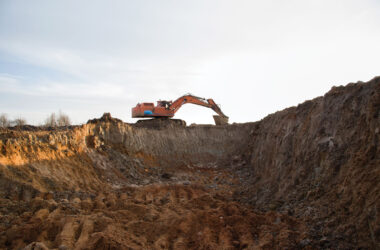

No one knows the ups and downs of the Saskatchewan economy better than Treverr Poole. When the oil and gas industry was booming and potash was thriving from 2008–13, his company, Garry’s Construction Ltd. (GCL) was thriving with 50 employees and upwards of 70 pieces of equipment. After oil and gas dried up, potash took a downturn and then the pandemic hit, his crews and equipment sat idle at his facility in Edam.

That’s when he made the crucial decision to pivot into a new business. GCL now specializes in heavy equipment sales and rentals and he formed a complimentary company, Garry’s Heavy Repair (GHR), which provides heavy duty mechanics for truck and trailer sales.

“There was a time when we were making good money and my crew were getting well paid, but it was very stressful. Then in 2014 the oil and gas industry crashed and big projects were cancelled. It got really quiet for about nine months and we didn’t have much income coming in. It was pretty scary. I’d been through ups and downs before but I could tell that this was different and there wasn’t going to be a big comeback like before,” said Poole.

With the construction side fading, the company’s heavy duty mechanical work began to take on more importance. GHR was operating in a 15,000 square foot facility with an overhead crane for repairing his equipment. Poole began expanding into repairing other equipment, such as farm trucks and trailers, and that seemed to be the future.

Another factor that led him to exit the construction business was the death of his two long-term foremen within a few months of each other. One succumbed to cancer and another to a heart attack. Some of the members of his crew found other jobs while the company waited for other work to come in, and while the pay may have been less, they were assured of a paycheque. This discouraged them from returning to the construction industry.

Poole contacted his friends at Ritchie Bros. Auctioneers and decided to sell his construction equipment. Once he recognized the tax implications from the sale, he agreed to keep about 20 pieces that he could use as rentals. The equipment includes dozers, track hoes, scrapers, compactors, rock trucks and much more. Today, his equipment can be found at a provincial government irrigation project near Swift Current, at an elevator site near Kindersley and at various road construction projects in different areas of the province.

Although GCL has been involved in numerous heavy construction projects over the years and Poole has been asked to bid on other projects that have come up, he’s content to stay focused on sales, rentals and repair. He has no intention of returning to the construction side of the business.

“Now I don’t have to deal with projects and timelines that impact my weekends. Now it’s like any other business and we can shut the door at the end of the day. Before it could be seven-days-a-week and sometimes 24-hours-a-day,” he said.

“Now it’s like any other business and we can shut the door at the end of the day. Before it could be seven-days-a-week and sometimes 24-hours-a-day.”

– Treverr Poole, GCL and GHR

GCL Origins

GCL traces its roots back Poole’s father, Gary, who started in the industry in the late 1960s by building roads for a local construction company. After serving as foreman for a while, he decided to strike out on his own and formed GCL in 1974.

“He probably started with five pieces of equipment and had about 10 guys working at any given time. It was all road construction work and a bit of oil. He didn’t go looking for work but rather took work when it came to his door,” said Poole.

Poole started working at the company while just a teenager and began running things when he turned 22 in 1994. Over the years, the company worked on a variety of major projects including Husky Oil fields, the Kramer Tractor facility and an industrial park – all near North Battleford. GCL also constructed the road between Highway 16 and Battleford and did considerable work for the BHP Jansen Potash Mine site.

“We were doing potash work here and then over here we were doing oilfield work. We were really, really busy. I remember those days because people asked me if you’re busy and I would say that it just couldn’t get any busier. There just weren’t any more operators and equipment to work on more projects.”

But by 2015, it was becoming clear to Poole that the days of the major projects were coming to an end. He had also reached many of the goals he had set up for himself when he became the owner – hitting his sales targets and achieving financial independence. So it was time to move onto the next opportunity.

His cousin Darcy took charge of GHR and it has become a successful operation since large vehicles in the area always need to be maintained and repaired.

“There are still trucks going up and down the highway and they need to be repaired. Even combines need to be serviced. Farmers run large operations and they don’t want to fix large equipment so we are able to do that for them.”

The Next Generation

Just like when Poole took over from his father, his own son has shown an interest in the business. Trayton can often be found lending a hand at GHR and visiting auction sales to see if there is equipment that can be purchased and repaired so it can be either rented or sold. As the next generation becomes more involved in the business, Poole says his father still enjoys visiting the company and seeing how things are progressing.

GCL has been a SHCA member for many years and Poole said they likely joined when his father was still in charge. He says it is important to be a member to get the latest information and to know that the industry is being supported and promoted.

“This is a new and exciting time for our business,” he said. “It’s even a little bit scary, but it’s also exciting to see what can be done with this new venture and to see how it will turn out.” 

All photos courtesy of GCL

by SHCA SHCA

Engineering Our Nation

After entering the Saskatchewan market in 1953, Associated Engineering has become a fixture at major infrastructure projects

Plenty has changed in the world over the last 70 years, but one thing that has remained constant is the stable existence of consulting firm Associated Engineering. Founded in Edmonton, Alta., following the Second World War, Associated Engineering has grown to become one of the Canada’s most significant long-serving engineering consulting firms with 21 offices across Canada and employing more than 1,000 staff. The company is the largest of the privately held, employee-owned engineering firms in the country, working with public and private sector clients here and internationally.

“The fact that we are a private firm means we take complete ownership of the work that we do, the relationships that we have with our clients and the products that we produce,” said Paul Pinder, a professional engineer and vice president and general manager of Associated Engineering for Saskatchewan and Manitoba.

During the past 12 years, the firm has been awarded one of Canada’s Best Managed Companies, earning Platinum membership status in the respected national program. It has also been a carbon neutral company since 2009.

Associated Engineering provides community planning and engineering services for water and wastewater, transportation, municipal and industrial infrastructure, buildings and environmental projects. Beyond this, the company also provides infrastructure management and certified operational training and support to many clients, in the interest of public health and safety, through its ATAP subsidiary.

The firm also provides in-depth environmental science and management services for bridges, roads and highways, community and industrial development, infrastructure rehabilitation and airports. Other services include solid waste management, landfill design, composting, odour control and environmental impact assessment.

Entering Saskatchewan

The company entered the Saskatchewan market in 1953, opening an office in Regina to service clients in southern Saskatchewan. It quickly established itself by providing the engineering work for the initial Buffalo Pound project, which would supply water to Regina and Moose Jaw.

The company later expanded to offices in Saskatoon and Prince Albert with the Saskatchewan head office situated in Saskatoon. Pinder oversees all three offices, as well as the Winnipeg office and the ATAP subsidiary.

In Saskatchewan, Associated Engineering focuses on projects in the transportation, municipal infrastructure, water, wastewater, intakes, bridges, environmental, buildings and asset management sectors. The Saskatchewan employee complement currently sits at 140 staff across the three offices. Much of the firm’s work in the province is done in small communities, Indigenous communities and smaller cities, complemented by projects within bigger centres, such as Saskatoon and Regina.

“Many communities in the province are in need of an effective water treatment plant or have an existing facility that is inadequate, have insufficient capacity for the community’s size, are unable to consistently meet drinking water requirements or may be so dated that they simply need replacing,” said Pinder.

“Smaller communities and smaller cities are often in greater need of engineering assistance from firms like ours as they don’t have the tax base of the bigger cities like Regina and Saskatoon who are large enough to have in-house engineering departments. This is where we come in. We provide many small communities, or even cities like Moose Jaw or North Battleford, with the engineering expertise they need when they need it without being a continuous financial load on their operating budget. The same can be said of highly specialized and complex projects in the larger cities as well, where our extensive experience and specific expertise, such as water and wastewater treatment, can really be brought to bear.”

Associated Engineering also does a significant amount of work with the Saskatchewan Ministry of Highways and Infrastructure on transportation infrastructure design and construction.

“Everything that we do in this sector is engineer-based, either design engineering or construction administration. When we are commissioned for transportation infrastructure by the Ministry, we do an in-depth review of what is required and come up with a detailed design solution and a tender package. Then we also provide service in construction management and operational assistance,” explained Pinder, a transportation engineering specialist.

Associated Engineering also has a strong partnership with SHCA to assist them in the work that they undertake.

“We work with SHCA with many contractors all the time. So not only do they support us, but they are also a part of the process,” said Pinder.

Current projects

Currently, Associated Engineering is doing a significant amount of work in Langham, a small community west of Saskatoon, including sewage pump station upgrades, a lagoon upgrade and infrastructure assessment.

Another larger project Associated Engineering has been contracted for in Saskatchewan is the development of The Greens on Gardiner, a major residential subdivision located in southeast Regina. Associated Engineering also led the design and construction of upgrades for the La Ronge and Air Ronge municipal utilities to provide back-up systems to keep tap water flowing during power outages – an issue many northern communities face.

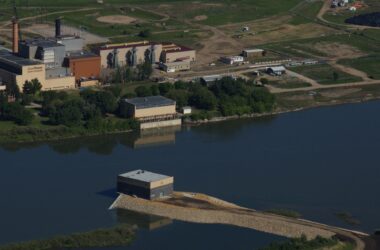
Associated Engineering has also been involved with the City of Martensville Athletic Pavilion, snow management facility, the Avenue H Reservoir, Raw Water Intake and Pump Station in Saskatoon, the Regina Bypass, Chief Mistawasis Bridge and environmental site assessment for the Town of Lumsden’s landfill. A listing of Saskatchewan projects can be found on the company’s website at www.ae.ca.

Projects and overall work load has continued for the firm across Canada despite COVID-19. Fortunately none of the offices have had to be shut down yet; however, many of the employees started working from home when the pandemic started. Any staff who remained in the offices, or have returned to the offices since, follow health guidelines, contact and cleaning protocols stringently.

“Work never really slowed down for us because provinces and municipalities confirmed engineering as an essential service. A community that is in need of a critical infrastructure project, like a new water plant, cannot put something like that on hold, so we have kept most projects moving through the pandemic,” said Pinder.

Despite COVID-19, Associated Engineering assures its clients that its project delivery remains the same. Staff are available by phone, email, teleconference or videoconference. Project managers will continue to reach out to clients about project updates and reviews and answer any questions.

“Our goal is to keep building better communities; we do that in three ways. The first is more obvious with building better infrastructure that supports the health and economic wellbeing of our towns and cities; the second is contributing to important local charities – we believe in our social responsibility to the communities in which we work; and the third is developing and training our staff to provide them career growth and opportunities while creating a great culture within our firm. What we do is all in the service of public protection, environmental stewardship and fiscal responsibility. In this way, we shape a better future for all of us.” 

Photos courtesy of Associated Engineering