by Jim Timlick Jim Timlick

Cenovus Energy

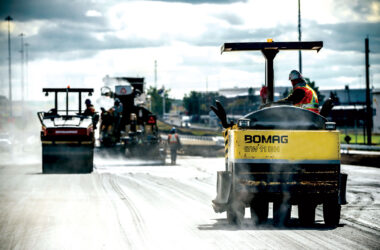
Contractors paving road
Contractors work with Cenovus Asphalt to pave a road using a hot in-place recycling technique, which is the process of rehabilitating deteriorated pavement

This Canadian-based integrated energy company has had a presence in Canada’s so-called breadbasket region dating back all the way to the mid-1940s.

That’s when Husky Energy established one of its very first oil fields in the northwest corner of Saskatchewan near the Alberta border. It was about the same time Husky opened its first asphalt plant to produce the paving material required to build many of the province’s roads.

Today, Cenovus, which purchased Husky in 2021, is one of Saskatchewan’s top employers with a workforce of more than 1,300 people in the province. The company is headquartered in Calgary, Alta., and has asphalt producing refineries in Lloydminster, Alta. and Superior, Wis. It also has asphalt terminals across Western Canada and the Midwest in the U.S., with Cenovus’ most recent addition being a new terminal near Denver, Colo.

“All of our network is supplied by crude oil produced in Saskatchewan and supported by the brilliant minds in our technical services and innovation lab based in Saskatoon,” said Martin Ray, director of the company’s asphalt and industrial products division. “We like to consider ourselves an integral part of the community and the economy in Saskatchewan.”

Lab technician wearing safety goggles
Cenovus’s Saskatoon lab performs quality testing on all the asphalt and industrial products sold in Canadian Downstream Terminals including asphalt binder, polymer modified asphalt and asphalt emulsions.

Asphalt and industrial products are part of Cenovus’ downstream division that refines crude oil into finished products. Cenovus is the third largest asphalt producer in Canada and the U.S. Other divisions include crude oil and natural gas production and midstream, which is responsible for the transportation of crude oil to the markets that require them.

“I think it’s a cool story and it’s a Canadian story,” Ray said. “We’re a fully integrated company. In other words, our operations involve activities that find, develop and unlock value from commodities that originate in Canada. In our downstream business, our team handles the marketing, transportation and sales of all of these commodities across North America.”

Cenovus provides two essential products to Saskatchewan’s heavy construction sector. The first is diesel fuel to power heavy equipment, which is processed at its upgrader on the Saskatchewan side of Lloydminster. The other is the asphalt used for road building, processed at the Lloydminster refinery and distributed through its terminals in Yorkton and Saskatoon. That asphalt is used in several different road building products, most commonly use as a binder for rocks in asphalt pavement. That same asphalt is also used to create an emulsion to help fill cracks and other imperfections in roadways. It’s essentially heated asphalt combined with water to create a liquid-like substance that can be sprayed on the road.

One of the more unique products the asphalt and industrial products division produces is a polymer-modified asphalt. It’s created by combining regular asphalt with rubber and rock to produce pavement that has elastic recovery properties and is able to better survive Canada’s harsh winters. “It’s a super cool technology,” said Ray. “It’s unique in that it can withstand our massive freeze/thaw cycles. It’s an engineered product that can stretch a little bit so it can absorb wear and tear. It’s more resistant to rutting and cracking.”

Something else that distinguishes Cenovus in Saskatchewan is its commitment to research in the province. To support this development, the company donated $2.5 million to Saskatchewan Polytechnic’s Time to Rise campaign in 2024. The campaign will fund the construction of the school’s new Saskatoon campus.

As part of this investment, Saskatchewan Polytechnic’s new centralized chemical technology lab, power engineering lab and instrumentation engineering lab will be named the Cenovus Energy Labs. The labs will provide students with the latest technology for hands-on training, something the company says it will need in its future workforce.

The company also recently made a $1.5 million donation to the University of Saskatchewan as part of that institution’s Be What the World Needs campaign. Those funds will be used to help develop the Cenovus Energy Makerspace that will play a key role in advancing engineering innovation and design and provide students access to advanced tools such as polymer 3-D printers and laser cutters.

Exterior view of refinery
Cenovus’s Lloydminster, Sask., refinery supplies the company’s network of terminals and direct to customers via truck and rail.

Ray says it’s all part of a team approach taken by Cenovus to help advance research and create new products that benefit the people of Saskatchewan and the rest of the country. “With academia, the private sector and government, you create a nice triangle of innovation to build the infrastructure that we all use,” he said. “Our role is to be able to build the best quality of roads at the lowest possible cost so that our tax money can go as far as it can. It’s all about industry partnering with academia and with governmental agencies, to provide Canadians better and safer access to commercial and human movement.”

Cenovus’s asphalt division has worked closely with the Saskatchewan Ministry of Highways on several projects throughout the province over the years. Ray says it has been a great partnership due in large part to the fact the province is committed to engaging in constructive dialogue with the private sector. “Saskatchewan Highways is excellent,” he said. “They engage their contractors, they engage their suppliers and they’ve been really innovative. I give Sask Highways a lot of credit. They’ve been quite progressive in a lot of ways.”

The company also engages in conversations regularly with the many contractors it works with in the province. Many of those conversations centre on technical questions such as which materials may be best suited to rebuild a road or deal with “alligator” cracking or a high-water table.

Another popular topic with those clients is the infrastructure deficit facing the province and what can be done to address the situation. “The infrastructure deficit is always a challenge,” Ray said. “I think Saskatchewan road builders play a big role in helping moderate discussions around infrastructure and [investing] in infrastructure versus other places to invest in the province. They help create an environment in which industry can speak with government to try to manage investment in the road system and bridges.”

“We like to consider ourselves an integral part of the community and the economy in Saskatchewan.”

– Martin Ray, Cenovus

Tariff uncertainty is something that the industry is dealing with now. Tariffs don’t impact asphalt since it’s one of the CUSMA-compliant products protected through the Canada-U.S.-Mexico trade agreement, but Ray points out that tariffs could mean increased costs to acquire the heavy machinery required to build roads. “Contractors utilize a lot of road building equipment, whether it’s yellow iron [heavy equipment] or trucks. I’ve got to imagine there’s some pressures that [contractors] like all of us are feeling,” he said.

Despite this, Cenovus plans to continue to focus on being a “worldclass” operator of its assets. The company recently completed several planned maintenance upgrades at its asphalt terminals in Yorkton and Saskatoon as part of a 10-year plan. It also has scheduled maintenance planned for its refineries in Lloydminster. Those improvements are all intended to drive a combination of cost, reliability and environmental improvements. “We are proud of our footprint and we’re going to keep investing in that footprint,” Ray said.

Cenovus is also continuing to work with its partners to develop several new and innovative technologies. One of those products is a softer form of asphalt that features different chemical properties that allow more of it to be recycled and incorporated in new roadways rather than shipped to landfills. The company is also involved in research looking into how consumer waste, including plastic polyethylene and other items, can be incorporated into asphalt used to build roads.

Something that isn’t likely to change is the value Cenovus sees in being an SHCA member. “We actively want to be part of associations that have influence in the industry and [SHCA] is brilliant at that,” Ray said.

“They pull together a range of stakeholders in this industry. You’ve got contractors, you have suppliers, you have governments at various different levels. They work collectively to create a forum by which we can be innovative, we can address challenges, we can work with governments to address industry-specific issues and we can advocate for infrastructure spending.”

by SHCA SHCA

From the Farm to the Truck to Earth Spraying

Taking advantage of opportunities

By Pat Rediger

It often seems like one opportunity leads to the next and that’s the case for Darin and Tina Stene. Situated in Shellbrook, the couple began Triple S Transport in 1995 to provide surrounding communities with grain hauling. As time passed, the company expanded to provide flat deck and tanker hauling, and about six years ago, they launched Green Earth Road Spraying, a complementary company that provides dust control, spraying, and manufactures and distributes liquid de-icer for road safety.

“Over the years, we have been through a lot,” said Darin. “We’ve seen labour shortages, fuel shortages, the pandemic and so on. Regardless of what the economy throws our way, we have remained proactive and resilient throughout all the changes needed to keep our business thriving.”

Darin grew up on a farm just outside of Shellbrook and his upbringing laid the foundation for his future career. At an early age, he learned how to operate all the different pieces of farm machinery and equipment, and he quickly developed a passion for the trucking industry. This passion eventually led him and Tina to start their own firm. 

From those humble beginnings, the company has grown to 37 employees, and is always on the lookout for more drivers to join the team. Today, Triple S Transport has a full line of trailers including flat decks, step decks, a ten-wide tilt deck, super B flat decks and super B tankers. It also provides over-dimensional hauling and pilot car services. The company, which is 50 per cent Métis-owned, operates across Canada and is always looking for ways to expand its areas of service. Green Earth Spraying works within Saskatchewan.

Green Earth Road Spraying uses a calcium chloride base stabilization to harden a road surface and reduce rutting caused by heavy traffic

The expansion into Green Earth took place about six years ago. Triple S Transport was contracted by Kortech, an Alberta company that produces and distributes calcium chloride, to transport their products. As they began working more closely together, Darin and Tina determined there was a future in becoming a distributor and established the new company. 

“Green Earth Road Spraying provides a start-to-finish – and beyond – relationship with all our customers,” said Darin. “We haul the fluid, prep the roadways or coach the rural municipal operators on how to prep their roadways, spray the calcium chloride and follow up with the maintenance with all the rural municipalities that we work with. Each roadway is unique and must be treated as such. Proper preparation and maintenance are key for any roadway, and we make sure to be a part of both with all our customers.”

Heavy construction contractors in Saskatchewan often turn to Green Earth Road Spraying for its expertise in dust control. The company frequently receives inquiries about the benefits of dust control and the application rates needed to achieve optimal results.

“As dust control becomes increasingly sought after, we strive to provide the most effective solutions and remain at the forefront of the industry,” said Darin.

“Proper preparation and maintenance are key for any roadway, and we make sure to be a part of both with all our customers.”

– Darin Stene, Green Earth Road Spraying

Understanding calcium chloride

Green Earth Road Spraying uses a calcium chloride base stabilization to harden a road surface to reduce rutting from heavy traffic. It also reduces surface erosion and sedimentation, improves safety on the roads by reducing dust, raveling and wash boarding and lessens costly frost penetration. There are also different types and mixes of calcium chloride, some of which are less corrosive on roads compared to traditional de-icing rock salts, and others that are designed for roadways with little or no clay in the aggregate.

Darin and Tina’s dedication to their clients helps them stand out from competitors. Green Earth Road Spraying provides start to finish services and goes above and beyond to establish a strong relationship with customers. Due to the increasing demand, there is no shortage of work to go around. However, it can be difficult to schedule all the clients because Mother Nature sometimes has different plans. 

Supply chain issues have also been a concern for the company. They have had trucks down for close to year while waiting for parts to arrive. Even now, they have several parts on backorder that are needed to repair trucks essential to business.

One of Green Earth Road Spraying’s units

Being part of the Saskatchewan Heavy Construction Association has been helpful to the company. SHCA provides excellent training and advice for those in the industry. Making connections and being able to phone others in the industry who have important information is extremely beneficial. 

As family-run businesses, both Triple S Transport and Green Earth Road Spraying understand the importance of a healthy relationship with customers. Whether it is delivering goods from coast to coast, or providing much-needed road maintenance work, you can count on both companies to provide excellent service.    

by SHCA SHCA

Big Equipment at Big River

Coop-A-Deez Contracting Ltd. provides resilience and reliability even in times of uncertainty

By Pat Rediger

Fresh out of high school in 2009, Cooper Davis found himself in the oilfield at just 18 years old. Working long hours at remote locations, he quickly learned the value of a dollar and the hard work to earn it.

At first, the oilfield offered a lucrative and seemingly stable job where he operated heavy equipment. He met a fellow who mentored him on the equipment, and he became quite a proficient operator. But as prices became uncertain, people began losing their positions and Davis was forced to reconsider he career options.

When oil prices reached an all-time low in 2015, Davis decided that the time might be right to return home to Big River and do some contract earth-moving work.

“Oil had taken a hit and as a result I saw the chance to get my first piece of equipment,” he said. He and his wife Emily saw the equipment purchase as an opportunity to build a business of their own, leading to the creation of Coop-A-Deez Contracting Ltd.

Cooper Davis in his Dozer
Some of the earthmoving equipment used
by Coop-A-Deez Contracting, Ltd.

With only a single dozer and a strong work ethic, the Davises set about making a name for their new company. Although times were tough in the oilfield, farmers and ranchers were still looking for operators to work their land as the agricultural industry continued to do well.

After the area was impacted by the depressed oil industry, heavy equipment was still needed in agriculture.

“People needed work done and there was really no one around left to do it,” Davis said.

Working out of Big River, he began doing some clearing and brushing work for local farmers. As trust and appreciation grew, word of mouth began to spread, and the phone began ringing on a more regular basis.

Davis began purchasing more equipment and accepting larger jobs. After landing a contract from the Prairie Farm Rehabilitation Administration (PFRA) to help remove a bridge in Meadow Lake, he purchased his own excavator as a necessary step in the business’ progression.

The old highway bridge had long since collapsed and had been converted to a cattle crossing, but when that structure fell into the creek, Coop-A-Deez removed the remnants and rebuilt the nearby abutments.

“The biggest thing was that I was young, on my own, and didn’t have a lot of equipment to work with,” said Davis. Dealing with a 90-by-40-foot bridge of solid steel components proved to be a real challenge. “It was extremely heavy and kind of daunting once we got up there and started working.”

After overcoming the challenges, the successful project marked a milestone for the company. As his first and one of the biggest projects to date, Davis says the work he put in was both challenging and rewarding.

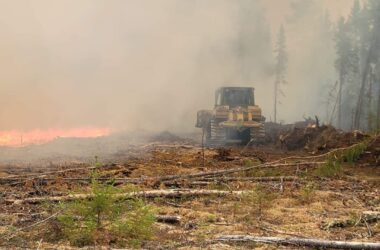
Coop-A-Deez Contracting Ltd. has sent staff and equipment to northern Saskatchewan to fight fires

Company expands

Shortly after completing the bridge project, Davis decided to make another significant purchase by investing in a mulcher and expanding his scope of work even further. A few years later, he invested in a second dozer, winch truck and a scissor neck lowbed trailer and has continued to reinvest in himself and his employees ever since.

Last summer when the province was experiencing significant forest fires in the north, Davis was contracted to help contain the disaster. He quickly moved both dozers there and chased multiple fires in the area for three months.

“It can be very fast-paced, and you have to learn quickly,” he said. “You have to be skilled with equipment, but more than that, you have to be willing to push that equipment to the edge.”

The steady growth of the company also meant long hours away from home and with rising inflation, Davis has begun to rethink his priorities.

“Travel and fuel were getting expensive, along with accommodations,” he said. “It can become unprofitable very quickly working on the road.”

He and his wife had also started a family – they now have three children – which made time away from home that much more difficult.

Cooper and Emily Davis with their three kids

“You need to spend enough time on your business, whether that’s on the machine working a job, in the shop fixing equipment, looking at jobs, moving equipment, doing office work and attending meetings,” he said. “I also need and want to spend time with my wife and kids. It can be hard to find balance.”

For this reason, they decided to refocus on local projects. They are able to provide exceptional service while still finding time for family life. Business is still booming, and Davis says as his sons grow older, there is a potential to re-prioritize expanding the business – especially if they are as passionate about operating equipment as he is. 

by Pat Rediger Pat Rediger

Protecting Canadian Businesses

EQUA provides customized insurance and risk management solutions

Although the start of a pandemic is probably not the best time to begin a new business, that didn’t stop David Richards and Andy Bates. They knew the risks when they began EQUA Specialty Risk Partners Corporation (EQUA), an insurance brokerage that specializes in managing construction risks that leads to improved coverage and competitive pricing for its clients.

Despite the economic pressures brought on by the pandemic, Richards and Bates were confident that they had the right approach that would allow them to start and grow the brokerage. They wanted to create a business that would focus on clients and provide customized insurance and risk management services.

The duo already had a track record of success. Richards was the former chief executive officer of Jardine Lloyd Thompson Canada Inc. (JLT Canada) and an executive vice president of Aon Canada, while Bates had been the chief operating officer of JLT Canada, and a senior vice president with Marsh Canada Ltd.

“We wanted to provide true customer service and get to know our clients as individuals and not just clients.”

– Greg van Ginkel, Managing Partner/Construction Leader

Richards and Bates wanted to attract the right team to make this vision a reality and Greg van Ginkel was one of the cornerstones in that approach. With nearly 40 years of experience in insurance and risk management, he was a natural fit for EQUA. He previously served as a managing director for a large multinational broker, where he became the national construction and design leader. Afterwards, he was a co-owner and CEO of a regional brokerage in Regina.

“We were founded under the premise of serving those businesses, which were the next level down to Fortune 500 businesses, but providing them with the service that a Fortune 500 business would receive,” said van Ginkel, EQUA’s managing partner of the Saskatchewan office and construction business lead. “We wanted to provide true customer service and get to know our clients as individuals and not just clients.”

“For the most part, advice is usually what our clients need the most.”

– Greg van Ginkel, Managing Partner/Construction Leader

He adds that EQUA provides expertise to a select number of industries, such as the construction sector, which enables the company to better understand its clients and the risks they face. They believe in being honest and upfront about potential risks associated with potential opportunities and what could happen if the client decides to move forward.

EQUA is led by a board of directors and nine managing partners, and has offices in Regina, Calgary, Ottawa, Toronto and Vancouver. All nine managing partners are insurance and risk management experts, which creates employee owners across the entire team and leads to an incredible level of dedication to their clients. The company is also supported by a robust administrative team that ensures its leaders and client executives are free to focus on building solutions and creating value while clients enjoy an incredibly high level of support and service.

Looking at construction in Saskatchewan

For Saskatchewan, van Ginkel says the company is focussed on the construction sector.

“We plan to continue to grow and to serve the construction community here,” he said. “Our team members have incredibly deep roots in Saskatchewan. We want to connect with the local business community to learn about your needs. We want to work together to build solutions that support Saskatchewan’s businesses and economy. We are here to help protect this industry and to do what we can to help it thrive.”

The Saskatchewan office provides insurance and risk management solutions for the local construction community, using highly specialized knowledge, its local presence, national support and a global network. It offers the full suite of risk management advice – including assessing and allocating risk – and insurance procurement.

The local office is connected to the talent elsewhere in the company. When clients present their specific issues, the brokerage accesses expertise from other departments to ensure they understand the possible risks that a client may face with a particular project and who is going to take responsibility for those risks through the process.

It’s this connectivity that served them well during the pandemic. EQUA was founded as a digital company with no legacy systems that needed to be maintained. This helped them better respond to the restrictions set in place when the pandemic hit. The brokerage is paperless and cloud-based, which made them naturally remote from the moment they opened their doors and that has benefited them through the entire pandemic.

Their experience with digital systems has led them to be experts in the growing field of cyber insurance. They recognize the importance of having highly secure access to fields and information from anywhere in the world using secure systems.

van Ginkel says EQUA has grown, and will continue to grow, because of the value they provide to their client.
“The value could mean something different for each client,” he said. “For some it could be advice, for others it could be a price. But, for the most part, advice is usually what our clients need the most.”

Connections are also very important to the company and that’s a key reason why the company joined SHCA. Staff pride themselves on reaching out and making the calls so they can better connect with the people in the communities they serve.

“Our membership with SHCA provides us with access to important conversations and the opportunity to learn about the challenges that the industry is facing here,” said van Ginkel. “For us, that is fundamental. We pride ourselves on offering relevant solutions and creating unprecedented value, which is only possible when we work closely together with our community. SHCA is the right place for us to grow our network and listen to the voices that make up this industry.”