by Shantel Lipp Shantel Lipp

From Summer Projects to Fall Planning

Shantel Lipp

Looking at summer in the rearview mirror gives our industry time to reflect on how much work was done in the province during construction season. SHCA members were busy throughout the summer, working on projects in all corners of Saskatchewan to ensure that our roads and travel paths remained serviceable and safe.  

SHCA remained busy over the summer, hosting and preparing for our fall events. We were pleased to hold our Northern Golf Tournament at the Dakota Dune Resort in Whitecap Dakota First Nation in September. The golf tournament gave us the opportunity to socialize and enjoy the beautiful surroundings of the Dakota Dunes Resort. It also gave us the time to discuss the industry’s future in Saskatchewan and how best to tackle issues that impact heavy construction.  

Our engagement with the government steadily continues to keep the Ministry of Highways informed about issues impacting the industry. At the end of August, the Ministry of Highways released the fall tender plan for new highway construction projects. SHCA has received feedback from several of its members, and it will ask the entire membership for their opinions and concerns regarding the plan. This will help us bring forward to the government any issues and concerns with the plan that impact our heavy construction industry.  

Engagement update

As previously noted, SHCA held its Northern Golf Tournament last month and had the honour of hosting David Marit, Minister of Highways, for a portion of the event. This was an opportunity for our members to speak directly with Marit about their businesses and the industry’s current state, and offer suggestions on ways to strengthen heavy construction in Saskatchewan.  

On Tuesday, Oct. 28, SHCA will again host its annual MLA Reception at the Legislative Building in Regina. All MLAs from the government and the opposition are invited to attend our brief presentation and then enjoy the reception. This event is always an excellent opportunity for us to talk to government members and share our success stories.  

SHCA will also co-host an industry-government mixer with Merit Contractors in Saskatoon on Friday, Nov. 7.

by SHCA SHCA

Ministry of Highways Partners with the Rural Municipality of Prince Albert

Prairie Road and School House Saskatchewan Canada

On Aug. 6, the Ministry of Highways provided an update on a partnership with the Rural Municipality (RM) of Prince Albert to cost share paving of the service road south of Prince Albert between Elevator Road and the junction of Highways 2 and 11. The service road will act as a truck route, reducing traffic crossing the median at the intersection of Highway 2 and Elevator Road.

“The Ministry of Highways is continuing to work closely with municipal governments to improve roadways through partnership agreements aimed at providing benefits to local traffic and the economy as a whole,” Highways Minister David Marit said. “Paving this service road will support both the local and provincial economies by fostering growth and improving safety.” 

The agreement between the RM and the ministry was signed in the spring. Surfacing work is estimated at $924,000, with the ministry contributing up to 50 per cent of the cost. The Ministry of Highways will perform all maintenance, except for winter maintenance.

“Investing in our road infrastructure is essential for the growth and quality of life in our community,” RM of Prince Albert Reeve Tyrel Tait said. “This project is one of a number of road upgrades the RM is undergoing that will not only improve heavy hauling, but also support local businesses by facilitating better transport routes.”

by SHCA SHCA

Provincial Traffic Safety Fund Delivers $1.54M in Grants to Saskatchewan Communities

A view of traffic on the Gardiner Express at rush hour

Flashing pedestrian crossing signs in Estevan, a crosswalk in Lampman and streetlights on the Red Earth Cree Nation are among the road safety enhancements that will be delivered using funding provided in the Provincial Traffic Safety Fund’s latest round of grants.

Sixty-two projects in 61 Saskatchewan communities will receive grants, totalling nearly $1.54 million. Grants in this round range from $853 to $100,000. “The Government of Saskatchewan and SGI are committed to delivering safer roads for everyone in Saskatchewan,” Minister Responsible for SGI Jeremy Harrison said. “This $1.5 million in provincial grants will enable 61 municipalities and First Nations throughout our province to deliver enhancements to traffic safety in their communities.”

The full list of approved projects and grant amounts can be found on SGI’s website.

Provincial Traffic Safety Fund grants are awarded to communities twice a year, using proceeds from photo speed enforcement. A total of $14.55 million has been awarded to 918 projects in Saskatchewan since the program was established in 2019. Eligible projects must focus on one or more of these traffic safety priorities: speeding, impaired driving, distracted driving, occupant protection, intersection safety, aggressive driving, vulnerable road users or medically-at-risk drivers.

Applications are reviewed by a committee made up of representatives from the Saskatchewan Urban Municipalities Association, the Saskatchewan Association of Rural Municipalities, the Prince Albert Grand Council, the Saskatchewan Association of Chiefs of Police, the Ministry of Justice, the Ministry of Highways and SGI.

Applications are now being accepted for the next round of funding. The deadline for applications is Sept. 30, 2025. For more information and for the full list of approved projects, visit SGI’s website: https://sgi.sk.ca/community-grants-programs.

by Shelby Piel Shelby Piel

Increased Funding for Rural Road Infrastructure a Boost for Saskatchewan’s Rural Municipalities

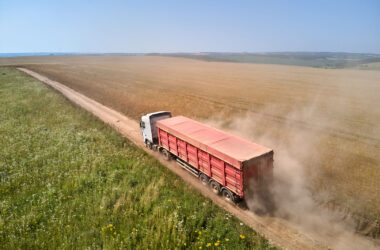
Road through wheat fields
rcphoto/123rf

As inflation continues to affect the cost of maintaining infrastructure, the need to address the condition of rural roads in Saskatchewan has become increasingly pressing.

These roads form the backbone of the province’s vast agricultural and industrial economy, enabling the movement of goods, services and people across rural areas. Deterioration of rural transportation infrastructure not only impacts local travel, but has far-reaching and devastating implications for Saskatchewan’s economy.

In response to these challenges, the Rural Integrated Roads for Growth (RIRG) Program Management Board, which is made up of members from both the Saskatchewan Association of Rural Municipalities (SARM) and the Ministry of Highways, has taken significant steps to support rural municipalities (RMs) by increasing funding for rural road maintenance during the 2024-2025 fiscal year, and have introduced several updates to enhance the RIRG program. Municipalities can apply to access RIRG funding through three distinct sub-programs: The Road Construction Program, Bridge and Large Diameter Culvert Construction Program, and the Clearing the Path (CTP) Program. Each of these programs is tailored to address specific infrastructure needs.

The Road Construction Program along with the Bridge and Large Diameter Culvert Program are ways that RMs can access funding to upgrade or replace their current infrastructure. These programs not only improve safety and efficiency for rural residents, but support local industries by facilitating the movement of agricultural and industrial products.

When a road project qualifies and is accepted into the Road Construction Program, the RM can receive up to $500,000 for eligible costs with a 50 per cent assistance rate from RIRG. RMs can choose from several road project types including, earthworks and grading, clay capping, base and subbase, and surface strengthening on any road that is a CTP corridor or has a rural road class of 3, 4,or 5. The Bridge and Large Diameter Culvert Program has undergone some significant and exciting changes. After hearing feedback from members on the significant increases to the cost of building rural bridges, the funding cap for bridge projects has doubled; RMs can now receive up to $1 million with a 50 per cent assistance rate. The next intake for these programs will take place this fall, with approvals scheduled for January 2026.

These programs not only improve safety and efficiency for rural residents, but also support local industries by facilitating the movement of agricultural and industrial products.

The CTP Program provides incremental maintenance funding to assist with the cost of maintaining roads to carry primary weights. The purpose of the program is to connect and move Saskatchewan’s commodities and industry at primary weights, creating a seamless network throughout the province.

The network aims to be dynamic and not permanent so that if economic activity is slowing down in one area and increasing in another, funding may be moved to an area with more economic activity. To be eligible, roads must meet criteria such as, minimum truck traffic counts, proximity to economic generators and a minimum proximity of the roadway to other primary weight roads. If an RM applies for an eligible CTP corridor and agrees to maintain the road to carry primary weights, they can receive funding each year to assist with maintenance costs.

After hearing from SARM members and studying the impact of inflation on maintaining these roads, RIRG has also increased the funding for CTP corridors by $300 per kilometre. RMs can now receive $1,300 per kilometre for a standard corridor and $1,500 per kilometre for a premium CTP corridor annually. Standard corridors have an average daily truck traffic greater than 10 trucks per day, while premium corridors have an average daily truck traffic greater than 35 trucks per day. An RM can apply for a new CTP corridor at any time on SARM’s website, with formal application reviews occurring annually at the start of each calendar year.

In other exciting news, the RIRG program, which is governed by an agreement between SARM and the Ministry of Highways, was recently extended for five years, until March 31, 2029. This extension signals a strong commitment from both the provincial government and SARM to long-term investment in rural infrastructure, and can provide municipalities with the confidence and stability they need to plan and execute infrastructure projects with greater certainty.

We strongly encourage all RMs to take full advantage of these renewed opportunities. The tools are in place, the funding is available and the support is ongoing. For detailed information on program eligibility, application processes and program timelines, municipalities are encouraged to review the RIRG Policy Manual available on SARM’s website (sarm.ca).

by SHCA SHCA

Construction continues on Highways 2 and 13 Assiniboia partnership project

Portrait of builder standing at construction site
nomadsoul1/123rf

Highways Minister David Marit and the Town of Assiniboia celebrated the ongoing progress of a more than $10.6 million partnership project that will improve Highways 2 and 13, while strengthening the heart of the community.

“Our provincial government is proud to play a role improving these key transportation arteries through Assiniboia, which is a service hub for the region,” Marit said. “These highways when completed will better support Saskatchewan’s export-based economy, local agriculture, tourism and businesses in the centre of town.”

The 4.96 km project involves:

  • The rehabilitation and repaving of Highway 2 (also known as Empire Road and Centre Street) from Leeville Street to north of Highway 13, along with Highway 13 (also known as First Avenue West and First Avenue East) from Centre Street to Leeville Street.
  • Curb and sidewalk replacements along the route.

“We are incredibly grateful for the investment in this vital infrastructure project,” Assiniboia Mayor Sharon Schauenberg said. “Improved roads mean safer travel, more efficient transportation, and long-term benefits for our residents and local economy.”

The Ministry of Highways is investing more than $10.17 million toward the project. The Town of Assiniboia is investing up to $485,000. On-site project work began this spring and is expected to be completed this fall, pending weather.