by Jim Timlick Jim Timlick

Cenovus Energy

Contractors paving road
Contractors work with Cenovus Asphalt to pave a road using a hot in-place recycling technique, which is the process of rehabilitating deteriorated pavement

This Canadian-based integrated energy company has had a presence in Canada’s so-called breadbasket region dating back all the way to the mid-1940s.

That’s when Husky Energy established one of its very first oil fields in the northwest corner of Saskatchewan near the Alberta border. It was about the same time Husky opened its first asphalt plant to produce the paving material required to build many of the province’s roads.

Today, Cenovus, which purchased Husky in 2021, is one of Saskatchewan’s top employers with a workforce of more than 1,300 people in the province. The company is headquartered in Calgary, Alta., and has asphalt producing refineries in Lloydminster, Alta. and Superior, Wis. It also has asphalt terminals across Western Canada and the Midwest in the U.S., with Cenovus’ most recent addition being a new terminal near Denver, Colo.

“All of our network is supplied by crude oil produced in Saskatchewan and supported by the brilliant minds in our technical services and innovation lab based in Saskatoon,” said Martin Ray, director of the company’s asphalt and industrial products division. “We like to consider ourselves an integral part of the community and the economy in Saskatchewan.”

Lab technician wearing safety goggles
Cenovus’s Saskatoon lab performs quality testing on all the asphalt and industrial products sold in Canadian Downstream Terminals including asphalt binder, polymer modified asphalt and asphalt emulsions.

Asphalt and industrial products are part of Cenovus’ downstream division that refines crude oil into finished products. Cenovus is the third largest asphalt producer in Canada and the U.S. Other divisions include crude oil and natural gas production and midstream, which is responsible for the transportation of crude oil to the markets that require them.

“I think it’s a cool story and it’s a Canadian story,” Ray said. “We’re a fully integrated company. In other words, our operations involve activities that find, develop and unlock value from commodities that originate in Canada. In our downstream business, our team handles the marketing, transportation and sales of all of these commodities across North America.”

Cenovus provides two essential products to Saskatchewan’s heavy construction sector. The first is diesel fuel to power heavy equipment, which is processed at its upgrader on the Saskatchewan side of Lloydminster. The other is the asphalt used for road building, processed at the Lloydminster refinery and distributed through its terminals in Yorkton and Saskatoon. That asphalt is used in several different road building products, most commonly use as a binder for rocks in asphalt pavement. That same asphalt is also used to create an emulsion to help fill cracks and other imperfections in roadways. It’s essentially heated asphalt combined with water to create a liquid-like substance that can be sprayed on the road.

One of the more unique products the asphalt and industrial products division produces is a polymer-modified asphalt. It’s created by combining regular asphalt with rubber and rock to produce pavement that has elastic recovery properties and is able to better survive Canada’s harsh winters. “It’s a super cool technology,” said Ray. “It’s unique in that it can withstand our massive freeze/thaw cycles. It’s an engineered product that can stretch a little bit so it can absorb wear and tear. It’s more resistant to rutting and cracking.”

Something else that distinguishes Cenovus in Saskatchewan is its commitment to research in the province. To support this development, the company donated $2.5 million to Saskatchewan Polytechnic’s Time to Rise campaign in 2024. The campaign will fund the construction of the school’s new Saskatoon campus.

As part of this investment, Saskatchewan Polytechnic’s new centralized chemical technology lab, power engineering lab and instrumentation engineering lab will be named the Cenovus Energy Labs. The labs will provide students with the latest technology for hands-on training, something the company says it will need in its future workforce.

The company also recently made a $1.5 million donation to the University of Saskatchewan as part of that institution’s Be What the World Needs campaign. Those funds will be used to help develop the Cenovus Energy Makerspace that will play a key role in advancing engineering innovation and design and provide students access to advanced tools such as polymer 3-D printers and laser cutters.

Exterior view of refinery
Cenovus’s Lloydminster, Sask., refinery supplies the company’s network of terminals and direct to customers via truck and rail.

Ray says it’s all part of a team approach taken by Cenovus to help advance research and create new products that benefit the people of Saskatchewan and the rest of the country. “With academia, the private sector and government, you create a nice triangle of innovation to build the infrastructure that we all use,” he said. “Our role is to be able to build the best quality of roads at the lowest possible cost so that our tax money can go as far as it can. It’s all about industry partnering with academia and with governmental agencies, to provide Canadians better and safer access to commercial and human movement.”

Cenovus’s asphalt division has worked closely with the Saskatchewan Ministry of Highways on several projects throughout the province over the years. Ray says it has been a great partnership due in large part to the fact the province is committed to engaging in constructive dialogue with the private sector. “Saskatchewan Highways is excellent,” he said. “They engage their contractors, they engage their suppliers and they’ve been really innovative. I give Sask Highways a lot of credit. They’ve been quite progressive in a lot of ways.”

The company also engages in conversations regularly with the many contractors it works with in the province. Many of those conversations centre on technical questions such as which materials may be best suited to rebuild a road or deal with “alligator” cracking or a high-water table.

Another popular topic with those clients is the infrastructure deficit facing the province and what can be done to address the situation. “The infrastructure deficit is always a challenge,” Ray said. “I think Saskatchewan road builders play a big role in helping moderate discussions around infrastructure and [investing] in infrastructure versus other places to invest in the province. They help create an environment in which industry can speak with government to try to manage investment in the road system and bridges.”

“We like to consider ourselves an integral part of the community and the economy in Saskatchewan.”

– Martin Ray, Cenovus

Tariff uncertainty is something that the industry is dealing with now. Tariffs don’t impact asphalt since it’s one of the CUSMA-compliant products protected through the Canada-U.S.-Mexico trade agreement, but Ray points out that tariffs could mean increased costs to acquire the heavy machinery required to build roads. “Contractors utilize a lot of road building equipment, whether it’s yellow iron [heavy equipment] or trucks. I’ve got to imagine there’s some pressures that [contractors] like all of us are feeling,” he said.

Despite this, Cenovus plans to continue to focus on being a “worldclass” operator of its assets. The company recently completed several planned maintenance upgrades at its asphalt terminals in Yorkton and Saskatoon as part of a 10-year plan. It also has scheduled maintenance planned for its refineries in Lloydminster. Those improvements are all intended to drive a combination of cost, reliability and environmental improvements. “We are proud of our footprint and we’re going to keep investing in that footprint,” Ray said.

Cenovus is also continuing to work with its partners to develop several new and innovative technologies. One of those products is a softer form of asphalt that features different chemical properties that allow more of it to be recycled and incorporated in new roadways rather than shipped to landfills. The company is also involved in research looking into how consumer waste, including plastic polyethylene and other items, can be incorporated into asphalt used to build roads.

Something that isn’t likely to change is the value Cenovus sees in being an SHCA member. “We actively want to be part of associations that have influence in the industry and [SHCA] is brilliant at that,” Ray said.

“They pull together a range of stakeholders in this industry. You’ve got contractors, you have suppliers, you have governments at various different levels. They work collectively to create a forum by which we can be innovative, we can address challenges, we can work with governments to address industry-specific issues and we can advocate for infrastructure spending.”

by SHCA SHCA

Saskatchewan Polytechnic and Westridge Construction partnership lays foundation for success

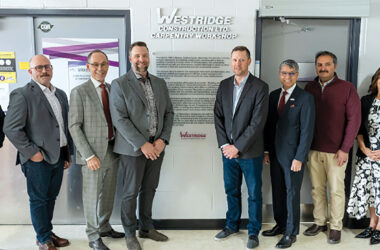
Group photo in front of Westridge Construction Carpentry Workshop
Photo: Westridge Construction

Westridge Construction donated $840,000 to Saskatchewan Polytechnic to support the Time to Rise campaign and future carpentry students. This donation will create a legacy at the new Joseph A. Remai Saskatoon Campus. The carpentry shop in the new Skilled Trades and Technology building will be named the Westridge Construction Carpentry Workshop.

Leon Friesen, president of Westridge Construction and a journeyperson carpenter, recognizes the importance of hands-on learning and the value of a polytechnic education. Westridge Construction will invest $750,000 in the Joseph A. Remai Saskatoon Campus to create a modern learning environment that reflects real-world workplaces. An additional $90,000 will go to carpentry student awards. These awards will help carpentry students overcome financial barriers, allowing them to focus on mastering their craft.

“It is an honour to support Saskatchewan Polytechnic’s Time to Rise campaign and help shape the future of carpentry in our province,” said Colin Olfert, Westridge Construction CEO and general manager. “This gift reflects our deep respect for the trades and our belief in the power of education to transform lives and communities. With so many of our team members, past and present, being proud Sask Polytech graduates, this partnership is both personal and meaningful. We are proud that the Westridge Construction Carpentry Workshop will leave a lasting legacy at the new Joseph A. Remai Campus and the other campuses across our great province.”

“We extend our heartfelt thanks to Westridge Construction for their generosity and belief in education as a force for good,” said Larry Rosia, Sask Polytech president and CEO. “Your leadership shows what it means to build not only structures, but communities. We are proud and privileged to call you a partner and to count many Westridge team members among our alumni.”

The Time to Rise campaign aims to empower Sask Polytech graduates and strengthen the provincial economy. The Remai Saskatoon Campus will consolidate an existing network of decentralized, outdated buildings into a modern, technology-rich learning environment, increasing program capacity for more students.

Learn more about the campaign and the Joseph A. Remai Saskatoon Campus at timetorise.ca.

by SHCA SHCA

Procurement Begins for Saskatchewan Polytechnic Joseph A. Remai Saskatoon Campus

Professional Mechanical Engineer team Working on Personal Computer at Metal lathe industrial manufacturing factory. Engineer Operating lathe Machinery. Product quality Inspection

The Ministry of SaskBuilds and Procurement and Saskatchewan Polytechnic have issued a Request for Qualifications (RFQ) to procure a new Skilled Trades and Technology (trades) building. The new trades building is using a Design-Build procurement model for its delivery as the first building planned as part of the new Joseph A. Remai Saskatoon campus.

“This is an important next step in building the new Saskatoon campus,” SaskBuilds and Procurement Minister David Marit said. “We are pleased to work with our partners to make this happen. The Request for Qualifications shows our focus is on creating a top facility for students and industry. Starting this process will help us find the right team to build the new Skilled Trades and Technology building for Saskatchewan Polytechnic.”

The new trades building is the first building planned as part of a new and consolidated campus in Saskatoon. It will be built on a green field site, located at Innovation Place Saskatoon, adjacent to the University of Saskatchewan.

“Saskatchewan’s post-secondary institutions are crucial in positioning the province as a global research leader, further solidifying our reputation as a hub for innovation,” Minister Responsible for Innovation Saskatchewan Warren Kaeding said. “This new campus will open more opportunities for Saskatchewan students and aims to attract top talent to cultivate our future innovation leaders.”

The RFQ is the first step in a two-step process to evaluate and pre-qualify professional service providers for the building. Qualified teams from the RFQ process will compete in the second stage for the design and construction of the trades building.

“I am pleased to see the Saskatchewan Polytechnic, Joseph A. Remai Saskatoon Campus project moving forward,” Advanced Education Minister Ken Cheveldayoff said. “The campus will play a critical role in preparing students who will help meet Saskatchewan’s labour market needs. The Skilled Trades and Technology building will provide a high-quality learning environment for Saskatchewan students, helping keep our province competitive with other jurisdictions and attracting more students and instructors.”

Site preparation work began in September of 2024 and includes the removal or upgrading of underground infrastructure, tree relocation and grading. Site preparation is nearing completion, with substantial completion anticipated in the spring. The new campus will transform an existing network of several decentralized, outdated buildings into a revitalized, modern, technology-rich learning environment for students and greater opportunities for applied research and investment. 

“We are excited to reach another momentous milestone for the Saskatchewan Polytechnic, Joseph A. Remai Saskatoon Campus with the launch of the procurement process for the Skilled Trades and Technology building,” Saskatchewan Polytechnic president and CEO Larry Rosia said. “We have undertaken extensive consultation with faculty, students, the City of Saskatoon and other key stakeholders, and we greatly appreciate everyone’s feedback. This campus will lead the way in applied learning across Saskatchewan, enhancing the student experience and expanding our capacity for applied research and collaboration.”

Since 2022-23, the province has provided $16 million for the project. The 2024-25 Provincial Budget included $6 million for design and pre-procurement work of the new campus. The Government of Saskatchewan announced in September 2023 that it would commit up to $200 million toward the new campus. The Ministry of SaskBuilds and Procurement and Saskatchewan Polytechnic are leading this procurement in partnership from the Ministry of Advanced Education, Innovation Saskatchewan and the University of Saskatchewan. 

by SHCA SHCA

Trades and Tech Summer Camps Promote Girl Power

For many of us, summer brings back fond memories of camp. Learning to paddle a canoe, roasting marshmallows over a campfire, slapping mosquitoes on endless walks through the woods, and for some… learning to use power tools.

Of course, camp these days can mean many things, with options ranging from traditional nature camps to urban sports-themed or creative arts options. But power tools? Saskatchewan Polytechnic’s Brittany Grimsdale says, “Absolutely!” 

Grimsdale heads up Women in Trades and Technology (WITT), which offers a variety of trade and technology-themed summer programs for youth. With nearly 30 summer camp seasons under its belt, it seems WITT must be on to something. WITT offers two Girls Exploring Trades and Technology (GETT) camps—one in Regina and one in Saskatoon—and has offered other camp options in previous years, including a welding camp called Mind Over Metal. WITT also supports a camp called Plan, Program, Play, put on by Sask Polytech’s Business Information Systems program, where youth spend three days exploring game development.  “Camp can be fun, a great learning experience and career exploration all at the same time,” said Grimsdale.

A plumber by trade, the WITT program head shares her skills with girls ranging from 12 to 15 years old at the Saskatoon GETT camp. There, she says, opening minds to opportunities is the focus. “Studies show that before girls hit high school is really the time to share the opportunities available in terms of careers. Maybe they’ve never thought of a trade before. Trades are not often thought of as a first-choice career for girls. Whether or not they go into trades later in life, it’s a chance for them to gain some skills and gain confidence.”

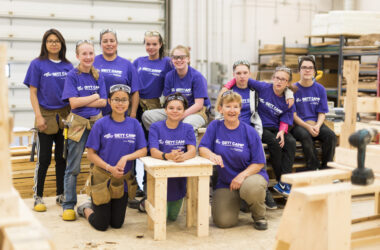
That’s exactly how Saskatoon camper Nevaeh Moore experienced GETT. At 13, she was this year’s youngest girl in the week-long camp, and she came away with some new skills and the handiwork to show for it. “We got to come up with our own design for a table and build it,” explained Moore. “Mine is rounded on the edge on one side and stained with dark stain. It’s in my bedroom now for makeup and hairbrushes.” 

The Grade 8 student had some experience with tools, having helped her mom in the past, but at GETT she got to try new things and improve on what she already knew. “Now I know how to design a table that stands up and works,” she said. “The table legs were a challenge. I had to take my table apart and put it back together three times! I learned how to use a level, right angle and a measuring tape.”

Moore’s mom, Amy, saw a change in her daughter’s confidence by the end of the week. “It was a cool opportunity for Nevaeh to tinker with some tools and make a useful object. The empowerment of being able to create something independently was great to see.” GETT’s girls-only focus is part of what contributes to that confidence building, says instructor Robin Reynolds, who teaches the carpentry portion of the Saskatoon camp. 

“All our instructors are women, that makes a difference,” she explained. Reynolds describes the camps as a safe place for teen girls to try something new. “It’s a really supportive environment. They’re among peers that are at the same skill level, so it’s less intimidating.” 

“Trades are not often thought of as a first-choice career for girls. Whether or not they go into trades later in life, it’s a chance for them to gain some skills and gain confidence.”

– Brittany Grimsdale, Women in Trades and Technology (WITT)

The journeyperson carpenter has been an instructor at camp for six seasons, and it’s clear she also gets something from the experience. “It’s been a blessing to be part of it,” said Reynolds. “I love seeing how proud the girls are of themselves. It’s a nice atmosphere. It has also become a community at the instructor level, and I really value that.”

The Regina and Saskatoon camps vary slightly in activities, but both offer a hands-on experience and exposure to career choices not traditionally thought of as options for women. Both camps have a strong carpentry focus—an area most campers really enjoy because they can build something to take home. This year, Saskatoon campers had some plumbing instruction, a visit from a firefighter and spent a morning learning about robotics. In Regina, campers learned some computer coding and built robots, and had a visit from Rose Santos, an electrical engineer from the camp’s title sponsor, SaskPower.

SaskPower has been the GETT camps’ title sponsor for several years, providing funding and guest speakers. In addition, the Crown corporation sponsors four seats (two in each city) that WITT filled through the Big Brothers/Big Sisters organization. “SaskPower has been great to work with. We use pallets for lumber, and this year when they were hard to come by, SaskPower sent us a whole crate from their shipping department,” said Grimsdale.

“It was incredible to see SaskPower involved in this program, and to help Saskatchewan girls explore career possibilities in Trades and Technology,” said Rose Santos, project portfolio manager, Distribution Construction at SaskPower. “In the early 1900s, Saskatchewan women couldn’t vote, so we’ve come a long way. It’s exciting to be a part of the evolution of this journey!”

Reflecting back on this summer’s camps, Grimsdale talks about the range of girls the camps appeal to. Some are there to learn skills for a hobby. Others are more serious and quite focused. Grimsdale describes a camper who brought a pen and paper and furiously scribbled notes about everything she could glean from her instructors. 

“She wants to learn how to renovate and flip houses and is actively seeking skills that will help her prepare for that.”

Others, like Moore, who hopes to become an orthopedic surgeon, want to try new things and have fun. Most teens fall somewhere in the middle, and don’t yet know what life has in store for them. Regina camper Rycelle Amurao perhaps summed it up best: “I had a really great time at the camp. Even though I might not take a job in any of these subjects, I don’t feel like I wasted any time. I had fun learning about the different types of trades. I feel like it helped me learn new things and gave me new job opportunities to consider.”

GETT campers vary in age and focus, but they often end up being a tight-knit group by the end of the week. Moore went to the camp by herself but came away with a few friends with whom she’s keeping in touch. “Two girls had done the camp before, so they got to do some more advanced stuff,” she said. “I might do it again.”

“We do see repeat campers,” said Grimsdale. “Even more amazing is that mothers who took the camp years ago are now sending their daughters. GETT is now old enough we have alumni parents!” 

Regina Blue Seal carpenter Patricia Fayant, who has been instructing WITT camps since the 1990s, was one of three instructors this year with a special connection to a camp participant. “My granddaughter attended, and two other instructors had a daughter and niece join.” 

Fayant, who is Métis, enjoys instructing the camp and being a face for Indigenous women in trades so much that she plans her contract work around it. “It’s a really positive experience and one of my favourite weeks of summer.”

For more information about Women in Trades and Technology, including summer camp programming, visit our WITT Program and Event page.