

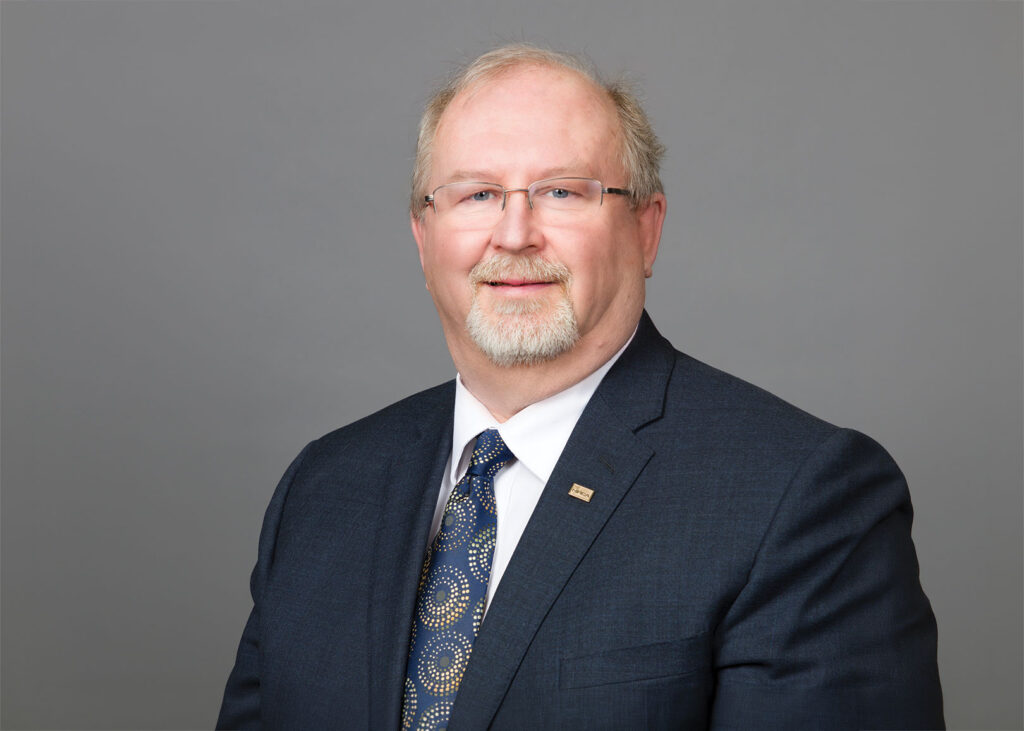
When Chris Lorenc retires as president and CEO of the Manitoba Heavy Construction Association (MHCA) at the end of 2026, he will close a remarkable 35-year chapter in heavy civil construction advocacy.
Over more than three decades, Lorenc has become one of the industry’s most influential voices, helping shape policy in Manitoba, across Western Canada and nationally through organizations such as the Western Canada Roadbuilders & Heavy Construction Association (WCR&HCA) and the Canadian Construction Association (CCA). To reflect on his career, impact and lessons learned along the way, Saskatchewan Heavy Construction Association President Shantel Lipp sat down with Lorenc for a candid conversation about public service, advocacy, leadership and the future of the industry.
From city hall to heavy civil
Lipp: Thirty-five years, Chris – that’s a lifetime. I’ve been here 18 years and people already ask me, “Are you still there?” So 35 years is remarkable. Honestly, I never thought you were going anywhere. I was shocked when you announced your retirement. One thing I’ve always said is that there has never been a more enthusiastic and passionate advocate for this industry. But I’ve never actually asked you: How did you get into it?
Lorenc: That’s an interesting question. I served on Winnipeg City Council from 1983 to 1992. During that time, I chaired both the Planning and Environment Committee and the Public Works Committee, which gave me the opportunity to become deeply involved in public policy – something I’ve always enjoyed. My interest started early. I remember debating federal politics with my Grade 5 teacher and arguing over who would win the election. Politics and public service have always fascinated me. Later, I studied law, served on council and ran for federal office.
What has always driven me is the understanding that public policy, progress and leadership don’t happen on their own. They require people willing to step forward, exercise judgment and work toward the public good. We all inherit communities built by those who came before us. I believe we have a responsibility to leave them better than we found them.
By the early 1990s, I knew I wanted a new challenge. I had a successful law practice, but it wasn’t providing the sense of fulfillment I was looking for. Then my wife, Maria, spotted an advertisement for the president and CEO position at the Manitoba Heavy Construction Association. I applied in September 1991 and was interviewed with Barry Brown and Colleen Munro. I came home and told Maria it was one of the best interviews I’d ever had. Shortly afterward, Barry called and said, “The job is yours.” I started on Oct. 1, 1991, and I’ve never looked back. It has been the most rewarding professional experience I could have imagined – a privilege beyond description.
Building something from almost nothing
Lipp: What was the state of Manitoba Heavy when you arrived? Did you have the support and freedom to build what it became?
Lorenc: I was fortunate then, and I remain fortunate today. When I arrived in 1991, there wasn’t much of an organizational structure. There were no minutes, no audited financial statements and very little institutional framework. The association existed, but there was no real foundation on which to build. What it did have, however, were visionary leaders: Barry Brown, Wilf Tallieu, Colleen Munro, Don Whitmore, Chuck Lee, Dick Mulder, Neil Wither, Dave Brown… all big-picture thinkers. These were the people who understood that the association needed to become more than it was. They saw the potential for a stronger, more influential organization and were committed to building it.

“Advocacy is a marathon, never a sprint. You can go faster alone, but further together – remember that.”
– Chris Lorenc, Manitoba Heavy Construction Association
So while I inherited very little infrastructure, I inherited tremendous visionary leadership, which continues to the present. Being surrounded by people who thought and think big made it much easier to pursue the changes I believed were necessary.
I’ve always enjoyed a transparent, trusting relationship with the board. I made it a point to bring solutions, not just problems. Anyone can identify a problem. The challenge is finding a path forward. When you’re surrounded by people who are committed to horizon, to progress, it becomes much easier to reframe, repurpose and rebuild an organization.
The strengths of heavy civil
Lipp: Once you have that trust, I find that within the industry – not just my board, but the industry overall – you can do so many other things because they will back you. When these guys really care about something, they have no problem uniting and joining forces and fighting until they get what they need.
Lorenc: One of the industry’s greatest strengths is its practicality. People here aren’t offended by mistakes. They’re offended when you fail to learn from them. Everyone understands that mistakes happen. No individual, company or organization is infallible. What matters is how you respond – whether you learn, improve and avoid repeating the same mistake. Another defining trait is authenticity. There isn’t much pretense in heavy civil construction. You’ll never leave a meeting with a contractor wondering where they stand. If my board tells me to back off, they’re telling me for a reason – and I’d better listen.
Contractors are also exceptional risk managers. Every day, they navigate uncertainty, anticipate challenges and make decisions that carry significant consequences. Don’t assume you can out-negotiate a contractor on risk. They live it, understand it and manage it every day. That practical understanding of risk, survival and problem-solving is what sets heavy civil apart. The industry is also highly organized, strategic and engaged in advocacy. Few sectors invest as much time and energy into advancing shared priorities.
Heavy civil teaches lessons that no classroom can. It teaches resilience, risk management, long-term thinking, ambition and a strong connection to the public’s best interest. Those experiences shape exceptional business leaders.
Lessons in advocacy
Lipp: What do you think government could do better to work with us and understand our industry? We’ve always said that if governments want better outcomes, they need to ask the people doing the work. We’re never trying to steer anyone in the wrong direction. What we’re looking for is a win-win – successful businesses, strong infrastructure and a growing economy.
Lorenc: There’s no single answer. The frustrations we experience in Manitoba are often the same frustrations our colleagues face from coast to coast. First, you have to engage in the political process. If you’re not prepared to support good candidates running for office – financially, organizationally or otherwise, then it’s difficult to complain about the people who ultimately get elected. That doesn’t mean your preferred candidate will always win, and that’s not the point. The point is to be engaged.
“One of the industry’s greatest strengths is its practicality. People here aren’t offended by mistakes. They’re offended when you fail to learn from them.”
– Chris Lorenc, Manitoba Heavy Construction Association
Second, you have to build credibility over time by demonstrating principle, integrity and a commitment to the public interest. You need to be able to look back and honestly say that everything you’ve advocated for has been principled, connected to the public good and delivered in a respectful, collaborative way.
Policy and politics can’t be only about policy and politics. They have to be about people. They have to be about relationships, trust and genuine human interaction. Some of the most productive conversations begin with a laugh and end with a laugh. When people come to our events, they’re welcomed and treated with respect. It’s important to demonstrate that you’re not an adversary. Public servants and elected officials should know they can rely on your advice and perspective. They may not always agree with you, but they should never question your motives or your commitment to providing honest input.
Persistence matters, too. Be present. Be visible. Be heard. Stand by your principles but do so respectfully. Agree or disagree, but never be disagreeable. There is no magic formula because politics is constantly evolving, and advocacy must evolve with it. What matters is showing up consistently, acting on principle, focusing on the public interest and bringing people together around common goals.
We’ve always believed that you can go further together. That collaborative approach has earned us respect and helped us achieve meaningful progress.
Changing the perception
Lipp: When you took the reins at Manitoba Heavy, what were some of the challenges facing the industry? And how has that changed over time? I still hear many of the same debates today that we were having when I started.
Lorenc: One of the biggest challenges was what I used to call “perimeter-itis.” There was a perception – and, to some extent, a reality – that the association primarily existed to serve the larger contractors based in Winnipeg. If you were outside the Perimeter Highway, you weren’t always seen as a priority. The board recognized that concern and made a deliberate decision to change it. It accepted recommendations aimed at creating a more representative organization, one that reflected the full diversity of the industry – rural and urban, large and small contractors, suppliers and service providers.

That kind of transformation doesn’t happen overnight. You don’t flip a switch and suddenly become an inclusive organization. It takes years of commitment and effort. The board made that commitment, and it succeeded. I’m not suggesting there aren’t still people who occasionally feel overlooked. But I can say unequivocally that we have never assessed a request for assistance based on whether a member was large or small, rural or urban. If a member needed help, our job was to help.
Highs and lows
Lipp: Take me through your best and worst moments over the last 35 years. What was the peak and what was the pit?
Lorenc: Interestingly, both occurred during Gary Doer’s time as premier. The most challenging period was the Floodway Expansion Project in 2005. The project was initially presented as an open, competitive procurement process. We were then surprised to learn that contractors would have to be unionized in order to bid. At the time, and largely today, less than five per cent of Manitoba’s heavy construction industry was unionized. As you can imagine, that raised significant concerns – not only about the project itself, but about the precedent it could set for the future of the industry.
For the next year and a half, we fought the proposed project labour agreement. It was the most stressful period of my career because we believed the long-term makeup of the industry was at stake. In the end, changes were made that reduced many of the risks. It still wasn’t an agreement we supported, but it was far less damaging than the original proposal. That experience reinforced the importance of preparation, persistence and standing your ground when fundamental industry interests are at risk.
“There isn’t much pretense in heavy civil construction. You’ll never leave a meeting with a contractor wondering where they stand.”
– Chris Lorenc, Manitoba Heavy Construction Association
The high point came in 2009 with the creation of CentrePort Canada, Canada’s first inland port. CentrePort spans approximately 20,000 acres between the RM of Rosser and the City of Winnipeg and was created through legislation unanimously passed by the Manitoba Legislature. I’m particularly proud of CentrePort because it largely emerged from a report I chaired for the City of Winnipeg in 2008. Premier Doer, with strong support from Diane Gray, his Deputy Minister of Intergovernmental Affairs and of Finance and a broad coalition of business and labour leaders, recognized the opportunity and moved it forward. The vision was simple but ambitious: create a globally competitive trade and transportation hub that would attract investment, strengthen supply chains and support long-term economic growth.
Since its creation, CentrePort has attracted more than $2 billion in private-sector investment, supported by strategic public sector investments in transportation, water and sewer infrastructure. Billions more are expected in the years ahead. CentrePort has helped reposition Manitoba as a global trade and transportation hub. It remains, in my view, the most significant public policy achievement I’ve had the privilege to help advance.
What I’m equally proud of is that, despite our differences on issues like the Floodway Project, I maintained a respectful relationship with Premier Doer throughout. We disagreed, but we remained friends.
Building a Western Canadian voice
Lipp: You’ve talked a lot about Manitoba Heavy, but another significant part of your career has been your work with the Western Canada Roadbuilders & Heavy Construction Association. What role did WCR&HCA play in shaping your approach to advocacy?
Lorenc: When I first became involved, my board felt WCR&HCA wasn’t fully using its potential to shape national conversations and advance Western Canadian priorities. In 1995, the president and CEO position became available, and I was given the opportunity to take it on. Working alongside successive boards, chairs and our provincial association partners in Saskatchewan, Alberta and British Columbia, we transformed WCR&HCA into an organization that had a meaningful impact on federal policy through CCA.
“There isn’t much pretense in heavy civil construction. You’ll never leave a meeting with a contractor wondering where they stand.”
– Chris Lorenc, Manitoba Heavy Construction Association
On paper, we only had four members. But WCR&HCA gave us a forum to identify shared priorities, develop ideas and bring a unified Western Canadian perspective to national discussions. It became a place for vision, strategy and collaboration. One of the best examples was the Canada Trade Infrastructure Plan (CTIP), developed in 2021 and 2022. The plan focused on growing Canada’s economy through strategic investments in trade-enabling infrastructure and transportation networks.
Working with CCA and the Canada West Foundation (CWF) – whose research was foundational – we brought together a coalition of national organizations that shared a commitment to economic growth, trade diversification and infrastructure investment. The coalition included the Business Council of Canada, the Canadian Chamber of Commerce, CCA, the CWF and WCR&HCA. In 2023, the Premiers’ Council of the Federation unanimously endorsed CTIP and referred it to the federal government. Today, elements of that plan are reflected in federal trade infrastructure strategies.
We believe Western Canada has an important role to play in the country’s success. We contribute to Canada’s prosperity, and Canada is stronger because of that contribution. That’s what WCR&HCA became – a place where the western provinces could work together, develop ideas and influence national policy.
Looking ahead
Lipp: As you wind down a 35-year career, what do you think the industry needs to do to reach the next level?
Lorenc: Understand that advocacy is a marathon, never a sprint. Of all the lessons I’ve learned, that’s probably the most important. If you’re looking for immediate results, you’re in the wrong business. Meaningful policy change takes time. Take the Gas Tax Accountability Act. We worked with Premier Doer’s government to establish legislation that dedicated provincial fuel tax revenues to highway investment. It was a landmark achievement. Then a subsequent government repealed it. That’s advocacy. Progress isn’t always permanent, and that’s why the work never stops. You can go faster alone, but you go further together.
Success requires patience, persistence, principle and collaboration. It also requires resources. Organizations need to be financially disciplined and prepared for moments when they must invest in making their case publicly and effectively. There isn’t a universal roadmap because every challenge is different. What matters is a long-term commitment to the fundamentals: showing up, building relationships, acting on principle and staying engaged.
Lipp: From our first interaction, you’ve been an incredibly generous mentor. One thing I’ve always appreciated is your encouragement. You consistently told me, “You need to be at the table. People need to hear what you have to say.” When I was new to the industry – and often the only woman in the room – you never treated me as anything other than a peer and colleague. I’ve always respected that. You’ve made an extraordinary contribution to this industry.
Lorenc: Thank you. I sincerely appreciate that – and right back at you, Shantel.
Lipp: I’m going to miss you.
Lorenc: I’m going to miss you, too. I’m going to miss the entire industry.