
The built environment is a major contributor to climate change, and accounts for nearly 39 per cent of global carbon emissions. Canada’s construction sector contributes up to 15 per cent of the nation’s greenhouse gas (GHG) emissions, in terms of direct jobsite emissions, embodied carbon in materials and the impact of a project’s lifecycle.
Today, sustainable design, energy-efficient building codes and green infrastructure are helping reduce the impact of construction on the environment while also building greater resilience to climate change.
Building a more sustainable foundation
Heidelberg Materials is a vertically integrated construction materials company that specializes in cement, concrete and aggregates. The multinational company is based in Heidelberg, Germany, and has operations located worldwide.
For those on the outside of the sector looking in, there may be the impression that all concrete is made equal, regardless of its function. After all, whether it is a sidewalk or staircase, concrete is seen as a grey, stone-like substance that is generally made up of the same ingredients: water, fine aggregates (like sand), coarse aggregates (like gravel or crushed stone) and – the most energy and carbon intensive component of the mix – cement.
Traditionally, concrete has been designed as the most cost-effective way to achieve the performance required for a given application. While a carbon-optimized concrete mix still aims to deliver the required performance, it focuses more on the carbon impact of the different materials than on cost as an outcome. To accomplish this, ‘greener’ concrete mixes include more SCMs in the aggregate structure within the concrete matrix, as well as leverage newer technologies or novel materials that may not yet be mainstream.
Performance first and foremost
Heidelberg Materials’ approach to low-carbon concrete is that performance is non-negotiable, and the needs of a given project and application dictate how the concrete mix is designed.
“We’re ultimately trying to make sure that we’re still delivering the same compressive strength and meeting the various exposure class conditions that that concrete is potentially exposed to,” said Shane Mulligan, sustainability market manager at Heidelberg Materials in Calgary, Alta. “In fact, from a durability perspective, our lower carbon concrete will often perform the same – if not better – than traditional concrete due to better particle packing and the use of supplementary cementing materials [SCMs], which also help it better stand up to conditions like sulfate attack or chloride penetration.”
“If you’re looking at foundations or footings or piles that will sit on site for a long period of time before any other construction happens, that is the ideal opportunity to use lower carbon strategies and maximize them to the fullest extent possible.”
– Shane Mulligan, Heidelberg Materials
Despite this potential for improved performance, some challenges, such as impacts on schedule, the potential for higher upfront costs and supply chain limitations, remain when using lower-carbon concrete, as producers are often restricted to locally available materials.
“In Canada, our prairie markets historically use fly ash in their concrete and, for some of our Ontario operations and coastal markets, there’s more reliance on slag due to the local industries that exist in those areas or port access to other markets,” said Mulligan. “So, while there might be a low carbon strategy that exists on the coast, the cost of importing that strategy to the Prairies makes it infeasible, even though it might make sense from a carbon reduction perspective. It just becomes a trade-off that most general contractors and owners are not yet willing to make.”
Another challenge that slows the adoption of greener concrete alternatives is a tendency for slower curing when compared to traditional concrete. The more SCMs in the mix, the slower the concrete gains strength.
“There are some applications where schedule trade-offs are not possible, such as when you’re building a high-rise building and need to strip your forms to move up to the next floor – that’s an application when low-carbon concrete doesn’t fit very well with today’s strategies,” said Mulligan. “But if you’re looking at foundations or footings or piles that will sit on site for a long period of time before any other construction happens, that is the ideal opportunity to use lower carbon strategies and maximize them to the fullest extent possible.”
The push for adoption
One of the most significant developments in the use of low carbon concrete has been the advent of Environmental Product Declarations (EPDs), which are essentially nutrition labels for construction materials that denote the environmental impacts of the concrete, including carbon intensity.
“Being able to measure the Global Warming Potential [GWP] of a given concrete plant, and specific to the mix that might be going out the door, is a very powerful lever to understand the impacts of different material choices. It allows you to optimize your mix designs for carbon reductions and provides transparency for stakeholders along the project value chain,” said Mulligan.
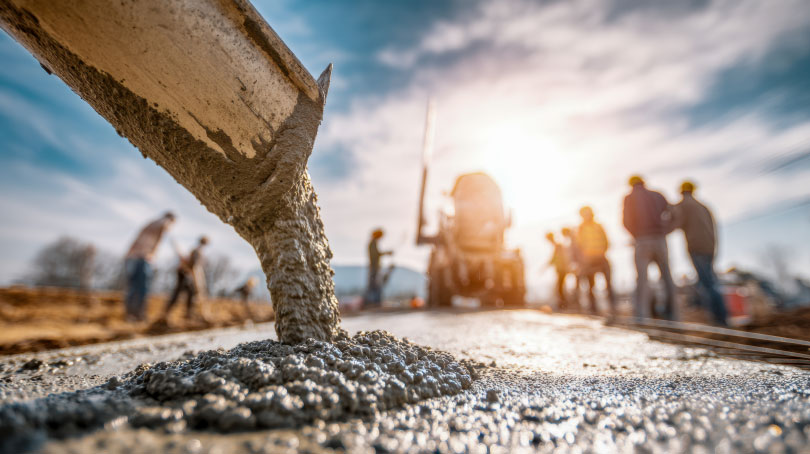
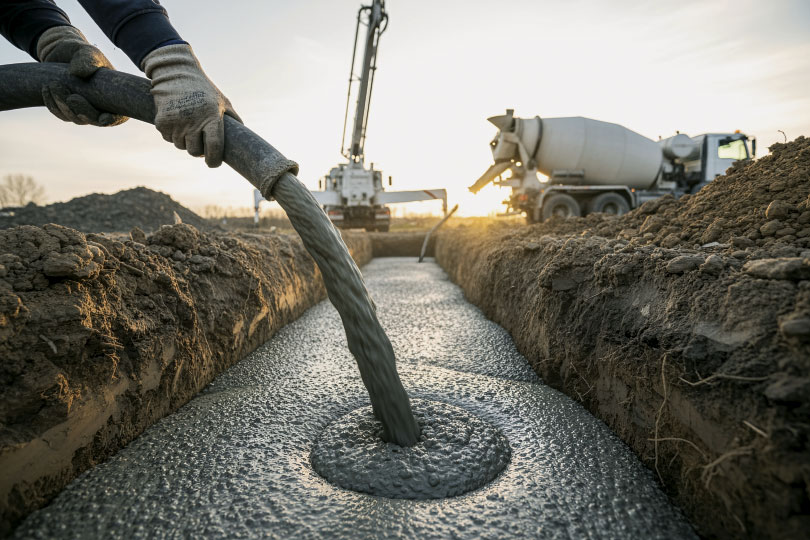
Ultimately, it is important to remember that concrete is more of a system than it is just a material – there is the mix itself, but then there’s the pumping of the mix, the placing and finishing of the mix and the curing practices that all factor into the performance of that concrete long term. Everyone involved has a role to play in lowering the environmental impact of concrete, from design through to construction.
“We’ve seen some strategies like Integrated Design Teams, where you have the owner, the design engineer, the general contractor, the testing firm and concrete supplier all getting together at various project stages to discuss low-carbon concrete strategies, the impacts and the associated trade-offs,” said Mulligan.
However, this level of information sharing is still more of the exception than the rule, and being able to really move the needle when it comes to a wide-scale adoption of carbon-optimized concrete mixes will require different industry stakeholders to come together and collaborate like never before.
Collaboration is key
Founded in 1980 with a vision to balance profits and people and drive change within the Canadian construction industry, Chandos is one of North America’s most innovative technical builders. The company is 100 per cent employee-owned and has a national presence with offices in Edmonton, Calgary, Red Deer, Kelowna, Vancouver, Toronto and Ottawa. Chandos also takes the mantra of ‘Let’s build better together’ to heart and sees sustainability and collaboration as being one and the same, believing that only through teamwork can construction be pointed in the direction of a more sustainable tomorrow.
“We are all trying to be accountable for the impact that we have on the planet, and we all bring different strengths and perspectives to the table,” said Audrina Lim, Chandos’ director of sustainable construction. “Only by working together will we be able to achieve our sustainability goals.”
“Only by working together will we be able to achieve our sustainability goals.”
– Audrina Lim, Chandos
The projects Chandos chooses to take align with its Net Zero by 2050 goals, and the company does what it can to reduce its operational carbon as much as possible. Chandos prefers projects that also offer incentives for sustainability, where all parties have buy-in and are pulling in the same direction on environmental issues.
“When we procure, we want to make sure that we are choosing ethical companies, as well as look at things like local sourcing and job creation in terms of sustainability,” said Lim. “Obviously, we can’t do that across the board, and there are still projects that are challenging in that they focus on the bottom dollar. But that just means we look for opportunities where we can have the most impact within the projects that come through the door, and then try to be more sustainable within the entire process.”
Chandos believes one of the greatest areas where the construction industry can affect climate change is in material selection and schedule efficiency. It is here that, when made early on, decisions about sustainability will have the greatest impact and, for this reason, Chandos prefers to start with Canadian-made materials wherever possible. The company has seen firsthand that this can result in fewer logistical challenges, more reliability and longer service life, as well as greater advocacy from material manufacturers.
Challenges in going green
Despite the advances made in sustainable construction, there remain some lingering misconceptions within the industry and among owners as to what it means to build green, as well as pushback on emerging – but still unproven – green technologies.
“We need to ensure that, if we utilize new material or technologies, that it’s fully understood and trained with maintenance and operations for the long term,” said Lim. “For this, Chandos has its internal commissioning team that helps to train owners, facilities and management staff on the nuances required to optimize the technology. As long as we can communicate and understand what the goals are, we will be able to find outcomes that are sustainable. It may not be everything, but doing something is always better than doing nothing.”
Focusing on more environmentally-friendly building materials can also improve a project’s bottom line especially given government policies that promote sustainable practices through stimulus spending. For example, at a recent project in Ottawa, Ont., Chandos chose lower-carbon materials to earn credits toward LEED Silver certification and, in doing so, uncovered other value-added benefits.
“We looked at the materials we would typically work with and then found a lower GWP version of the product. Low carbon was never our main objective. We just wanted to find enough credits optimize LEED credits for the project and support funding for the project,” said Lim. “What’s more, these additional credits we found meant that the owner – a nonprofit organization – could attain best value on the build and move those savings into their programming to help the community. This was a win-win for everyone – we first needed to understand what was in the market and then make a choice to go more sustainable.”
Looking ahead, Chandos expects to see greater uptake among manufacturers producing ever-greener products and becoming more responsible in both how they manufacture and where they source.
“This is the sort of space Chandos wants to play in,” said Lim. “It attracts more social investment and aligns us with the next generation of thinking with regard to climate and affordability. As an industry, we need to understand who we’re building for in the future. We’re evolving as a society, and so are our values – and I love seeing that that kind of growth with sustainability applied to it.”
Showcasing success
Encouraging greater adoption of green building materials and practices in construction will take more than a ‘carrot and stick’ approach; it will also come down to education. To this end, Chandos recently released case studies on its website to highlight the benefits of thinking green. Lim points to a project where, driven by schedule and the desire for cost savings, the company chose not to install deep foundations, but instead was able to reduce the amount of material required to rebuild the foundations of the existing building. This move saved Chandos an incredible amount of emissions material, as well as approximately $250,000 that could be credited back to the owner.
“Because we had to do less digging, excavating, and replacement of slab, we could actually condense our schedule,” said Lim. “This then allowed us to beat the winter conditions, which reduced the amount of diesel used for the heating and hoarding because we didn’t have to pour the concrete at that time, and that reduced our GHG emissions. This project was an opportunity to show others where we could find some sustainable benefits, even though the environment wasn’t our primary end goal. That’s the sort of education we want to share … and challenge others to also look for those kinds of opportunities on their own projects.”
However, Lim says education is a two-way street, and there is much that can be learned from the competition, many of whom are also doing amazing things regarding sustainability.
“We talk a lot with other construction companies to see what they are uncovering and [if there are] areas where we can do research together, which is a shift from years past. We’re not looking for advantages; we’re instead relying on each other to improve the way construction is done. We can do impactful things when we work together and create critical mass in the right direction.”
Looking ahead, Canada’s construction industry is at a pivotal moment, one where it is both a major contributor to emissions, as well as uniquely positioned to mitigate the impact of climate change. By embracing innovative materials and a collaborative spirit, the industry can help reduce its carbon footprint while building greater resiliency to an evolving environment. Though challenges remain, early adopters like Chandos and Heidelberg Materials are showing what is possible, and their leadership offers a blueprint for a future where construction becomes part of the solution, not the problem.