

The Saskatchewan Research Council (SRC) is laying the foundation for a North American rare earth element (REE) supply chain by developing a first-of-its-kind, fully integrated Rare Earth Processing Facility (REPF), with hydrometallurgy, separation and metal smelting stages.
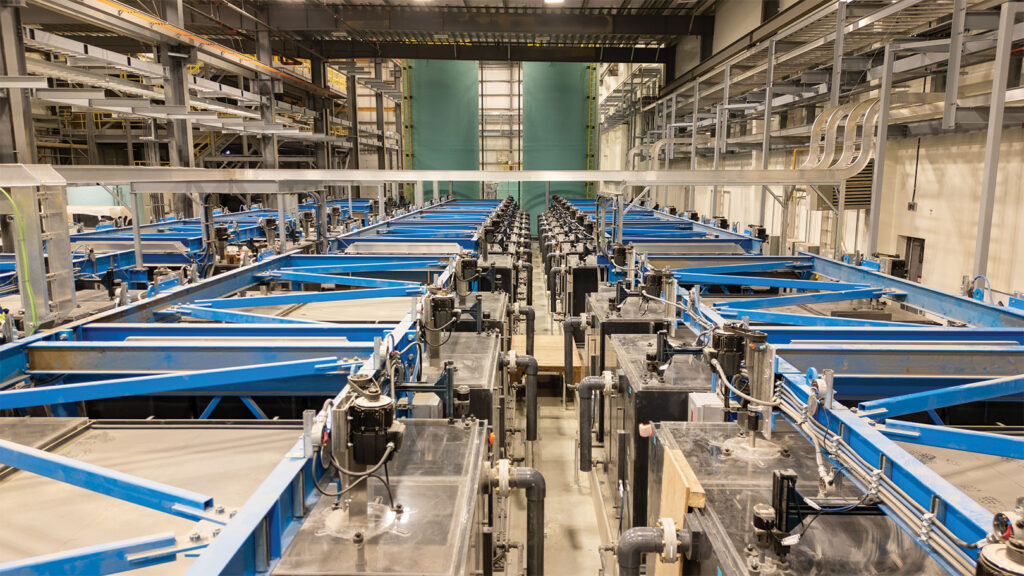
Currently in its early commissioning stages, with full operations on the horizon in 2027, SRC’s state-of-the-art minerals-to-metals facility is positioned to stimulate Canada’s resource sector and showcase the range of innovative technologies designed in-house by SRC experts. Among these technological achievements, SRC’s proprietary solvent extraction (SX) cells are the most notable. They were designed and manufactured in-house at an SRC-operated fabrication facility.
This commercial-scale, multi-year fabrication project formed the backbone of the facility’s SX Unit, one of two new buildings purpose-built for the REPF. The SX Unit building houses more than 400 custom-made SX cells, which were built into modular units known as “batteries” and arranged into banks. These cells will separate specific REEs, helping increase their value before they advance to the metal-smelting stage.
With the installation of these cells complete and several patents pending on key aspects of the equipment and processes, SRC is now among a select few entities in the world capable of designing and delivering this leading-edge SX technology. What makes SRC’s approach unique is the integration of machine learning and AI to enable more efficient, automated operations, thereby reducing costs, labour and processing time while enhancing overall system performance.
Up to the challenge: Designing and fabricating in-house technology
SRC’s proprietary SX cell fabrication project was born out of necessity after China restricted exports of the REE processing equipment that SRC’s team had planned to use in the facility. “When we started this project back in 2020, our plan was to procure these cells internationally, but a new export law in that jurisdiction restricted exports of the REE processing equipment,” said Mike Crabtree, SRC president and CEO. “We tried to get the cells from other countries, but ultimately, we thought we should do what we do best as a research and technology organization and design and build the SX cells ourselves.”
SRC’s industry-leading mineral processing and REE experts went to work designing, testing and manufacturing the SX cells in-house. The cells were fabricated from locally sourced polyvinyl chloride (PVC) material that was welded into shape. To address the challenges of PVC welding, SRC developed semi-automated welding equipment to improve performance and reduce physical demands.
“Saskatchewan has a rich history in equipment development, innovation and manufacturing for the agriculture and mining industries, so developing this technology for REEs was a natural next step,” said Erin Herman, director of REE Commercial with SRC’s REE Division. “SRC is fortunate to have in-house experts in REE separation, as well as machine learning and AI, so this work was something [SRC] was ideally suited for.”
Along with manufacturing the SX cells, SRC’s team developed an AI-driven control system that detects system imbalances and ensures overall efficiency. “SX cells are well known for causing difficulties in attaining and maintaining critical steady state conditions, which are required in order to meet the strict quality standards in industry for separated REEs,” said Herman. “SRC’s proprietary, computerized control system, in conjunction with the SX cells, will run the cells, reducing operator intervention and optimizing performance.”
This system includes the necessary automation components built into the SX cells, enabling algorithm-driven control functions. In addition to the control system, SRC developed another proprietary innovation: a patent-pending fluid-level sensor that generates specific process information data, which is critical to the performance of the SX cells and the control system.
“The work we are doing has a substantial impact on the overall economy of Saskatchewan.””
– Muhammad Imran, Saskatchewan Research Council
As a key co-developed product, SRC also developed its own designs for mini-SX and micro-SX cells used for pilot testing, with cell sizes ranging from 250 millilitres to four litres. These small, bench-scale cells mirror the functionality and performance of the commercial cells – enabling effective process validation and optimization – and include SRC-designed control systems and testing apparatus. “The experience gained and the equipment developed in this project make SRC one of the leading rare earth SX companies in the world,” said Crabtree. “Through this project, we’ve proven that SRC can model and design, provide bench and pilot-scale testing and validation, and fabricate commercial equipment.”
This also includes associated sensors and control systems, either as stand-alone services to clients or as an all-in-one package.
Building the REE supply chain
Saskatchewan’s long history of mining critical resources makes the province a unique leader in REE processing. “Canada has some of the largest known reserves and resources, measured and indicated, of rare earths in the world,” said Muhammad Imran, Ph.D., vice-president and chief technology officer in SRC’s REE Commercial Division. “So, it makes sense to kickstart the industry where the resource availability is.”
SRC’s REPF consists of three crucial components: the Monazite Processing Unit, the SX Unit and the Metal Smelting Unit. SX is a necessary step that increases the value of REEs. Once this stage is complete, the separated rare earths can be converted into metal in the Metal Smelting Unit.
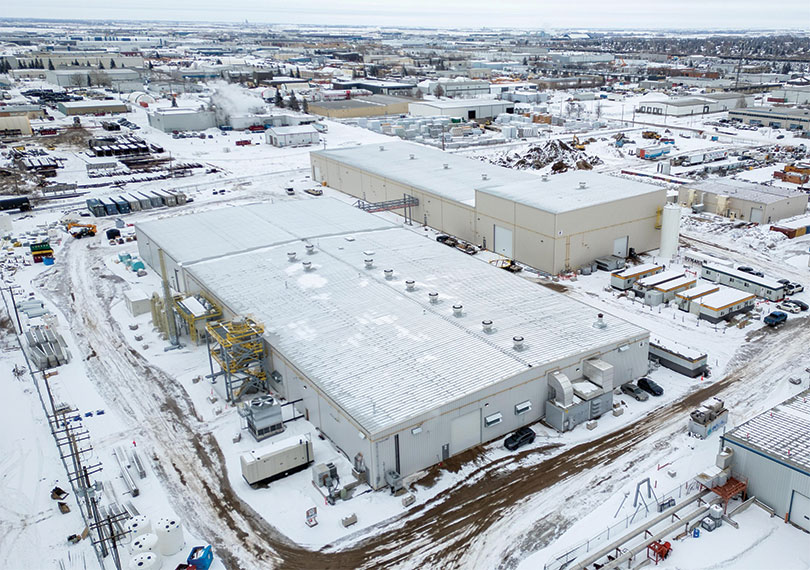
Rare earths are not really different from other mining sectors when you look at the raw material,” said Imran. “REEs are separated from impurities in the Monazite Processing Unit. Once that process is complete, the rare earths need to be separated from each other, and that’s where the SX Unit comes in.” At SRC’s facility, the in-house fabricated SX cells will separate the rare earths into five products: medium and heavy-mixed REEs, lanthanum cerium carbonate, a neodymium-praseodymium (NdPr) mixture and pure terbium and dysprosium. The NdPr product then undergoes further processing in the Metal Smelting Unit to produce the NdPr alloy.
This unit features in-house-developed, innovative metal-smelting technology for producing REE metals. In the summer of 2024, SRC achieved a North American “first” when this technology produced REE metals at commercial scale. As it moves towards fully integrated operations in 2027, SRC has already secured a client to purchase the majority of the REPF’s annual production and continues to seek domestic and international clients, supporting broader market development and diversification opportunities.
The skills and expertise for the job
With nearly 80 years of innovation experience, SRC has a proven safety record and the expertise needed to handle the complexities of REE processing. As Canada’s second-largest research and technology organization, SRC has unparalleled experience in mining and mineral recovery.
“REE processing is quite complex and includes the use of chemicals, large quantities of water and skilled techniques. The process must also follow strict environmental regulations,” said Imran. “You need to have the expertise and the capabilities, and that’s where SRC really shines.”
From the safe operation and decommissioning of a SLOWPOKE-2 research reactor to the management of Project CLEANS, a multi-year project to assess and remediate 37 abandoned uranium mines, SRC regularly works closely with industry, regulators and communities. “The work we are doing has a substantial impact on the overall economy of Saskatchewan. … in the form of jobs, improved productivity, process optimization and delivery of new concepts to commercial applications,” said Imran.
Canada’s second largest research and technology organization supporting innovation and industrial commercialization.