

In 1933, construction of the Golden Gate Bridge connecting San Francisco to Marin County began. It was an ambitious project that many believed could never be completed. However, chief engineer Joseph Strauss not only succeeded, but also played a key role in introducing unique safety measures for construction projects.
Jonathan Sherman, occupational health and safety consultant for Birchbark Safety Consulting, delivered his informative presentation, “Lessons from the Construction of the Golden Gate Bridge,” at the SHCA Infrastructure Summit and Trade Show in December.
Building a culture of safety
“In his focus on innovation and following strict procedures, Strauss developed a unique safety culture that had not been documented in modern industrial construction before this time,” said Sherman. “During the building of the Golden Gate Bridge, Strauss and his team instituted unique safety measures, such as skin cream for workers to protect them against wind, hard hats for the first time in the modern construction era and, of course, [they] installed the famous bridge’s long safety net that saved 19 workers from death during the build. These innovations and the workplace culture they produced can still be seen in the modern safety management system practices we use today.”
All of this took place during a period in North American construction history when the industry’s expectations for infrastructure projects such as the Golden Gate Bridge reflected a grim outlook: For every $1 million spent, at least one fatality could be anticipated. With the Golden Gate Bridge’s budget set at $35 million, it implied that 35 lives might be lost.
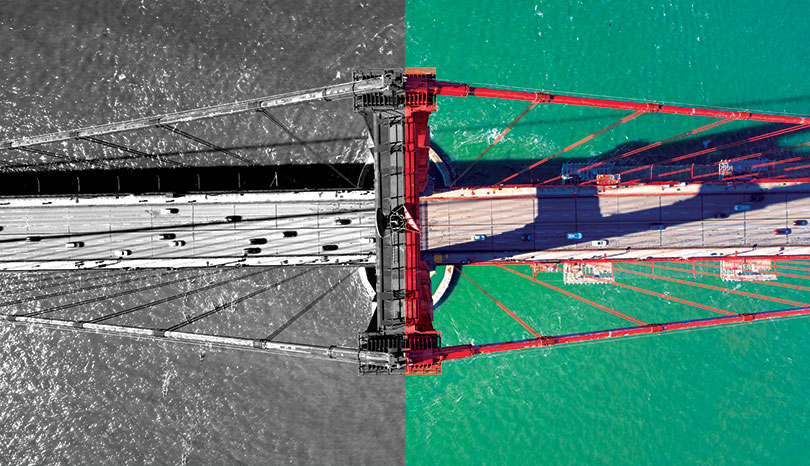
Strauss actively challenged this statistic through innovative methods and stringent safety protocols. However, 11 workers still died over the course of the five-year project, including 10 in a single accident near the end. Despite these tragic losses, when compared to other large-scale infrastructure projects built around the same time, such as the Hoover Dam, which cost $49 million and recorded 96 worker deaths, Strauss and his team demonstrated that the one-death-per-million formula was not an expectation that needed to be accepted.
Eliminating workplace hazards follows a standard method in construction projects. In the 1950s, the National Safety Council introduced the hierarchy of controls, a five-tier approach used to reduce or eliminate workplace hazards, ranked from most to least effective.
When starting a construction project, the hierarchy of controls follows these steps:
- Elimination: physically removing a hazard
- Substitution: replacing the hazard with a less dangerous one
- Engineering controls: putting safeguards in place to isolate people from a hazard
- Administrative controls: changing how people perform their work, whether through rotating shifts or posting warning signs, by implementing changes through training, procedures and policies
- Personal protective equipment, such as safety glasses, hard hats and respirators
By the time Strauss and his team finished the bridge, they had also helped establish new construction safety standards. However, what initially seemed like a symbol of workplace safety soon became linked to a public safety catastrophe.
Protecting the public
“Once the Golden Gate Bridge opened, it unfortunately became a location of choice for those who wanted to [die by] suicide. From 1937 to 2024, there have been over 2,000 deaths reported as a result of individuals taking their own lives by jumping from the bridge,” said Sherman.
Over the years, measures have been implemented, such as suicide prevention techniques, to decrease the number of deaths annually at the bridge. Suicide hotlines were installed along the bridge pathway, and pedestrian access was restricted at night. In 2024, the installation of 20-foot-long metal barriers extending from the walkway was completed at a cost of $240 million. All these measures can be traced back to parts of the hierarchy of controls, where, in this case, they were used to reduce the rate of suicide.
For every $1 million spent, at least one fatality could be anticipated.
“Those actions … were approached in an analytical way, where the hazards were evaluated, and the response was to implement physical barriers…. That being said, administrative controls, or the ‘human touch,’ also had a big impact on suicide prevention, and in some cases suggested that human intervention outperforms physical barriers, even those such as the new suicide-prevention net installed in 2024,” said Sherman.
A volunteer group called the Bridgewatch Angels was formed in 2011, mobilizing hundreds of volunteers to patrol the bridge during major holidays and search for anyone who might be contemplating suicide. Additionally, Sergeant Kevin Briggs, a California Highway Patrol officer known as the Guardian of the Golden Gate Bridge, has dissuaded more than 200 people (with a success rate of 99 per cent) through personal engagement. This method, in terms of hierarchy controls, is considered an administrative control.

“The lesson that we should learn is that while we have come a long way in bringing safety preventions into the worksite, there is still work to be done to understand the mental health aspect of keeping someone safe,” said Sherman. “Prior to the 1990s in both the U.S. and Canada, there were no laws in place to ensure public buildings were made accessible to people with physical restrictions, and today, it is part of both federal law and the National Building Code.”
The question now is whether the industry will address mental health risks in infrastructure development and design, and what the best protection method would be, whether that’s traditional engineering controls (barriers and netting) or a more human approach that raises administrative controls above their usual lower position in the hierarchy.

Martin Charlton Communications is the largest public relations company in Saskatchewan and one of the largest in western Canada.