

The Wirtgen Group, a John Deere company, is a global powerhouse in the construction equipment industry, delivering integrated solutions across the entire road-building lifecycle. Its roots trace back to a 1961 trucking firm that evolved into a technology leader and now comprises six specialized brands.
Frank Miller and Sven Mayer of the Wirtgen Group attended the 2025 SHCA Infrastructure Summit and Trade Show in Regina to talk about the Hamm AG Smart Compact technology and how it delivers real-time density scanning for road building. Hamm AG is the compaction specialist within the Wirtgen Group. It produces a broad portfolio of rollers: over 200 models ranging from 1.5 to 25 tons, including tandem rollers, soil compactors and pneumatic-tire rollers.
For more than 145 years, Hamm has pioneered modern compaction technology, focusing on sustainable drives, digital innovation and precise asphalt and earthwork solutions that complement the group’s road-construction chain. One piece of that technology is the Realtime Density Scanner, which Hamm developed for efficient road building. The presentation at the Summit gave attendees an idea of what Hamm offers compared with traditional compaction methods.
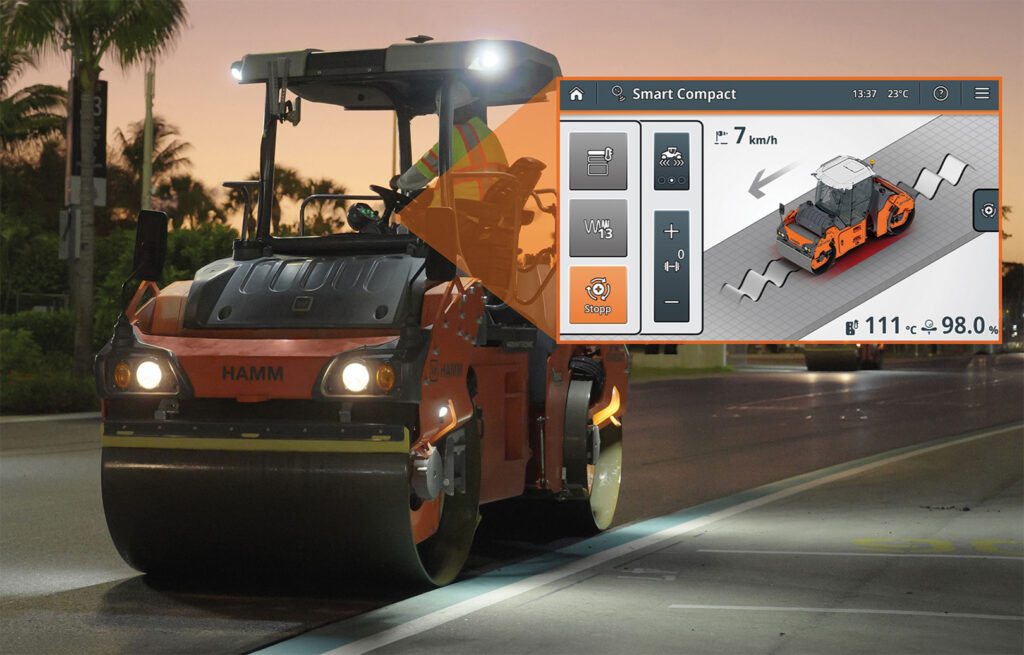
Smarter compaction through automation
“The Smart Compact technique was developed to help with the uniform density critical for durability, smoothness and longevity of pavements,” said Miller. “It takes the guesswork out of applying asphalt that traditionally relies on operator skill and manual adjustments, which can lead to inconsistency, over-compaction, under-compaction and costly rework on a project.”
In 2022, Hamm introduced Smart Compact Basic, an intelligent digital assistant that automates much of the decision-making for asphalt operators. Then, in 2025, it advanced that technology and introduced Smart Compact Pro, with real-time density measurement integrated into the automated control system. Smart Compact Basic allows operators to select the layer type (base, binder or surface course), and the system independently controls both drums (front and rear) for compaction mode (vibration, oscillation or static) and force.
During operation, Smart Compact Basic continuously monitors key physical parameters: asphalt temperature, stiffness, layer thickness, cooling behaviour, ambient temperature and local weather data. Using empirical algorithms, it optimizes passes within the ideal temperature window, prevents over-rolling and supports temperature-reduced mixes. It also offers cost savings by using ECO mode, which reduces dynamic compaction and engine speed by up to 20 per cent near completion, delivering up to 15 per cent in fuel savings and
lower emissions.
Cost is always an issue when choosing how to approach a project. However, in the long run, it is technology like Smart Compact that will save dollars on road building for the contractor, road owner and the tax payer.
Smart Compact Pro builds directly on what Smart Compact Basic offers, incorporating real-time density measurement into automated control. A groundbreaking “Realtime Density Scan” sensor – essentially a ground-penetrating radar unit mounted beneath the machine’s centre – continuously scans the asphalt mat as the roller moves. It measures dielectric conductivity, which correlates precisely with actual density or porosity, and displays live percentage values on the screen. Unlike Smart Compact Basic, which relies on indirect proxies such as temperature and stiffness, Smart Compact Pro uses density as the primary control variable. The system automatically adjusts vibration, oscillation or static modes and force in real time, shutting off dynamic compaction exactly when the target density is achieved across the full pass width, not just at isolated points.
“Using Smart Compact technology, whether it is the basic or the pro, puts more certainty into the quality of a project,” said Miller. “Human error can cost a project thousands of dollars to fix, but by using Smart Compact, an operator has a built-in system that helps them to avoid those errors that, in the long run, save them time and money.”
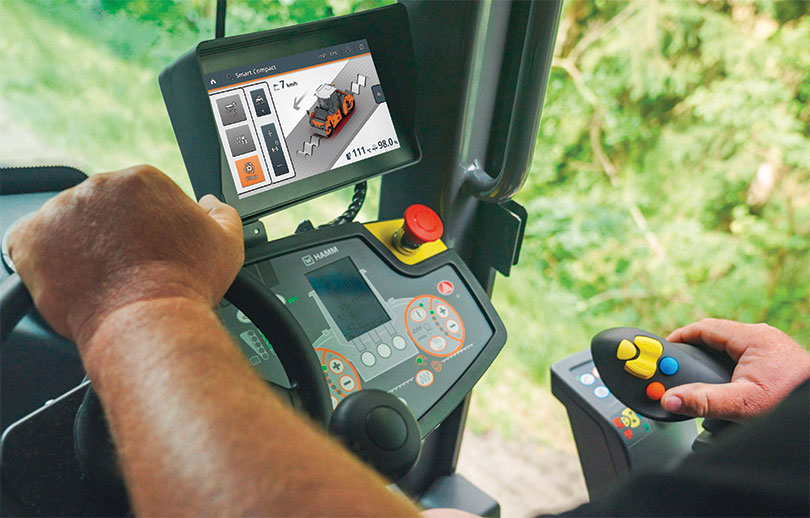
When considering which technology to buy, customers can assess their budgets and needs based on each technology’s offerings. Smart Compact Basic offers an operator smart assistance to ensure the desired quality level on a project is achieved. It excels at process automation by using material physics, such as temperature, stiffness and asphalt thickness, to deliver consistent results. However, the Smart Compact Pro version brings operations to a full, density-driven autonomy platform. In addition, it directly quantifies density in real time via dielectric scanning, providing full-area coverage that helps dramatically reduce variation and surface damage.
“Based on what works for you, the Smart Compact technology gives the operator a choice between assistance and automation,” said Miller. “Regardless of what version is chosen by the customer, in the end, they come away with a better result than if they had used traditional methods.”
Better roads, lower costs
Cost is always an issue when choosing how to approach a project. However, in the long run, it is technology like Smart Compact that will save dollars on road building for the contractor, road owner and the tax payer. The contractor mitigates penalties and may gain access to additional bonuses when they hit the density targets.
Proper compaction determines whether a pavement lasts 15 or 30-plus years. Inadequate density leads to voids, moisture ingress, rutting, cracking and premature failure, costing billions globally in repairs. On large highway or airport projects, consistent compaction translates to faster lane closures, smoother traffic flow and higher productivity. Operators using smart technology complete jobs with fewer passes, allowing less-experienced crews to produce professional-grade results. This mitigates skilled-labour shortages and minimizes or eliminates core sampling, improving safety and slashing testing costs.
As infrastructure demands grow amid labour and cost pressures, this technology not only elevates compaction from an art to a precise science, but also delivers safer, longer-lasting and more economical roads.

The Wirtgen Group is an internationally active group of construction equipment manufacturers. As a technology leader in the construction sector, The Wirtgen Group is a strong partner for road construction, earthmoving, and material processing.