by SHCA SHCA

We’re Hiring

(Or we’re trying to)

Where did all the workers go?

If only I had a loonie for every time I heard that question in the months since the end of the pandemic.

As employers scramble, or perhaps more accurately pull their hair out, over vacant jobs, strong demand and no one to actually do the work, it is little wonder they are frustrated these days. And StatsCan seems to amplify that sense when it posts surveys showing “record-setting job vacancies” now sitting north of one million positions. The logical response on the part of employers is to ask: where have all the workers gone? We were good, then came COVID and now we’re not good.

The answer is out there, and it might surprise you. And it isn’t CERB, or an apparent lost generation of 20-somethings cooped up in a dark basement playing video games, incapable or unwilling to secure gainful employment. Nope. Turns out, all those lost workers retired.

Demographics expert Eddie Lemoine was in Saskatchewan not long ago speaking to CEO groups in the major cities and he simply walked through the numbers showing Boomers are a significant part of the problem.

Actually, the answer is out there, and it might surprise you… Turns out, all those lost workers retired.

People in that age group were turning 65 at a rate of 8,500 a week or so through the pandemic; that meant somewhere between 500,000 and 800,000 (depending on your view of when the pandemic ended) reached the birthday usually associated with retirement.

Then there is the immigration story.

Lemoine notes that while Ottawa’s claim that we set a record with more than 400,000 new immigrants last year was “technically” correct, more than half of those were already here … only their status from temporary to permanent changed. So cut that figure in half.

Further, a large percentage of the immigrants who were here on temporary visas, such as student authorizations, actually returned to their homelands to ride out the pandemic with their families.

That’s another three or four hundred thousand taking us remarkably close to the one million posted jobs currently going unfilled in this country.

All of this brings us to policy responses. At the provincial level, we’ve seen the premier advance the notion of a “nation in a nation” as he demands the feds hand over more control over immigration.

The Fraser Institute think tank has advanced the idea that pension rules need to be changed to encourage older workers to stay in the workforce longer, even part-time, to take up some of the slack. They argue OAS claw-backs should be reduced or eliminated so older workers can take employment without being penalized. After all, why would anyone work for free?

COVID changed a lot of things, the labour market among them. But solving the issues at hand starts with getting a proper handle on what the issue actually is, and we might be moving that way. But the journey isn’t necessarily a short one. 

by SHCA SHCA

Mental Health in the Workplace

What employers need to prepare for

By Tracy Slywka, Injury Solutions Canada

In 2022, mental health and wellbeing are huge concerns for employers. Mental health is one of the biggest factors affecting employers and employees today! Mental health has come to the forefront in recent years with progress being made, but is it enough?

First and foremost, employers need to be educated on how to deal with mental health in the workplace. They need to be compassionate and educated to know what they as a company can do to assist employees when there are mental health concerns and to keep staff mentally well. Employers must come to terms that the old way (“sucking it up”) simply isn’t good enough anymore and realize the damage that comes with this mentality. In this day and age, we are all under a lot of stress and that looks different for all of us. The old way about we approached mental health – or rather, didn’t approach it – needs to go in the trash can.

What can employers do to help prepare their workplace for mental wellness? All employers should have a policy on mental health, discrimination, harassment and bullying. They should also acknowledge that not all people can be supervisors and nor should they. Just because someone is good at their job does not make them a “great supervisor.”

There is a saying that employees don’t quit their jobs, they quit their supervisors or bosses. Employers must recognize that we all have lives outside of the workplace and sometimes our home life creeps into our work world. For example, if a colleague or supervisor recognizes that someone isn’t themselves and suddenly has trouble with their job that previously they did no problem, there may be extenuating factors impacting that person. An employee needs to know that they are in a “safe place” at work, and it is okay not to be okay! Employees should feel safe to ask for help.

Employers can impact mental health positively in the workplace. For starters, consider enrolling in a mental health first aid course and offer it to employees as well. The University of Fredericton has partnered with WorkSafe Saskatchewan to bring courses on mental health at reduced rates. Courses are online and are available through the WorkSafe Saskatchewan website, www.worksafesask.ca/training/online-courses. There are many resources through WorkSafe Saskatchewan, and employers should utilize them.

Employers should also take advantage of free events like speakers on mental health, put on by WorkSafe Saskatchewan, industry associations and safety associations. Host lunch and learns in the workplace. Ensure you have an employee and family assistance program (EFAP) as some workplaces may not be equipped to deal with mental health concerns, and programs like these can offer critical support to employees. Employees need to know that there is someone who may be able to help them confidentially in their time of need.

It’s important that employers walk the talk, as too often policies and procedures are written but when it comes time to apply them, they’re forgotten. Treating a mental health concern should be no different than a broken leg. People need to feel that there is no stigma associated with mental health and should feel free to ask for help – no different than a physical injury. Employees should know that if they are not mentally well that they can take the time they need to get better. Employees who are not mentally well cannot be productive in the workplace.

One in five Canadians (7 million) will experience mental illness annually, according to an article prepared for the Mental Health Commission of Canada. Mental illness, if not treated, can lead to greater absenteeism rates as well as disability claims, which ultimately affect productivity as well as the financial implications from having employees away from the workplace. It really is in the best interest of employers to acknowledge mental health as a challenge employees may face and have a plan of action to help them get the help they need. People function best when they are mentally and physically well. 

by SHCA SHCA

Drones are Benefitting Earthmoving Operations

Why you should add this tool to your toolbox

Submitted by CONEXPO-CON/AGG

Drones – the aerial eye of the jobsite – have become a versatile tool for earthmoving operations. Among the benefits: increasing efficiency, productivity and accuracy on job sites. In addition, drones help reduce unplanned costs and rework throughout a project by providing a steady stream of job site progress data.

As drone technology evolves, the greater the return on investment in employing them, according to Zach Pieper, director of operations and co-owner of Quantum Land Design, an industry leader in managing and preparing 3D data required for construction projects of any scale.

“Drones are another tool contractors can put in their toolbox to make more efficient and better decisions.”

– zach pieper, quantum land design

“That is why is it important for those in the construction industry, especially in earthmoving, to learn about using drones,” said Pieper. “Drones are another tool contractors can put in their toolbox to make more efficient and better decisions. There are many situations where a contractor might need to keep track of how much earth is being moved, compare the current site to the planned site, and figure out how many yards of earth [there are that] still to be moved and where that dirt must go. Drones can be a very cost-effective way to do that.

“Drones can also provide a very rich layer of data that can be added to your knowledge of a project and your ability to manage it properly.”


feverpitched/123RF

When it comes to drones, Pieper says there are two types of contractors.

“One group I call ‘drone curious.’ They think drones are interesting and they need to be learning about them,” said Pieper. “The second group are those contractors that already have drones and feel they are not utilizing them as well as they could be. Or they bought a drone for a single purpose, which it is serving well, and they want to get more use out of the information collected. Or they want to get ideas on how to better use their drones on job sites.”

The How to Utilize Drones in Your Earthmoving Business education session at CONEXPO-CON/AGG will cover the high-level basics of drones, including types of drones, applications, the kind of data you can get out of drones and basic data collection procedures.

“The session applies to nearly any size contractor,” said Pieper. “It will be an information-dense way to learn how you can use drones to make better decisions with your contracting company and on each job site. It will be focused on applied technology. Everything in the education session will be information that any contractor can take back to their company or their jobsite and put it to work.” 

Held every three years, CONEXPO-CON/AGG is the must-attend event for construction industry professionals. The show features the latest equipment, products, services and technologies for the construction industry, as well as industry-leading education. The next CONEXPO-CON/AGG will be held March 14–18, 2023, in Las Vegas, Nev. For more information on CONEXPO-CON/AGG, visit www.conexpoconagg.com.

by SHCA SHCA

The Saskatchewan Common Ground Alliance Celebrates 15 Years of Promoting Public Safety

Committed to worker safety and damage prevention

By Ron Podbielski and Shannon Doka, Saskatchewan Common Ground Alliance

Do you remember the year 2007?

The third instalments of the Spiderman and Shrek movie series were the top grossing movies of the year. Apple released the very first iPhone. And in November, the Saskatchewan Roughriders, led by quarterback Kerry Joseph, claimed their third Grey Cup with a victory over the Winnipeg Blue Bombers in Toronto.

But there was also an especially important milestone in the world of public safety that year.

That’s because the Saskatchewan Common Ground Alliance (SCGA) was formed. We’re proud to be celebrating 15 years of a network of businesses and communities committed to damage prevention in our province.

Prior to 2007, there were many parties who saw the benefits of educating the public on the need to protect not only the billions of dollars of underground infrastructure that provide the services we rely on, but also the safety of those working around it.

But mostly, these companies and communities were pursuing their safety programs individually, without a wider network to share resources, discuss best practices and coordinate activities. From its modest beginnings, the SCGA grew to offer members a way to work together – right at a period when Saskatchewan’s economy (as well as its digging activity) began to experience tremendous growth.

Over the past 15 years, the SCGA has collaborated tirelessly with its partners to promote safe digging and construction practices to frontline workers and to the general public.

The SCGA spring series of contractor Dig Safe breakfasts in communities across Saskatchewan has been a tremendous tool in promoting these safety messages to thousands of frontline workers.

The SCGA has also developed a series of professionally produced education videos on a variety of topics, as well as safety information cards and resources on its website, www.scga.ca. The SCGA produces a quarterly newsletter to share and posts content on Facebook, Twitter and LinkedIn.

Over the past 15 years, the SCGA has collaborated tirelessly with its partners to promote safe digging and construction practices to frontline workers and to the general public.

The SCGA partnership with Sask1stcall.com has allowed us to take our safety focus to the tens of thousands of digging projects every year in Saskatchewan. And our members share a commitment to promote best practices through joint discussion and tools like the Damage Information Reporting Tool (D.I.R.T).

Another highlight was the 2021 launch of our Youth Ground Disturbance Program, a free safety training initiative for students aged 14 to 21, delivered in cooperation with the Saskatchewan Safety Council and Heavy Construction Safety Association of Saskatchewan.

We are proud that today, we have grown to 95 members and sponsors who share our vision of a safe digging community where everyone works safely, comes home to their families at the end of the day and protect the vital underground infrastructure that we all depend on.

Thank you for your support and we look forward to where the next 15 years takes us, together in partnership with all of Saskatchewan. 

by SHCA SHCA

You Only Retire Once

Are you prepared?

By Stuart Sutton, B.Comm., CFP®, Assante Capital Management Ltd.

Growing up, I was always afraid of standing up in class to speak or being singled out to answer a question. I thought it was because I was shy. Then I learned that people feared public speaking more than death!

Public speaking might have topped the list of fears at one time, but it’s been replaced. A survey by Allianz Life Insurance reported that three out of five people over age 55 fear running out of money in retirement, and 45 per cent don’t feel confident they’ll be able to afford the post-work lifestyle they want.

As time goes by, people are growing increasingly afraid they won’t have enough money. It’s gut-wrenching to wonder, “Will I have enough?” Or worse, “Will I have to depend on the kids?”

The Allianz poll also asked the following question to people who had amassed between $1 million and $10 million in net worth: “Are you concerned about losing your wealth?” An astonishing nine out of 10 millionaires said they were indeed worried about losing their wealth.

This fear is not unfounded. In addition to the ongoing challenges of the pandemic, Canada’s annual inflation rate has been increasing; it is at its highest point in over 30 years. This has led the Bank of Canada and most other central banks around the world to crank up interest rates, with the goal of reigning in the scourge of inflation.

Combined with the growing cost of living (which makes it harder to preserve your hard-earned dollars), the number of years you will need to fund your lifestyle after retirement has increased dramatically over the past few decades.

Steady gains in life expectancy were made through the 1960s, ’70s, ’80s and ’90s. Then, there was a huge jump in the 2000s. By 2009, Statistics Canada reported that a 65-year-old male had an average life expectancy of 18 more years, while a 65-year-old female could expect to live an average of almost 22 more years.

By 2009, Statistics Canada reported that a 65-year-old male had an average life expectancy of 18 more years, while a 65-year-old female could expect to live an average of almost 22 more

While it is a good thing that advances in science and healthcare have increased the number of potential years we can enjoy retirement, it can cause added stress. The combination of high inflation and increased lifespan makes the worry of running out of money even more pronounced.

It raises the question, “Is your retirement income plan stress-tested to age 100?”

That’s important. You want to make sure.

A secondary question is this: How much income will you need in retirement? This question is important because you may have heard one of the common myths out there, which is that you can retire on 70 to 80 per cent of your working income.

Peace of mind is knowing for certain that you’re doing everything possible to ensure you’ll have the freedom to live the rest of you life on your terms.

If you have subscribed to that standard in your retirement planning, I have two questions for you:

Which 20 per cent or more of your lifestyle do you not want to enjoy? Will you cut travelling, quit your hobbies and stop providing for the people and causes you care about?

Is it possible you might need more after retirement to do everything you’ve been putting off?

Sutton’s webinar will address ways for residents of Saskatchewan to protect their assets and minimize the bites on retirement income

Peace of mind is knowing for certain that you’re doing everything possible to ensure you’ll have the freedom to live the rest of your life on your terms. Maybe you are in good hands, but maybe you could use a specialist to take a second look. Either way, you want to be certain, because you only retire once.

Stuart Sutton, B.Comm., CFP® is a wealth advisor at Sutton Wealth Planning of Assante Capital Management Ltd. He is the author of “5 Serious Barriers to your Retirement Plans” and co-author of the “Is Now the Opportune Time to Upgrade Your Lifestyle (And Your Financial Advisor)?” special reports and the facilitator of “The Big Three Retirement Fears” webinar. Sutton specializes in helping family business and is a second-generation owner and partner at Sutton Wealth Planning. Sutton and his team have been showing business owners, professionals and executives how to preserve, protect and pass on their wealth for over 25 years.

Register for Sutton’s free webinar to discover new and easy ways to save taxes, eliminate fears and keep more of what you make: visit www.fairwaterworkshops.com/seminar/taxes-retirement-free-webinar-in-saskatchewan.

by SHCA SHCA

Big Equipment at Big River

Coop-A-Deez Contracting Ltd. provides resilience and reliability even in times of uncertainty

By Pat Rediger

Fresh out of high school in 2009, Cooper Davis found himself in the oilfield at just 18 years old. Working long hours at remote locations, he quickly learned the value of a dollar and the hard work to earn it.

At first, the oilfield offered a lucrative and seemingly stable job where he operated heavy equipment. He met a fellow who mentored him on the equipment, and he became quite a proficient operator. But as prices became uncertain, people began losing their positions and Davis was forced to reconsider he career options.

When oil prices reached an all-time low in 2015, Davis decided that the time might be right to return home to Big River and do some contract earth-moving work.

“Oil had taken a hit and as a result I saw the chance to get my first piece of equipment,” he said. He and his wife Emily saw the equipment purchase as an opportunity to build a business of their own, leading to the creation of Coop-A-Deez Contracting Ltd.

Cooper Davis in his Dozer
Some of the earthmoving equipment used
by Coop-A-Deez Contracting, Ltd.

With only a single dozer and a strong work ethic, the Davises set about making a name for their new company. Although times were tough in the oilfield, farmers and ranchers were still looking for operators to work their land as the agricultural industry continued to do well.

After the area was impacted by the depressed oil industry, heavy equipment was still needed in agriculture.

“People needed work done and there was really no one around left to do it,” Davis said.

Working out of Big River, he began doing some clearing and brushing work for local farmers. As trust and appreciation grew, word of mouth began to spread, and the phone began ringing on a more regular basis.

Davis began purchasing more equipment and accepting larger jobs. After landing a contract from the Prairie Farm Rehabilitation Administration (PFRA) to help remove a bridge in Meadow Lake, he purchased his own excavator as a necessary step in the business’ progression.

The old highway bridge had long since collapsed and had been converted to a cattle crossing, but when that structure fell into the creek, Coop-A-Deez removed the remnants and rebuilt the nearby abutments.

“The biggest thing was that I was young, on my own, and didn’t have a lot of equipment to work with,” said Davis. Dealing with a 90-by-40-foot bridge of solid steel components proved to be a real challenge. “It was extremely heavy and kind of daunting once we got up there and started working.”

After overcoming the challenges, the successful project marked a milestone for the company. As his first and one of the biggest projects to date, Davis says the work he put in was both challenging and rewarding.

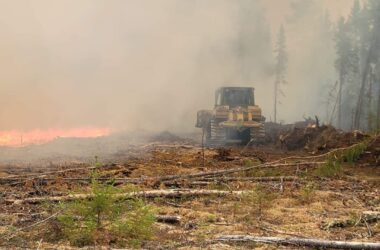
Coop-A-Deez Contracting Ltd. has sent staff and equipment to northern Saskatchewan to fight fires

Company expands

Shortly after completing the bridge project, Davis decided to make another significant purchase by investing in a mulcher and expanding his scope of work even further. A few years later, he invested in a second dozer, winch truck and a scissor neck lowbed trailer and has continued to reinvest in himself and his employees ever since.

Last summer when the province was experiencing significant forest fires in the north, Davis was contracted to help contain the disaster. He quickly moved both dozers there and chased multiple fires in the area for three months.

“It can be very fast-paced, and you have to learn quickly,” he said. “You have to be skilled with equipment, but more than that, you have to be willing to push that equipment to the edge.”

The steady growth of the company also meant long hours away from home and with rising inflation, Davis has begun to rethink his priorities.

“Travel and fuel were getting expensive, along with accommodations,” he said. “It can become unprofitable very quickly working on the road.”

He and his wife had also started a family – they now have three children – which made time away from home that much more difficult.

Cooper and Emily Davis with their three kids

“You need to spend enough time on your business, whether that’s on the machine working a job, in the shop fixing equipment, looking at jobs, moving equipment, doing office work and attending meetings,” he said. “I also need and want to spend time with my wife and kids. It can be hard to find balance.”

For this reason, they decided to refocus on local projects. They are able to provide exceptional service while still finding time for family life. Business is still booming, and Davis says as his sons grow older, there is a potential to re-prioritize expanding the business – especially if they are as passionate about operating equipment as he is. 

by SHCA SHCA

The Hiring Landscape

Employers are having a hard time finding people – here’s what some Saskatchewan heavy construction contractors are facing

By Martin Charlton Communications

Some heavy construction employers in Saskatchewan are sharing what they are trying in order to find and retain workers to keep their businesses and the industry strong.

A lack of experience isn’t a barrier for someone interested in a job in heavy construction. Employers are willing to train, seeing it as an investment to secure the employees they need.

“We have people out here who have never been in a rock truck,” said Kevin Arneson of Allan Construction. “We’ll spend as many days as we need to with them to train them up, so we get them comfortable with that piece of equipment. We hope that they stay around and become a valuable employee for us.”

Even with that approach and the accommodations the business can make – around scheduling and travel, for example – Arneson has found it difficult to retain employees. He’s onboarded many this year, but they aren’t working out.

“It’s been probably one of the worst years in history,” said Arneson, who said the company promotes its jobs at career fairs, through local hiring events and online on recruitment websites.

Carmen Duncan will hire local teenagers to work in his shop until they are older to begin learning to operate the equipment.

He has been working full-time in the industry since he was 15 years old. He started even earlier working for his dad, Cameron Duncan, in the family business along with his brothers, picking rocks and helping where they could.

Over the years, I’ve learned to hire less and less based on experience. I’m not saying that experience doesn’t matter, but I really look for some key characteristics in people.”

– Darcy Nemanishen

To him, attitude is more important than experience. He wants employees who are interested in learning.

“I want to know they can retain knowledge and build on that knowledge,” said Duncan, who is the second-generation owner of C. Duncan Construction, based in Spy Hill. “Some people only want to learn so much and then carry on with life, but as my dad always said, ‘If you’re not learning something new every day, you’re dying.’”

Then, he needs to make sure they are committed to working long hours for 11 to 13 days at a stretch. They need to be comfortable not returning home every night as projects take them almost anywhere in the province.

One of Darcy Nemanishen’s newest employees came to him with lots of experience – in medicine – but it was his character that got him the job.  

Suhyb had been a physician in Ukraine. Nemanishen met Suhyb and his wife, Oksana, to discuss what work opportunities he could provide.

“To be honest, I was a little bit intimidated when I saw their resumés,” said Nemanishen, recognizing the extensive training the couple had – him in psychotherapy and her in laboratory medicine.

To Carmen Duncan, attitude is more important than experience. He wants employees who are interested in learning.

Suhyb had joined the fight in the war against Russia, but the couple left Ukraine when the situation in Kharkov, where they lived, became treacherous for Oksana, and Suhyb’s health weakened. They travelled for weeks through Poland finally to Canada where the Sunflower Network helped them settle in Martensville, where Nemanishen lives.

Nemanishen connected with Suhyb had joined the fight in the war against Russia through the Sunflower Network, a group of Saskatchewan people dedicated to helping Ukrainians settle in the province. It isn’t just Nemanishen who has been working with groups formed to help Ukrainians looking for a new start in Canada.

The SHCA has been working with the Ukrainian Canadian Congress, Employer Services and others connecting Ukrainian immigrants to companies for employment opportunities.  

SHCA has worked with Andrii Stakhov, who is employment liaison with the Saskatchewan Provincial Council of the Ukrainian Canadian Congress. It has an employment form on its website where employers can post jobs to support those displaced by the war in Ukraine. Then, Stakhov can identify what kind of employment is most suitable for each job candidate, depending on their backgrounds and credentials, including their ability to speak English.

Shantel Lipp, president of SHCA, says many members have been eager to work with groups such as the Ukrainian Canadian Congress and the Sunflower Network.

I’ve got a philosophy that when you find a good person, you find a spot for them, whether you have one or not.”

– Darcy Nemanishen

“The association believes, like many of our members, that if you can help someone in need, you should,” said Lipp, who encourages all members to fill out an employment form. “We believe in giving these folks, who are new to our great province, an opportunity to provide for their families.”

Looking beyond direct experience

Nemanishen believes in looking at an employees’ character when making hiring decisions.

“Over the years, I’ve learned to hire less and less based on experience,” said Nemanishen. “I’m not saying that experience doesn’t matter, but I really look for some key characteristics in people.”

He wants to hire people like Suhyb, who are humble, smart and
emotionally intelligent.

“Those are three of my top things. If you’ve got somebody who’s got those qualities, whether or not they have a lot of experience on a grader or a scraper or a dozer, there is a lot of that stuff you can teach to the right people,” said Nemanishen. “I’ve got a philosophy that when you find a good person, you find a spot for them, whether you have one or not.”

Those who make the cut can expect to make a good living. Recently, the SHCA explained to the City of Regina how employees of the industry are compensated. This was in response to the city considering attaching a fair wage policy to its procurement policy, a proposal that was
defeated by council.

Heavy construction employers are known to be one of the better paying employers in the province – statistically second only to the mining sector. The average hourly compensation for the heavy civil construction industry in 2021 was $39.84. This is 11.4 per cent above the provincial all-industry average and ranks seventh among 20 major industries in the province.

The industry compensates employees based on their skill, training, type of work and years in the position in balance with what the market will bear. Many employers provide benefits such as medical, dental, health spending accounts, company vehicles and additional training for their employees as part of their employment.

Getting one’s boot in the door can be the start of a solid career. Nemanishen explains how he trains new hires.

“We very much operate with a crawl, walk, run mentality here,”
said Nemanishen.

First, the new hire drives around with someone experienced to get used to being on a job site.

“There’s a lot of moving parts on sites. We’re driving huge, heavy, fast pieces of equipment and we love that. But if you’re not in the loop, it can be dangerous,” he said. “I’ve often said anybody can drive a piece of equipment from point A to point B. It’s knowing what to do with it or what not to do with it.”

The next step is getting the new employee in that equipment alongside an experienced operator. Then, they can begin to operate it with someone more experienced monitoring them.

“Depending on the feedback I get from my operator, that can last anywhere from a couple hours to several days. It just depends how fast people are catching on.”

That experience is coupled with training materials developed by the company. Safety is Nemanishen’s priority. His company has not had any serious injuries or deaths on its job sites in its 60-plus years. He intends to continue
that streak.

“I worked really hard to develop more of a structured training program,” said Nemanishen. “I’ve made my own manuals and my own exams, so there’s a lot more in-depth and company-specific information when it comes to training.”

Duncan believes a lot of younger people want to incorporate technology into their jobs. Anyone looking at how technology can intersect with operating heavy equipment might want to see Duncan’s equipment. It includes GPS technology that allows operators to monitor a 3D image of the road they are building as it is being constructed.

Jobs in heavy construction aren’t just about operating equipment. There is traffic accommodation, human resources, health and safety policy development, accounting and more. Those roles also require an employee to understand the industry while developing different knowledge and skills needed by
the business.

The great thing about our industry is that we are all contractors who are bidding on the same jobs, but when the job is done, we are all still friends, ready to sit down and have a beer and a laugh.”

– carmen duncan

Nemanishen explains his cousin, Jason, started out in the family business at about the same age he did. Jason now focusses on the accounting after getting his post-secondary education, but he too has experience operating equipment.

Even in a family business, Nemanishen says everyone working for the company needs to become qualified for their roles.

“My dad and his two brothers were really born into it. It was just assumed that they would kind of join the company my grandpa and grandma started, and they did. And all three of them are still involved,” he said. “My two uncles are operators and my dad did my job and now I’ve really taken over most of it.”

Hiring family because they are family won’t keep a company strong, he says. Employees need to see that their co-workers – even those who are part of the owner’s family – are committed to working hard and doing quality work. Otherwise, he says, the business can implode.

Duncan’s company has employed his wife and daughters at various times in its history. Five years ago, when his dad retired, Duncan bought him out to become the second-generation owner. His wife, Sherry-Lee, retired from nursing to now oversee the company’s human resources, including health and safety.

Their three daughters – Marissa, Kaylee and Zoe – have all worked for the company doing everything from operating equipment to developing health and safety policy. One of his sons-in-law is an employee while another is the son of a different  long-time
family-owned road building company from
the area – DJ Miller and Sons of Langenburg.

Knowing who is attracted to working in the industry has reinforced for Duncan what he appreciates about being part of it.

“The great thing about our industry is that we are all contractors who are bidding on the same jobs, but when the job is done, we are all still friends, ready to sit down and have a beer and a laugh,” he said.

As for finding the next great employee, Nemanishen says you never know who will be the one to work out.

“I still have yet to find the magic formula for hiring,” he said. “I know I’ve got some rules that I apply – and that helps – but when I look at some of the people we hired, when they walked in the office, I thought, ‘Oh my goodness, what are we doing?’

“And they’ve turned out to be amazing.” 

by SHCA SHCA

Heavy Construction & Local Economies

Small towns benefit when heavy construction crews roll in

By Martin Charlton Communications

Saskatchewan communities benefit when heavy construction crews show up to work on projects.

Not only do they have an improved highway, for example, after the crew leaves town, but they also have some more money in their local economy.

Each year, dozens of construction projects are undertaken by local road building companies. Those projects can be hundreds of kilometres away from where those companies are based.

That can mean employees have to temporarily relocate to another community, setting up a new home base from which they work. Those employees spend their nights sleeping in hotel rooms or campgrounds. Their meals are eaten at local restaurants or are made up of food from the community’s grocery stores. Their vehicles are filled with
fuel from local gas stations. That spending
quickly adds up.

Those employees spend their nights sleeping in hotel rooms or campgrounds. Their meals are eaten at local restaurants or are made up of food from the community’s grocery stores. Their vehicles are filled with fuel from local gas stations. That spending quickly adds up.

Planning for that relocation is done even before a job is bid on in Carmen Duncan’s business. He is the second-generation owner of C. Duncan Construction Ltd.

His company is based in Spy Hill in the east-central region of Saskatchewan. He was working in the southeast corner of the province in the RM of Souris Valley near Oungre in September. While working on the project, his crew was staying in a hotel in Estevan.

“Spending local is something we do every day,” said Duncan.

In advance of bidding on a project, those in his office will call local hotels to find out their rates. Bringing in a crew of 10 to 15 people to stay for nearly two weeks at a time is appealing to a hotel, so they are willing to negotiate their rates and even accommodate an earlier breakfast to get the business, says Duncan.

Then, Duncan’s staff makes sure there are local restaurants and grocery stores for their employees to find their meals.

His crew of 10 to 15 people works stretches of 11 to 13 days at a time. That adds up to many tanks of gas, more than 100 nights in hotel rooms and hundreds of meals being bought in a community – adding up to many thousands of dollars spent locally.

“That is a big benefit to the community,” said Duncan, who will sometimes base his crew in a smaller city, but will also often stay in a small town near their project.

That’s just one company on one project. A look at what this spending means when the entire industry is accounted for has been calculated in an economic impact analysis done for the Saskatchewan Heavy Construction Association by Praxis.

The analysis assesses the impact of the heavy construction industry on the province’s economy. One section of it looks at the money spent by road building crews in local communities. It includes many types of purchases, including hotel rooms, restaurant meals, groceries as well as vehicle repair and maintenance, laundry services, hair care
and more.

That analysis found that the heavy construction industry spends $400 million
each year in Saskatchewan communities where they work. That spending supports more than 1,110 jobs in those communities.

That spending is done by companies and individual employees. Kevin Arneson of Allan Construction explains they pay their employees a living allowance they can use for accommodations and meals. The decision on how that money is spent is up to the employee.

Saskatchewan communities benefit beyond this spending on accommodations and food by the heavy construction industry. Companies and individuals are choosing to support local events and initiatives as well.

Arneson says many of Allan Construction’s employees live in small towns. They appreciate when their employer supports local causes and will bring forward ideas for contributions that could be made by the company.

“There’s lots of money that goes back to communities, there’s no doubt,” said Arneson.

Duncan’s company’s support of small-town Saskatchewan also benefits his home community of Spy Hill and surrounding towns. He supports local events, such as rodeos and sports days, held each year. He provides organizers of the event a credit that they can use towards gravel or the use of his equipment, donates light plants for evening events or raffle prizes, for example.

Duncan’s crew of 10 to 15 people works stretches of 11 to 13 days at a time. That adds up to many tanks of gas, more that 100 nights in hotel rooms and hundreds of meals being bought in a community – adding up to many thousands of dollars spent locally.

If they need something, they can come to his shop, explain what is required and he will send over someone with the equipment needed to do the work necessary to get the grounds ready for the event.

“We want to get out and make our presence in our local communities well known,”
said Duncan.

That contribution to the communities, he hopes, is noticed by local families who have children. His reasoning is that these families might think of his company and encourage their children to work in the industry when they are deciding on a career.

It’s an industry he feels they can be proud to join.

“This country and this province were built by blue collar workers,”
said Duncan.

He will hire local teenagers to work in the shop and do smaller tasks until they are older and can begin taking their safety training and learn how to operate the equipment.

“We’re very fortunate that most of our employees are local with a few of them coming over from Manitoba,” said Duncan.

As someone who lives in a smaller community, Duncan knows how important local spending is to the towns and small cities. He also knows how important it is to be a gracious guest when visiting a community.

While they are in town, the employees get to be known on a first-name basis because they interact with local people often enough to become familiar. He reminds his employees that negative experiences get discussed for far longer than favourable impressions.

“I tell them that while we are there, they are representing the company and my family name is the company name,” said Duncan.

When they are visiting a community, he wants to leave knowing they
contributed to a good reputation for the industry and his business. He says they often leave the community having created a better impression of
what it is like to have a road building crew stay in town than might
have been anticipated before they arrived. 

Photo courtesy of C. Duncan Construction Ltd.

by SHCA SHCA

SHCA Southern Golf Tournament

SHCA would like to thank all the participants of the association’s Southern Golf Tournament in August. It was a beautiful day and a great opportunity to play and network with others in the industry.

Congratulations to all the players, and especially to the winners!

Thank you to the Wascana Country Club in Regina for being excelletn hosts
Closest to the Pin – Men
Sponsored by Husky Asphalt
Winner: Don Seen

Longest Drive – Men
Sponsored by Lester Communications Inc.
Winner: Alex Johnson
Longest Drive – Ladies
Sponsored by Lester Communications Inc.
Winner: Rebecca Unrau

Closest to the Pin – Ladies
Sponsored by Husky Asphalt
Winner: Kaitlyn Helmeczi
Winning Team
Congratulations to the tournament’s winning team!
Pictured left to right: Scott Donald (representing co-title sponsor Western Surety); Tanner Plaxton (representing co-title sponsor Korpan Tractor); and players Lome Schmell, Ryan Clark and Sean White (the team’s fourth player, Mike Sali, is missing from the photo)